|
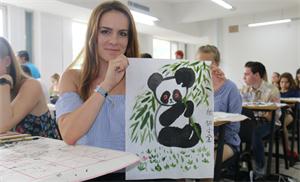
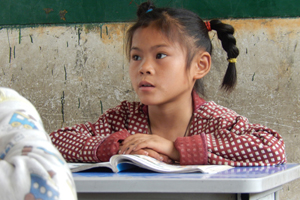
Brad Walsh, a Canadian teacher at ETU, with some of his students.Photos By Zou Hong / China Daily |
Disillusioned with standardized, test-based tuition, some parents are setting up their own schools. Zhao Xinying reports.
Having seen the ETU School in Beijing develop from an idea to a facility with 15 full-time teachers and more than 30 students, co-founder Li Yinuo is confident of success and feels ready to take the next step.
"Our goal for 2017 is to expand our school from the current scale of K-Grade 1 (kindergarten to Grade 1) to K-Grade 3, which means a further 80 or 90 students will be recruited in the academic year that will begin in September," said the mother of three, a former partner at McKinsey, a global management consultancy, in Beijing and Palo Alto, California.
ETU is located on the campus of the No 80 High School in Beijing's Chaoyang district. Although it has just three classrooms and one teachers' room, the school has attracted attention from parents disillusioned with standardized, test-oriented education in traditional schools. A large number of education specialists seeking innovation in the field have also expressed an interest.
When ETU's spring semester started in February, Feng Shu transferred her 6-year-old son to the new project from an international school near Beijing's North Fifth Ring Road.
"Although the facilities and hardware at ETU are not as fancy as those at my son's previous school, I took the decision to bring him here because I believe that rather than producing 'testing machines', ETU tries its best to help children discover themselves and help them to become happy, fulfilled people," the Beijing resident said.
Finding a way out
The idea of establishing the school came to Li early last year when she was trying to move her family back to Beijing from California's Silicon Valley. Like many parents, Li found it hard to find an ideal place for her eldest son.
"Our efforts to find a satisfactory school ended in vain because the public ones available to us were too uniform and reliant on tests, while international schools offer an education that is too Westernized and lacks Chinese roots," she said.
Li is not alone in her concerns. Yang Dongping, director of the 21st Education Research Institute, a think tank in Beijing, said many parents are concerned and dissatisfied with their children's education. They believe State schools are too reliant on exams, and the excessive workload exerts too much pressure on children.
"But for a long time, parents could only face this education system with an attitude of 'tolerate, criticize and go back to tolerating'," he said, adding that many parents choose to break the cycle by sending their children to study overseas.
That dissatisfaction may be one of the driving forces behind a recent exodus of children. At the end of 2015, almost 35,000 Chinese children were studying at K-12 level in the US, according to a report published last year by Eol, a leading Chinese education portal. In 2010, the number was about 9,000.
Li was reluctant to follow that path because she didn't want her son to grow up as a "foreigner", knowing little about Chinese language and culture. She said she had seen many young Chinese in the US "suffering from a vague national identity and failing to integrate into either community".
In her opinion, the ideal education should be tailored to inspire, motivate and protect children's intrinsic desire to learn, tap their potential, discover their strengths and help them become the person they want to be. It also should help them grow up as globally competent citizens, or as she described it, "truly Chinese, truly global".
According to Yang, rather than complaining and leaving, many parents, particularly well-educated couples in big cities, are now trying a "third way" by conducting educational experiments and exploring diverse forms of learning, such as homeschooling, which is discouraged by the education authorities.
Making things happen
Li was not the first parent in China to decide to establish a school, but for people with no track record of running such a venture, setting one up is easier said than done.
From the beginning, she kept asking herself where she would find the key elements, such as funding, a venue, the requisite permits and a source of teachers and students.
"We were really lucky, because we received so much assistance and support that all the difficulties were overcome one by one," she said.
Having reached an agreement to cooperate with the Beijing No 80 High School, Li and her co-founders opened ETU just 170 days after the idea first occurred to her.
The initial plan was to recruit 24 students for the first semester, but ETU received more than 150 applications. Thirty-one students were finally accepted.
Despite their different educations and professional backgrounds, the first batch of ETU parents shared one thing in common - a desire to find an education that would help their children achieve their personal goals. Moreover, they want the school to not only cultivate globally competent talents, but also instill a true appreciation of Chinese culture, especially at a time when East and West are becoming increasingly intertwined.
In addition to selecting students, Li said the parents' trust and belief in ETU and the personalized education the school tries to offer counted greatly during the admission process, especially during the first year.
"After all, in China's current position, and in many people's eyes, sending one's children to a school like ETU may seem like a big risk," she conceded.
Natural Instincts
Like their peers at public schools, ETU students learn Chinese, math and English using the Ministry of Education's textbooks and curriculum.
Unlike their State-educated peers, though, the students at ETU are taught in an innovative and personalized way that puts them at the center of the class, with their voices being heard and their needs being met by the teachers, according to Guo Xiaoyue, ETU's principal.
For example, when the students are learning Chinese characters, instead of memorizing and writing them out dozens of times, they are encouraged to think about the symbols and discuss why they should learn them. They are also encouraged to note the characters they see in their daily lives, study them on their own and then teach them to their classmates.
In addition, ETU also includes STEAM - the collective name for science, technology, engineering, arts and math - in project-based learning, or PBL, a type of class that requires teachers across all subjects to design the content and teach the class together, rather than working alone.
The teachers are not expected to simply deliver knowledge, but also to answer the students' questions and guide them to think, research and make things on their own.
"Our teachers spend a lot of time working together every day in the belief that PBL is a very effective way for children to learn. It can inspire their natural instincts to learn and explore the unknown," said Guo, who has run her own innovative education program in Beijing since 2013.
Xiang Rong, a teacher of Chinese at ETU, defined a good education as "being able to fill children's eyes with the light of curiosity". That's why, having taught at different schools in China for more than two decades, from primary level all the way up to college, she decided to transfer to the new school.
"Right here in ETU's classrooms, I feel we are doing things correctly. We are not fast, but every step we take is firm and solid," she said.
Guo has decided to enroll her 6-year-old daughter at ETU in September: "She liked the school at first sight."
Contact the writer at zhaoxinying@chinadaily.com.cn




Copyright 1995 - . All rights reserved. The content (including but not limited to text, photo, multimedia information, etc) published in this site belongs to China Daily Information Co (CDIC). Without written authorization from CDIC, such content shall not be republished or used in any form. Note: Browsers with 1024*768 or higher resolution are suggested for this site.
License for publishing multimedia online 0108263 Registration Number: 130349