Chinese help Kenyan farmers turn advantages into opportunities as nation faces climate challenges
Over the past decade, the first quarter of the year has always presented a bag of mixed fortunes for Kenya's small-scale farmers. A rainfall deficit, which is becoming the norm, leaves herders and farmers counting losses as animals die due to receeding pasture and bumper harvests of fruit perish from lack of market access.
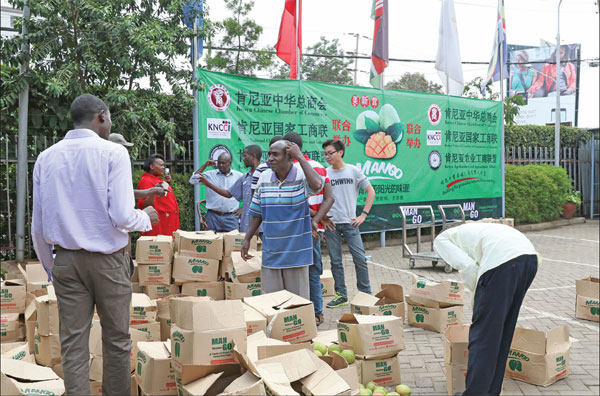
This year, however, things were a little different. Collaboration between the Kenya China Chamber of Commerce, the Kenya National Chamber of Commerce and Industry and a makeshift farmers association saw a turn around of fortunes when the local Chinese community turned up in large numbers to buy off the mangoes.
More than 20,000 mangoes were purchased within two hours, leaving 500 farmers with better earnings.
|
Kenya mango farmers arrange their products at a promotional event held by the Kenya Chinese Chamber of Commerce. Liu Hongjie / China Daily |
"Farmers lack market information and thus count themselves lucky when middlemen come calling," says Meshack Muteru, the farmers' representative. More often than not, supply outstrips demand.
According to the African Development Bank, Sub-Saharan countries face up to $4 billion in post-harvest losses annually. Fruit and vegetable losses average 35 to 50 percent of total attainable production, while grain losses are between 15 and 25 percent.
"Besides poor roads, farmers have not ventured into the value addition process because they lack capital and skills," says Peter Mathuki, a member of the East African Legislative Assembly, a law-making regional body.
Nevertheless, the successful sale of the mangoes to the Chinese local community has sown seeds of partnership in this unexploited but viable subsector.
"Africa's economic takeoff hinges on its ability to industrialize, and I believe this subsector provides the best opportunity," Mathuki says. "The region, therefore, needs policies that will strengthen the linkages between farms and agri-processing, while at the same time insulating it from the challenges posed by climate change."
William Zhuo, chairman of the Kenya China Chamber of Commerce, says Africa is a unique landscape at the moment. Despite its underdevelopment and promises of a healthy return on investments, investors face a myriad of challenges ranging from poor roads, a power deficit and finding the right model to increase farm yields while decreasing carbon production.
"China successfully increased its food production through innovation and technology. There is a lot of work to be done here to develop this sector," says Zhuo.
Lucy Muchoki, chief executive of the Kenya Agribusiness and Agro-Industry Alliance, says private sector partnership will spur development and growth in this fledgling sector.
"China is the second-biggest producer of mangoes and thus the best partner for us," Muchoki says, adding that the sector holds the comparative advantage needed for jump-starting the continent's industrialization and rural employment. "It will also disrupt rural-urban migration while addressing the cost of food and supply uncertainties."
Underinvestment in Africa's agricultural sector has left communities vulnerable to food insecurity. Global warming has further blurred the investment opportunities available.
The United Nations Environment Programme is advocating increased investments into this sector to build a new model of prudent farming practices that restore ecosystems while boosting production and earnings for farmers. Erratic weather patterns will be the norm in the next decade, the agency says.
"Under the changing climate, such extreme events are projected to increase," says Richard Munang, the agency's regional climate change coordinator in Nairobi. "For instance, at 20 C warming, a 40 percent decline of key food staples is projected by 2050."
This also suggests "a 25 to 90 percent increase in undernourishment, infant mortality and an annual shrinkage in GDP of up to 16.5 percent," he says. Additionally, a warming to 40 C would cause a projected 60 to 80 percent reduction of surface runoff by 2100 and up to a 70 percent decrease in ground recharge rates, Munang says.
The continent can borrow lessons from China by basically focusing on sectors with comparative advantages and investing both physical resources like financing and nonphysical resources such as enabling policies, partnerships and intellectual resources to maximize productivity, he adds. "Thus convert the comparative advantage into a global market-based competitive edge," Munang says.
Governments need to encourage investment in new technologies that optimize production and the use of clean energy. This combination can potentially create as many as 17 million jobs along the entire agri-value chain and catalyze creation of an agricultural sector worth $1 trillion by 2030, while offsetting carbon and restoring ecosystems, including forests and water systems, he says.
"For example, in the Democratic Republic of the Congo, a group of graduate youthful 'agripreneurs' is using clean energy to process cassava, an indigenous, climate-resilient crop, into flour, packaging and standardizing it for sale to higher value markets," Munang says. This creates income and jobs while also enhancing food security, he adds.
But while investing in the new production processing model, market access is critical, and Munang believes China's current infrastructure investment offers a solution. The Belt and Road Initiative "will create a potentially consolidated market for Africa's high value exports."
lucymorangi@chinadaily.com.cn




Copyright 1995 - . All rights reserved. The content (including but not limited to text, photo, multimedia information, etc) published in this site belongs to China Daily Information Co (CDIC). Without written authorization from CDIC, such content shall not be republished or used in any form. Note: Browsers with 1024*768 or higher resolution are suggested for this site.
License for publishing multimedia online 0108263 Registration Number: 130349