China's rise as a leader of technological innovation is being threatened by a global skills shortage
In just a few short years, China has gained a reputation as the global center for innovation and adoption in financial technology. But, like so many sectors in the high-tech sphere, the problem for China fintech is finding and retaining skilled workers.
Simon Lance, managing director in China for global recruitment agency Hays, says the areas most affected include internet, big data, augmented reality and virtual reality.
He says the skills shortage is global, and Chinese employers are competing for related talent.
|
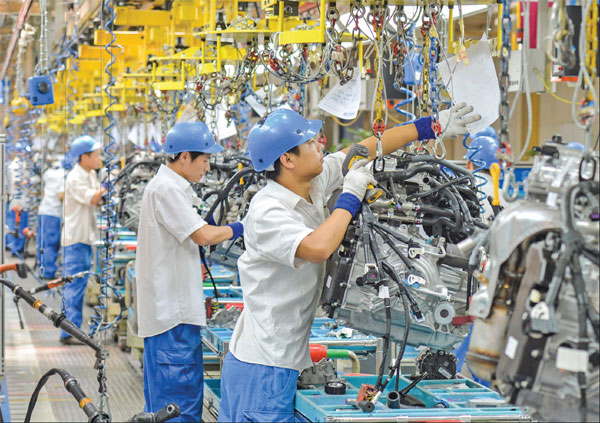
Technicians work on the assembly line of a car factory in Wuhan, in China's Hubei province. Like the financial industry, the country's automotive sector is facing a shortage of higher-skilled workers. Provided to China Daily |
The problem is not with the low-end, labor-intensive manufacturing sector, which is now moving offshore or becoming automated, but with the skill sets needed to take China to the next level of its development.
The country aims to shift from 'made in China' to 'designed or developed' in China.
"The sector lacking talent is the fintech sector," says Rio Goh, China managing director of employment agency Morgan McKinley.
While Silicon Valley, New York and London compete to position themselves as the world's fintech hub, China has leapfrogged ahead as a leader of fintech innovation and adoption. This is due to developments across multiple hubs, such as Shanghai, Beijing and Shenzhen.
The speed, sophistication and scale of development of China's fintech ecosystem have been at levels unmatched in more established markets. As banks and financial service institutions in the West look at ways to incrementally innovate, China's technology leaders are revolutionizing many aspects of financial services.
Fintech is the sector driving innovation, Goh says, but companies are finding it difficult to fill positions.
According to Goh, "banking technologists for payments businesses, software developers, data engineers, user experience and product talent" are all areas in which there is a shortfall in skills.
The automotive sector is another problem area.
Although local talent is preferred, as it is comparatively cheaper, when it comes to key development areas, such as connected vehicles and advanced driver assistance systems, overseas technology experts from Germany and North America are often hired to provide their industry know-how.
Bruno Lanvin, executive director of INSEAD Global Indices in Singapore, says the major challenge for China and India lies in their ability to attract talent.
"They both face the issue of local higher-skilled workers leaving to live and work abroad," he says. "To improve their attractiveness, they have to further boost their regulatory and market landscapes.
"However, delving deeper and looking at the city level, the two countries have metropolises exemplary in terms of their talent attractiveness."
Apart from Singapore, Lanvin says, Shanghai and Mumbai are the only Asian cities identified and ranked in INSEAD's Global City Talent Competitiveness Index, a benchmarking study released in December.
"But future editions will undoubtedly include more, confirming the growing attractiveness of Asian cities," he says.
The concern Chinese employers have with finding skilled labor has been borne out in repeated annual surveys of regional corporations by recruitment agencies such as Hays.
The 2017 Hays Asia Salary Guide, released in February, noted that about 70 percent of employers in China said they did not have the right talent to "achieve current business objectives".
The report also claimed that 53 percent of employers in China believe skill shortages have the potential to hamper effective business operations this year.
The report highlights salary and recruiting trends drawn from more than 3,000 employers across the Chinese mainland, Hong Kong, Japan, Malaysia and Singapore, representing 6 million employees.
"When the efficiency of a business is threatened, planning your business strategy and your talent pipeline has never been more critical," according to Christine Wright, managing director for Hays in Asia.
She says the focus for many businesses should be to build a highly talented and productive workforce.
"To do that, companies need to ensure they have access to the right candidates if they are to benefit from emerging conditions."
The survey found that over the last 12 months, 54 percent of employers in China tried to combat skills shortages by upskilling their employees, while 41 percent improved their attraction strategies. Only 5 percent said they took no action.
In the skills areas, 60 percent of employers in China said they would consider sponsoring or employing qualified candidates from overseas.
The workforce on the Chinese mainland is the least ethnically diverse in Asia, with only 6 percent of workers coming from another country. That compares to 9 percent in Japan, 11 percent in Malaysia and 12 percent in Hong Kong, while Singapore is the most diverse in the region, with foreigners accounting for 21 percent of employees.
China's changing dynamics - economic, social and demographic - are creating a distinctive set of problems, according to McKinsey & Co. The management consulting firm says companies are failing to find the high-skilled workers they need, while individuals find themselves ill-prepared for the jobs that are available.
"As China evolves from an investment-led economy to a consumption-oriented one, from being the workshop of the world to, perhaps, being a services powerhouse, it will need more high-skilled workers, in particular post-secondary vocational graduates," says McKinsey.
The shortage of skilled workers is one of the priority concerns of the government. Last month, the Ministry of Human Resources and Social Security called a meeting to discuss how to fully implement the 13th Five-Year Plan (2016-20) for China's vocational education.
The meeting covered how to raise the core competitiveness of vocational schools, strengthen recruitment and training and raise the wages of highly skilled laborers.
By the end of 2015, there were 2,545 vocational schools in China, including 434 technician schools with 3.22 million students. The employment rate for graduates from these schools was as high as 97.4 percent, according to the ministry.
Nevertheless, China is currently in need of nearly 10 million highly skilled workers, according to reports.
That group accounts for only 5 percent of all industrial workers in the country, much lower than the ratios in Japan and Germany, where skilled workers account for 40 percent and 50 percent, respectively, of industrial workers, according to Li Shouzhen, an official with the All-China Federation of Trade Unions.
Last month, Premier Li Keqiang delivered the 2017 Government Work Report, pledging to promote craftsmanship and foster a culture in which laborers display a strong work ethic and seek improvement.
In last year's report, Li also encouraged enterprises to use flexible and individualized production processes, and to foster the spirit of craftsmanship so that higher quality products will be made.
But will that be enough?
According to McKinsey, by 2020 at the lower end of the labor market there will be 23 million more people than jobs.
At the upper end, McKinsey projects that Chinese employers will need 142 million more high-skilled workers - those with university degrees or vocational training - or about 24 million more than the country will likely supply.
"Companies could fill this high-skilled labor gap with less-skilled workers, but this would result in productivity losses or poorer quality products and services," McKinsey says.
McKinsey estimates that if China does not bridge this gap by 2020, the opportunity cost could reach some $250 billion, or about 2.3 percent of GDP, greater than the economic output of Israel.
For China Daily




Copyright 1995 - . All rights reserved. The content (including but not limited to text, photo, multimedia information, etc) published in this site belongs to China Daily Information Co (CDIC). Without written authorization from CDIC, such content shall not be republished or used in any form. Note: Browsers with 1024*768 or higher resolution are suggested for this site.
License for publishing multimedia online 0108263 Registration Number: 130349