Belt and Road has support of 100-plus countries, international organizations
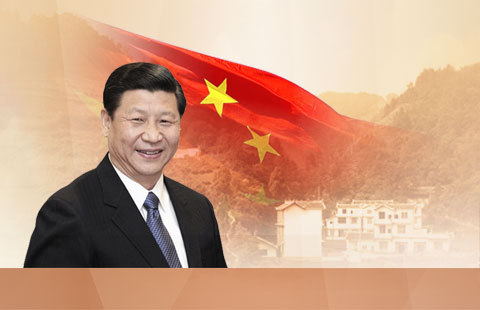
When a train approached a freight railway station in Warsaw, Poland, on June 20, President Xi Jinping, who was making a state visit to the country, happily bit into a red apple, as did his Polish counterpart Andrzej Duda.
The two leaders were attending a ceremony to mark the arrival of the first China-Europe Block Train, carrying Chinese-made products, including electronic components, to Warsaw. When the train returned to China, it was laden with Polish commodities, including produce, such as apples.
Boosting the interconnection of Asia and the rest of the world - the purpose of the China-Europe Block Train - is one of the goals of the China-proposed Silk Road Economic Belt and the 21st Century Maritime Silk Road, collectively known as the Belt and Road Initiative.
The initiative, put forward by Xi in 2013, has become one of the most important public goods China offers the world and a key vehicle for Beijing to help improve global governance.
China has invested more than $50 billion in the programs related to the initiative and has won the support of over 100 countries and international organizations - more than 40 have signed cooperation agreements with China.
At least 28 heads of state and government will attend the Belt and Road Forum for International Cooperation on May 14 and 15 in Beijing. The forum will be the highest-profile international meeting on the Belt and Road since the initiative was put forward.
Xi will attend the opening ceremony and host a roundtable leaders summit. The meeting is expected to translate the ambitious blueprint into solid progress and turn a new page on the initiative.
According to Foreign Minister Wang Yi, the results of the forum will range from consensus-building to specific measures on implementation. China expects to sign agreements with about 20 countries and 20 international organizations at the event.
Launched by China, shared by the world
During his visit to Kazakhstan in September 2013, Xi proposed building the Silk Road Economic Belt to boost regional cooperation. A month later, in a speech to the Indonesian parliament, he put forward a proposal to jointly establish the 21st Century Maritime Silk Road.
With its guiding principles of extensive consultation, joint contribution and shared benefits, the initiative has been defined by Xi as "a chorus of all countries along the routes, not only for China itself".
During his overseas trips in the past years, Xi repeatedly called on the countries - including in Asia, Europe, Africa and Latin America - to cooperate with China on the initiative.
"Instead of seeking any sphere of influence, China calls on all countries to join the circle of friends for the Belt and Road," he said in a speech in January 2016 at the Arab League headquarters in Cairo, Egypt.
The past three years have witnessed the launch, expansion, faster-than-expected progress and fruitful outcomes of the Belt and Road Initiative.
According to the National Development and Reform Commission, China's top economic planner, Chinese businesses have invested more than $50 billion in countries along the Belt and Road and have helped to build 56 economic and trade cooperation zones in 20 of those countries, generating nearly $1.1 billion in tax revenue and 180,000 local jobs.
"Through the Belt and Road Initiative, I want to share China's development opportunities with the countries along the routes and achieve joint prosperity," Xi said in his keynote speech at the opening ceremony of the business leader's forum of the G20 in September.
The Belt and Road Initiative has been widely recognized in the international community, showing that it is in accord with the will of the people, Xi said while visiting a port in the Guangxi Zhuang autonomous region last month.
Wang Yiwei, a professor at Renmin University of China's School of International Relations, said that since the launch of the initiative, China has been sharing its expertise in fields such as infrastructure construction and clean energy with countries and regions along the routes.
Though proposed by China, the initiative is an open, inclusive proposal and welcomes participation from all sides, he said.
Injecting impetus intoglobal economy
The Belt and Road Forum for International Cooperation meets an increasingly urgent need for a new cooperation platform that brings countries together to pull the world out of the economic mire and inject fresh energy into interconnected development.
Last year, the world experienced the worst economic hardship since the global financial crisis, with a 13-percent drop in foreign direct investment and weak trade growth.
Chinese companies' investment in countries along the Belt and Road routes have resulted in a number of major projects, which contributed to those countries' economic growth, Xi said in January in his keynote speech at the Davos World Economic Forum in Switzerland.
A series of major transportation, energy and communication projects, including the multipurpose road-rail Padma Bridge in Bangladesh, the China-Pakistan Economic Corridor, and China Railway Express trains to Europe, have advanced over the past three years along with the implementation of the Belt and Road Initiative.
In November 2014, Xi announced that China will contribute $40 billion to set up the Silk Road Fund to boost infrastructure and resource development while improving industrial and financial cooperation along the centuries-old Silk Road trading routes.
In 2015, China set up the Asian Infrastructure Investment Bank to provide financing for infrastructure improvement in Asia. The AIIB has 70 members, so far, and its total lending fund amounts to over $2 billion.
China is pushing forward six economic corridors in the framework of the Belt and Road Initiative: the New Eurasian Continental Bridge, the China-Mongolia-Russia corridor, the China-Central Asia-West Asia corridor, the China-Indochina Peninsula corridor, the China-Pakistan corridor and the Bangladesh-China-India-Myanmar corridor.
The six corridors form together a trade and transport network across Eurasia, laying a solid foundation for regional and trans-regional development plans.
Ruan Zongze, executive vice-president of the China Institute of International Studies, said the international community has higher expectations for China now, at a time when the global economic recovery lacks power.
"The Belt and Road Forum for International Cooperation will hopefully help drive away the clouds of the economic doldrums and channel more positivity to global economic growth," he said.
anbaijie@chinadaily.com.cn




Copyright 1995 - . All rights reserved. The content (including but not limited to text, photo, multimedia information, etc) published in this site belongs to China Daily Information Co (CDIC). Without written authorization from CDIC, such content shall not be republished or used in any form. Note: Browsers with 1024*768 or higher resolution are suggested for this site.
License for publishing multimedia online 0108263 Registration Number: 130349