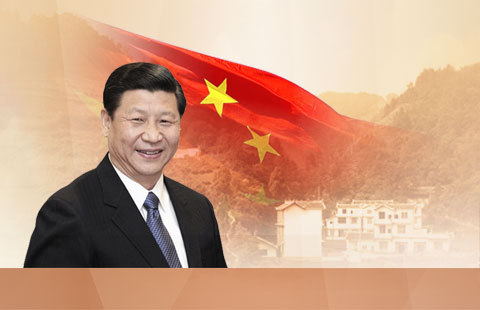
President Xi Jinping's early experiences have been a key influence on his determination to alleviate hardship
In June 1988, a 35-year-old man was made secretary of the Communist Party of China committee of Ningde prefecture in East China's Fujian province. Within two months, he had set foot in all the nine counties to gain firsthand knowledge of the region of which he was in charge.
Within two years, he had drawn up plans, taking into consideration the specific needs of Ningde, and took firm action to set his people on the road to becoming free of poverty.
The young official was Xi Jinping, today president of China. These days he is taking charge of a nationwide fight against poverty with the goal of taking all the 50 million poor people out of hardship by 2020.

Speeches made by Xi in Ningde have been published in an English book titled Up and Out of Poverty. In the book, we see his determination to develop the local economy with the spirit of "water droplets drilling through the rock", his eagerness in "taking advantage of new opportunities" and his leadership capabilities in directing an "economic chorus".
I was involved in translating another book, Xi Jinping: the Governance of China, into English in 2014. In three parts of that book he dealt with the subject of fighting poverty.
From both books, it is apparent that lifting people out of poverty has been a constant focus for Xi.
Now let's take a quick look at how he has promoted the fight against poverty and for economic development. First, we should get to know the history of Ningde. There are in China 334 administrative divisions like Ningde, between province and county. Some are called prefectures while others are referred to as cities. The once poverty-stricken Ningde prefecture is now a thriving city. What made it different is that poverty existed in the entire prefecture, with its nine counties, 913 kilometers of coastlines and over 300 islands, making it the poorest region in the province and one of the poorest regions in the whole country. When Xi first got there in 1988, the per capita GDP was only $198(173 euros; £153). Today, the figure is over $9,000, above the national average. Compared with those days, the region has enjoyed a 45-fold increase in income.
The first step was to shake off the poverty mentality. Xi said in the book Up and Out of Poverty: "We must eradicate the 'poverty' that exists in our minds before we can eradicate it in the regions we govern, before we can help the people and the nation out of poverty and embark on the road to prosperity."
The second step was to adopt measures suited to local conditions for economic development. Xi was fully aware that an official could not lead the fight against poverty by sitting in the office, and should not copy other people's development plans but give play to his area's own advantages to make up for shortages.
Third, strong leadership and coordination were needed. Poverty alleviation is a gigantic task that cannot be fulfilled with the efforts of only a minority of people. Xi used the expression "singing an economic chorus". He emphasized that a chorus must have a good conductor. The conductor at the local level is the local Party committee and government. The government must be highly responsible, be clear about the direction it is following and work effectively, mapping out annual, midterm and long-term plans. It must improve its service and formulate local rules and regulations that offer genuine protection of the rights and interests of foreign companies. Without a sense of security, foreign companies would not come, and those that were already here would leave. It was possible to simplify procedures, reduce fees, improve the quality of service and go through one-stop registration with one official stamp at one window.
Fourth, be prepared to take the heat and shoulder responsibility. Local people wanted to launch large projects such as railway building, port construction and development park building so as to get rid of poverty with a one-shot effort. Xi told them: "This kind of desire is good, and such enthusiasm is valuable. But it is simply not realistic to place our hopes in huge projects and hope to suddenly be given a 'gold mine'." He said: "Railways need huge funds to build and it is up to the State planners to decide where and when to build them. That is not something we can just go and do ourselves. "Ningde is neither a central region nor a producer of raw materials or a logistics center. These factors all restrict the building of railways and ports."
As for building a central city, he said: "This is no simple task. Central cities cannot be thrown up just anywhere and instead must naturally be formed, gradually through economic development."
To be bold enough to throw cold water on the people's suggestions instead of pursuing giant projects was an entirely responsible act, which reflected Xi's style of seeking truth. If he had been a politician, he could have used the sentiments of the local people to his personal advantage and given the responsibility to the provincial or even the central government.
From these two books we see clearly that, starting from working in a village, then a county, then a prefecture and finally at the national level, lifting people out of poverty has consistently been a key aim of Xi.
To me, this has a great deal to do with his own life. In early 1969, when he wasn't yet 16, Xi left Beijing to work in a village called Liangjiahe in northwestern China. The village was situated on the yellow loess plateau where people dug into the earth to make their homes, known as cave dwellings. He became covered with blisters and eventually had to spread pesticide on his earthen bed to protect himself.
People in rural areas had no regular holidays, so he led a life of continued labor, cultivating crops in the fields, carrying coal, transporting manure and so on. He did all kinds of manual work and experienced all kinds of hardship. He eventually won the trust of the villagers, who made him secretary of the village's CPC branch. Life was extremely hard but it gave him an opportunity to get trained and demonstrate his skills. This was also his first experience in fighting poverty. In order to expand the area of land suitable for farming, he encouraged the villagers to build dikes in winter when they did not have to work in the fields. He took the lead in icy conditions to help reinforce the bases of the dikes.
Years later, when working in Ningde, he would walk from 7 am until well after noon in order to learn about conditions in an impoverished village, where the road was inaccessible for automobiles. He worked to transform thousands of thatched huts into modern houses, to build homes for fishermen who for generations had had to live on their boats. Now they enjoy comfortable living conditions on land while going out to the sea only when they go fishing.
Xi's experience has been a process of leading Chinese people to a better life, a process of realizing the Chinese dream.
According to UN statistics, by 2016, more than 700 million people had broken free from poverty. Each of the past five years has seen more than 20 million people lifted out of hardship, and the entire population will bid farewell to poverty by 2020.
Xi has said that China and Africa belong to the same community of common history and shared future. His foreign policy, particularly his proposal for the Belt and Road Initiative, is to engage in extensive consultation, joint construction and shared benefits to ensure common development and prosperity with other countries.
The author is vice-president of the Translators Association of China. The views do not necessarily reflect those of China Daily.




Copyright 1995 - . All rights reserved. The content (including but not limited to text, photo, multimedia information, etc) published in this site belongs to China Daily Information Co (CDIC). Without written authorization from CDIC, such content shall not be republished or used in any form. Note: Browsers with 1024*768 or higher resolution are suggested for this site.
License for publishing multimedia online 0108263 Registration Number: 130349