OPINION> Commentary

|
OPINION> Commentary
|
|
Some real good news, even in these bad times
By Jeffrey D. Sachs (China Daily)
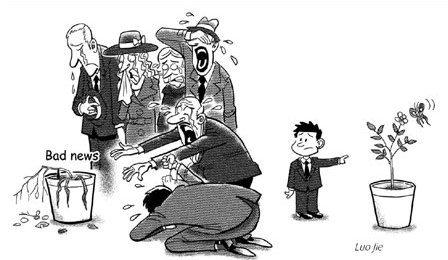
Updated: 2008-12-26 07:51 At a time when the headlines are filled with financial crises and violence, it is especially important to recognize the creativity of many governments in fighting poverty, disease and hunger. The point is not merely to make ourselves feel a little better, but rather to confront one of the world's gravest threats: The widespread pessimism that today's problems are too big to be solved. Studying the successes gives us the knowledge and confidence to step up our shared efforts to solve today's great global challenges. Hats off, first, to Mexico for pioneering the idea of "conditional cash transfers" to poor households. These transfers enable and encourage those households to invest in their children's health, nutrition, and schooling. Mexico's "Opportunities Program", led by President Felipe Calderon, is now being widely emulated around Latin America. Recently, at the behest of the singers Shakira and Alejandro Sanz, and a social movement that they lead, all of Latin America's leaders committed to step up the region's programs for early childhood development, based on the successes that have been proven to date. Norway, under the leadership of Prime Minister Jens Stoltenberg, is maintaining its tradition of creative social and environmental leadership. The government has put together a global alliance to prevent maternal death in childbirth, investing in both safe delivery and survival of newborns. At the same time, Norway launched an innovative $1 billion program with Brazil to induce poor communities in the Amazon to end rampant deforestation. Cleverly, Norway pays out the funds to Brazil only upon proven success in avoiding deforestation (compared with an agreed baseline). Spain, under the leadership of Prime Minister Jose Luis Rodriguez Zapatero, has given a major stimulus to helping the poorest countries to achieve the Millennium Development Goals (MDGs). Spain created a new MDG Fund at the United Nations to promote the cooperation needed within the UN to address the various challenges of the MDGs. The Spanish government rightly proposed that true solutions to poverty require simultaneous investments in health, education, agriculture, and infrastructure, and then the Spanish put up the funds to help make that integrated vision a practical reality. Spain will host a meeting in January 2009 to launch a new fight against global hunger.
 Once again, Spain is proposing practical and innovative means to move from talk to action, specifically to help impoverished peasant farmers to get the tools, seeds, and fertilizer that they need to increase their farm productivity, incomes, and food security. Australian Prime Minister Kevin Rudd has similarly surged to the forefront of global problem solving, putting forward a bold action plan on climate change and proposing new and practical means to address the MDGs. Australia put real money on the table for increased food production, along the lines that Spain is proposing. It also champions an increased program of action for the poor and environmentally threatened island economies of the Pacific region.
These efforts have been matched by actions in the poorest countries. The landlocked and impoverished country of Malawi, under the leadership of President Bingu wa Mutharika, has doubled its annual food production since 2005 through a pioneering effort to help its poorest farmers. The program has been so successful that it is being emulated across Africa. Mali's government, under President Amadou Toumani Toure, has recently put forward a bold challenge to the world community. Mali is eager to scale up investments in agriculture, health, education, and infrastructure in its 166 poorest communities. The plans are detailed, thoughtful, credible, and based on proven successes that the government has already achieved. The rich world has promised to help Mali, and now Mali has led the way with its creativity. There are countless more cases that can be mentioned. The European Union has launched a 1 billion euro effort to help peasant farmers. The Gates Foundation, the United Nations Children's Fund, Rotary International, and many governments have succeeded in bringing down polio deaths to one-thousandth of the rate a generation ago, bringing the disease to the verge of eradication. Similar efforts are underway on many other fronts - the control of worm infections and leprosy, and now a major global effort to bring malaria deaths nearly to zero by 2015. All of these successes, and many more, share a similar pattern. They address a well-defined and serious challenge, for example low food production or a specific disease, and are based on a well-defined set of solutions, such as agricultural equipment and inputs needed by peasant farmers, or immunizations. Small-scale demonstration projects prove how success can be achieved; the challenge then becomes taking the solutions "to scale" in nationwide or even worldwide programs. Leadership is needed, within the countries in need as well as among the rich nations that can help to launch and finance the solutions. Finally, modest amounts of money, directed at practical problem solving, can make an historic difference. Bad news can crowd out good news, especially in times of serious financial crisis and political unrest. Yet the good news shows that we will lose the battle against poverty and misery only if we give up, and fail to heed the intelligence and goodwill that can be mobilized today. And perhaps next year, the United States will rejoin the global effort with a new and remarkable force, led by a young president who has rightly told Americans and the world that "Yes, we can". The author is professor of economics and director of the Earth Institute at Columbia University The Korea Herald/Asia News Network (China Daily 12/26/2008 page9) |