OPINION> Commentary

|
OPINION> Commentary
|
|
Quantitative easing best to free up credit
By Hong Liang (China Daily)
Updated: 2009-04-07 07:47
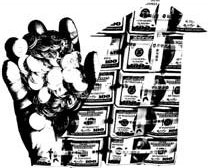
The strengthening of the US dollar against most other major world currencies in the past couple of months has been one of the least understood phenomena of the global financial crisis. As the crisis continues to worsen, it is difficult to identify the economic fundamentals to support a strong US currency. Therefore, one can only assume that banks and other financial institutions around the world are betting that the US will recover sooner than most other economies because of the stimulus efforts by the US government. This should be encouraging news for China, which is not only one of the major trading partners of the US, but also its largest creditor. For that reason, China has been watching closely the various measures taken by the US government in easing the credit squeeze and restarting the economic engine. One of policies pursued by the US government that seemed to have troubled many Chinese experts was "quantitative easing," which was widely interpreted in the domestic media as "money printing". This has raised concerns that printing money to buy assets, including treasury bonds, can greatly depress the value of the US dollar, resulting in widening losses to foreign holders of those assets. But critics of the policy may have missed the fact that "quantitative easing" doesn't really involve the printing of more banknotes, as noted by Hong Kong Monetary chief, Joseph Yam. Rather, it involves flooding the money market - or more precisely, the interbank market of the domestic currency - with liquidity, so that the supply of money, at least among the banks, is abundant, and the price of money (interest rates in the interbank market) is kept very low, Yam wrote in one of his essays published in the HKMA website.
The hope is that the banks will be willing to pass on the plentiful supply of money at low cost to borrowers, and, in so doing, revitalize the economy. "Normally 'quantitative easing' does provide support to the economy and is helpful for cushioning or arresting a downturn," Yam wrote. In technical terms, the central bank settles its purchase of assets in the open market by crediting the clearing accounts of the banks instead of borrowing from the market as in the case of "sterilization," a familiar monetary tool to neutralize a large inflow of funds. In normal circumstances, banks are keen on keeping only the minimum level of deposit in their clearing accounts required for capital adequacy purpose because of the low interest income. It is therefore reasonable to expect that banks will be keen to lend out the money credited to their clearing accounts by the central bank for asset acquisition. Market developments in the past few months have created a compelling reason for the US Federal Reserve to purchase more agency debt and US Treasury securities. This is far from being an "irresponsible" move as charged by some economists and commentators in the US and abroad. In fact, the Fed's action has helped stabilize the US bond market and stopped, at least for now, the price slide that should be of greater concern to foreign holders than possible currency depreciation. The price of 10-year US Treasury bonds fell 6.5 percent in the two months to mid-March because of the rise in yield arising from market expectations that the US government will issue more debt to finance its various economic stimulus initiatives. The pressure on yield eased after the Fed announced its purchase plan on March 18. Of course, "quantitative easing" is not the magic pill to cure all economic ills and it can potentially create problems of inflation in future. But for now, it is the only monetary tool strong enough to unfreeze bank credits and restart the economic growth engine. E-mail: jamesleung@chinadaily.com.cn (China Daily 04/07/2009 page8) |