OPINION> Commentary

|
OPINION> Commentary
|
|
Reading into Obama's Afghan withdrawal
By Li Qinggong (China Daily)
Updated: 2009-04-16 07:40 US President Barack Obama announced a new strategy for Afghanistan on March 27, switching the focus of US military actions "to disrupt, dismantle and defeat Al-Qaida". According to the new strategy, 4,000 extra soldiers will be sent to Afghanistan. If we count the 17,000 servicemen Obama announced on Feb 17, the total US troops in Afghanistan will surge from the current level of 34,000 to 55,000. The new strategy signals how the Obama administration has accomplished the assessment, discussion, and planning of the Afghan policy, and officially put the Afghan war on its own track. However, does Obama really want to continue the fight in this endless war? Does he want to be mired deeper in the mess? If we carefully examine his strategy, the answers may be "no". Obama's real intention is to withdraw in the future, while the surge in the number of combatants is just one step forward to prepare for two steps back in the withdrawal of troops. Obama could be sending reinforcements to Afghanistan for three reasons. First, he must fulfill his promise made during his presidential election campaigns - to withdraw troops from Iraq and reinforce Afghanistan. The promise, an election tactic to lure voters from both wings, contributed much to his triumph and now he has to honor it. The announcement on Feb 17, the declaration to withdraw part of the combatants in Iraq on Feb 27, as well as the latest Afghan strategy, are turning the promises into actions. Second, Obama needs to console the vested interests of the military-industry complex (MIC). Traditionally and typically in the US, the MIC has a large voice in politics. While Obama has vowed to attenuate manipulation from the military industry, he still conceded to the MIC for the sake of his election campaigns. As a new president, Obama definitely does not want to be challenged by the MIC. Thus, he dispatched reinforcements to Afghanistan to compensate the MIC for its losses in withdrawing troops from Iraq. Third, the disgruntlement of allied forces in Afghanistan also contributes to Obama's decision. When launching the Afghan war, NATO plunged 80,000 soldiers there, including 50,000 US armed forces. After Taliban rule in Kabul was overthrown, especially when the Iraqi War diverted its attention, the US gradually trimmed down its armed forces in Afghanistan. Other NATO member states were very discontent with the US strategy focusing on Iraq while ignoring Afghanistan. They also resent that only half of the US troops are under the command of NATO allied forces. In a bid to soothe angry allies and persuade them to stay and even contribute reinforcements, Obama made a positive gesture with sending more troops to Afghanistan. Though Obama has raised the number of US combatants in Afghanistan, several reasons determine that he will finally withdraw.
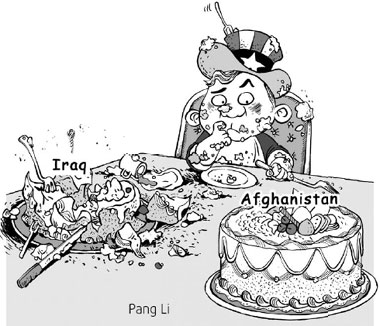
The US is simultaneously fighting on two fronts: Afghanistan and Iraq. Iraq was the focus of the US, where it sent five times as many troops than those to Afghanistan, and spent four times as much, while the US casualties in Iraq are also five times that in Afghanistan. The planned reinforcements will almost double the US armed force in Afghanistan, and multiply the costs of the Afghan war. The US casualties will very likely break the record of about 100 deaths every year. If the surging casualties and swelling expenditure cannot bring triumph, Obama will not be able to tolerate it. US enemies in the Afghan war include Taliban warriors, Al-Qaida fighters and anti-American tribal troops, which are much more superior than Iraqi anti-American insurgents in terms of command, organization and capacity, let alone the forbidding environment of the Afghan battlefields. Once US reinforcements arrive, its troops will take the lion's share of the allied forces and become the first target of its enemies. The battles in Afghanistan will be even tougher than those in Iraq. Since the US is not able to completely win the Iraq War, how can it do so in Afghanistan? Instead of fighting for an unattainable, complete victory, it is better to make a decent and responsible withdrawal. Logistics are also a thorny problem. The allied force in Afghanistan is mainly supplied through two routes from Pakistan to Kabul. More than 60 percent of the supplies have to be transported through the Khyber Pass. Since last year, the supply route through the pass has been assaulted numerous times, inflicting huge losses to logistical support. Once the US completes its reinforcement plan, the demand for supplies by more than 50,000 US troops will double or even triple, adding to the logistic conundrum of the allied force. Unless Obama finds the key to this logistical problem, he will have no choice but to withdraw. When part of the US troops in Iraq transfers to Afghanistan, a large share of the anti-American insurgents in Iraq will trace them to Afghanistan. It is reported that foreigners account for about 60 percent of the 15,000 Taliban fighters in Afghanistan, and Iraq is the largest source of foreign fighters. More anti-American insurgents from Iraq will extend the scale and raise the intensity of the Afghan war, posing a bigger threat to the US force. If the more than 50,000 US troops cannot deal with the expanding anti-American fighters, Obama might have to finally withdraw from Afghanistan. While Obama seems to be making steps forward, his new Afghan strategy implies his intention to withdraw, as he perhaps unknowingly hinted. In Columbia Broadcasting System's "60 minutes" program, Obama said, "what we can't do is think that just a military approach in Afghanistan is going to be able to solve our problems there's got to be an exit strategy this is not perpetual drift and stalemate so what we're looking for is a comprehensive strategy". The author is a researcher at the China Council for National Security Policy Studies. (China Daily 04/16/2009 page9) |