OPINION> Brendan John Worrell

|
OPINION> Brendan John Worrell
|
|
The monk's tale
 By Brendan Worrell (China Daily)
Updated: 2009-06-03 08:12 For more than 25 years Virginia Stibbs Anami has been following the trail of a Japanese monk who traveled to China during the Tang Dynasty (AD618-907). Her story, like the monk's, is a fascinating tale of passion and perseverance.
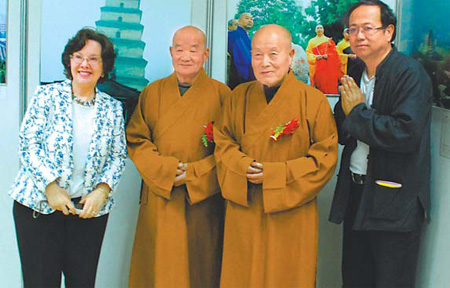
Anami, who lectures on Ancient Chinese at Tokyo's Temple University, has recently been back on the mainland to pursue her two passions; promoting her latest book, Following the Tracks of Ennin's 9th c. Journey and helping at an orphanage in rural Shanxi.
Anami says the monk's tale is a model of friendship between neighbors and resonates with people today. "He became a kind of symbol of China-Japan relations," she says, "because he was one of the first Japanese who lived in China and was given a lot of help by Chinese people during his nine years here." The wife of the former Japanese Ambassador to China, Koreshige Anami was born an American but has since become a naturalized Japanese citizen. Anami has sought to foster links within the region, both through her connections in diplomatic circles and her extensive travels and studies.
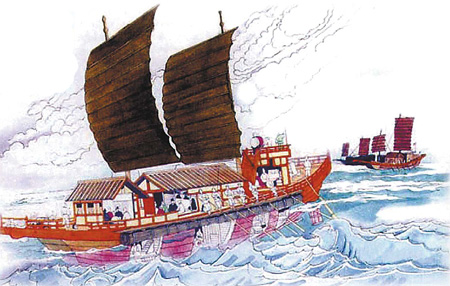
Her past teaching of history, geography and social studies immersed her in the intricacies of the centuries-old relationships between the three cultures of China, Korea and Japan. The life of Jikaku Daishi, or Monk Ennin, who traveled to China in the year AD838, links these three like few other figures in history. "It's a wonderful story about people helping each other," Anami enthuses. "Many Korean monks lived in the coastal towns of China at that time and they actually helped Ennin to get a boat to go home - so all three countries were involved in that." Ennin was part of the last ambassadorial delegation sent from Japan to Tang China and ended up staying for nine years. As far back as AD607, the Imperial Court of Japan sponsored these missions sending officials, monks, scholars and artisans to learn the advanced culture of China. At this time Tang was a very cosmopolitan society. Ennin wrote about Persians near Yangzhou, people from the Kingdom of Champa, modern day Vietnam, in addition to receiving lessons in Sanskrit from Indians in Chang'an or modern day Xi'an.
During the Tang Dynasty, foreigners undertaking long periods of study were customarily given full scholarships. Ennin could not have known then that his experiences would come in use 12 centuries later but he kept an almost daily detailed diary, his record of A Pilgrimage to Tang China in Search of the Law, compiled in four scrolls of 70,000 Chinese characters. This log has survived down the years and become the main focus of Anami's work. Early research by Okada Masayuki and his reproduction of the diary in 1926 paved the way for its later translation into English from classical Chinese by the renowned Harvard professor Edwin Reischauer in the 1950s. It was this version that Anami was to come across in the 1960s while studying Buddhist history and she admits she was instantly fascinated "with an almost immediate lure to follow his experience".
Anami cites Ennin's journal as one of the most important travelogues of the ages and compares it to other famed texts such as the Chinese monk Xuanzang's 7th-century Record of the Western Regions and Marco Polo's Description of the World, from 1298. These two were not written by the authors, however. Xuanzang dictated to his disciples once back in China and Marco Polo himself was illiterate. Anami was able to first begin exploring Ennin's path in the early 1980s when she first lived in China and later in more depth while her husband was based in Beijing working as the-then Japanese Ambassador to China. In 2007 she finally completed her quest to physically retrace the monk's footsteps, trudging through Jiangsu, Shandong, Hebei, Shanxi, Shaanxi, Henan and Anhui provinces. She thrilled in visiting world-famous locations like Xi'an and Yangzhou but it was the rural regions, "in between the famous dots", that really grabbed her imagination. Like the Monk Ennin, who put much emphasis on walking as a spiritual exercise, it was her intermingling with local Chinese people that saw her fall in love with the land and its people. Anami points out that it was Ennin's vivid accounts of his dealings with local people of the time that is so often absent from official historical compilations. A passionate scholar of Buddhism and the arts, she is also quick to stress the value of Ennin's work to Japan. "The magnificence of Tang had a strong impact on Japan, with new knowledge and art forms coming on the coattails of Buddhism," she says. Ennin was a vital link in the transmission of this heritage because anti-Buddhist persecution erupted under Emperor Wuzong during his second year in China. "Chinese people from high up to lowly people asked him 'Please take Buddhism back to Japan and keep it alive until we can practice it here again". So there was a kind of mutual help in all of this," says Anami. It is this tolerance for one's fellow man that has led Anami to strive to contribute toward improved development in isolated areas such as Datong in Shanxi province. Here Anami has been active in assisting an orphanage where about 80 families share the burden of caring for more than 200 children. "I was so impressed I wanted to do something," she says. "I started buying medicines, toys and books. And we were able to get the Japanese government to give some money for a clinic there." In addition to tracing the work of a 9th century Japanese monk, Anami has also written two books about Beijing's ancient trees and often holds exhibitions and presentations around Japan and China speaking about shared history between the two peoples. Her story, like Ennin's, provides a working model for all those idealistic souls who strive to tread a peaceful path across time and location.
|

 " style="WIDTH: 450px; HEIGHT: 286px" title="">
 " style="WIDTH: 450px; HEIGHT: 232px" title="">
 " style="WIDTH: 450px; HEIGHT: 288px" title="">
 " style="WIDTH: 188px; HEIGHT: 220px" title="">