OPINION> OP-ED CONTRIBUTORS

|
OPINION> OP-ED CONTRIBUTORS
|
|
China, India can change political climate
By Swaran Singh (China Daily)
Updated: 2009-09-04 07:54
In the past few weeks, the Indian media have reported a downturn in China-India relations. But the two countries' recent interactions on regional and global issues show some positive signs. Indian Minister of State for Environment Jairam Ramesh's three-day visit to China at the end of last month was one of those promising signs, for the growing importance of the climate change debate in international relations is likely to change the political climate further and cement the trust between the two neighbors. The passing of an important resolution on climate change by China's National People's Congress (NPC) last week was a fillip to the positive trend. The resolution says China will accord priority to evolving new policies on carbon emission, renewable resources, efficiency and conservation in energy use and other fields to combat global warming. The efforts are the precursor to a big policy announcement that is expected to strengthen Beijing's position at the UN Climate Change Conference in Copenhagen in December. Though China has already addressed some of these issues in its white papers and its last Five-Year Plan, the NPC resolution shows it is committed to becoming a major player at the Copenhagen climate talks. And the lessons have not been lost on India.
The developed world wants an agreement that would serve their narrow national interests to succeed the Kyoto Protocol, which expires in 2012. It's true that GHG emissions are increasing sharply in fast developing countries such as China and India. But counted in per capita terms, their emissions remain very low compared to that of the developed countries. We do not need rocket science to understand that GHG emission has to be counted on per capita basis because every member of society uses energy, and thus emits harmful gases. But that's not the way the developed world wants to see it or use as a basis to devise its future regimes.
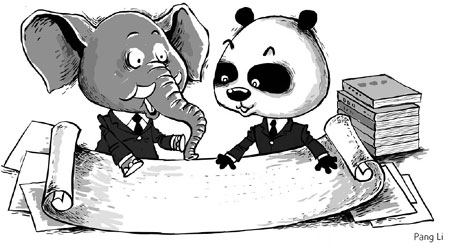 China and India have more than a billion people each, and hence high emission levels, which the developed world alleges is aggravating the climate crisis. China's industrialization is much faster and on a larger scale than India's because it is serving more people across the world, a large part of them in the developed countries. So its GHG emission is higher than India's. Conversely, it also means China has been investing more heavily to develop new policies, technologies and norms to fight climate change. And this is another lesson for India. China and India have begun to realize the importance of coordinating their policies to maximize their say at international negotiations. The developed world, for obvious reasons, is not interested in facilitating a China-India consensus. Instead, it seems interested only in passing the climate buck to the two countries. This leaves little scope for the two most populous developing countries and the industrialized world to work jointly on constructive common solutions to the climate change problem. The industrialized countries not only do not show any remorse for not meeting their agreed emission-reducing targets under the Kyoto Protocol, but also refuse to engage in any meaningful dialogue with other paradigms proposed by China and India. The US refused to ratify the Kyoto Protocol even after 183 countries did so. Though Barack Obama has now expressed interest in the Copenhagen talks, neither the US nor the European Union has responded to China's and India's attempts to include technology cooperation and carbon tariffs in the Copenhagen climate talks. China and India have begun coordinating both at bilateral and multilateral forums. They have agreed to form a joint experts' working group on the environment, and India will seek help from China for its afforestation and remote sensing information projects. The experts' group is scheduled to meet in November and also find ways to check trafficking of animal parts and poaching of tigers and antelopes. The two neighbors have agreed, in principle, to share information and grant permission to scientists conducting research on the fast receding glaciers in the Himalayas to visit each other's country. India has even said it is willing to initiate mitigation measures under international supervision provided funds and technologies are made available to it. So far, the developed world has refused to respond, and this makes China and India suspect its real motives. This fear of the developed world trying to impose another one-sided agreement that suits its interests remains a strong driver to make China and India to work jointly. The globalization of a few powers' vested interests is nothing new for China and India and explains why they need to strengthen their coordination, and draw other marginalized stakeholders to their table. The rising of China and India to their historic responsibility holds great hope for a fruitful bilateral relationship that could influence the course of the world. The author is professor of diplomacy and disarmament at Jawaharlal Nehru University, New Delhi (China Daily 09/04/2009 page9) |
|||||||



