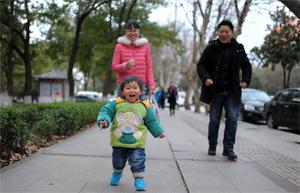
The New Year snow that engulfed Beijing yesterday cheerfully added to the magnificence of the city by sketching a silver outline on its mushrooming high-rises and lightly putting a blanket over underdeveloped zones.
For a traditionally agricultural country like China, this was more than welcome since, as it is said, timely snow augurs a good harvest.
But for an increasingly urbanized China, such a heavy snow can also be a critical stress test for the capacity of many local governments to deal with extreme weather.
Given the gridlock at the capital's post-modern airport caused by an early winter snow just two months ago, it seems fairly reasonable for local officials to be deeply concerned about the traffic situation on the first working day of the new year.
With about 17 million residents and 4 million cars, Beijing now has to worry about the traffic jams caused by each heavy snowfall instead of enjoying the much-needed precipitation the snow brings.
In a sense, the New Year snow resembles the global financial storm that has rocked the world economy for more than a year.
The New Year snow is demanding new solutions to the changed urban traffic situation in cities like Beijing.
Similarly, at the beginning of a new decade, the more urgent job for Chinese policymakers may be to find a new way out of the global financial storm to which the world has yet to bid farewell once and for all.
Like the New Year snow, the global recession has so far helped bear testimony to the resilience of the Chinese economy.
Since the global financial crisis took a turn for the worse when Lehman Brothers collapsed in September 2008, China had rapidly rolled out a massive stimulus package and achieved a V-shaped rebound in 2009 to cushion the world economy against the worst recession in many decades.
Though China has not escaped the global recession intact, it is no exaggeration that the relative slump of major developed economies has made the Chinese economy look more attractive than ever. At the moment, while major developed economies are expecting a weak recovery, China is set to embrace double-digit growth this year as it has in most of the past three decades.
All seems beautiful under the cover of the white snow except the dire consequence of traffic difficulties for tomorrow.
However, the snow will soon melt, the city will reveal its true face and local officials will run against the clock to fix all the problems the snow has caused or covered up.
How about global rebalancing? The current global recovery has prompted some leaders to quickly claim credit for bringing an end to the worst of the crisis while doing little to reduce the imbalance in the world economy.
If the new decade is to go down in history as the turning point for sustainable growth, all major economies will have to undergo more aggressive reforms and restructuring than what policymakers have done so far in an effort to buy short-term comfort.
At the very beginning of a new decade, it seems there is enough time for global rebalancing. But the failure of the international community in the past decade to reach a binding deal on climate change or a development-centered trade pact allows no opportunity to take a decade of global rebalancing for granted.
The increasing global imbalance has been identified as a cause of concern, but little has been done to effectively correct it. On one hand, rich debt-laden countries like the United States have only been trying to shift their household debts to the government to borrow their way out of the crisis. On the other hand, countries with surpluses like China have been slow to enrich consumers by improving the distribution of income.
Real global rebalancing is going to happen only when rich debt-laden countries are able to make ends meet by producing more and consuming little while countries with surpluses turn to consumer-led growth.
(China Daily 01/04/2010 page8)


Copyright 1995 - . All rights reserved. The content (including but not limited to text, photo, multimedia information, etc) published in this site belongs to China Daily Information Co (CDIC). Without written authorization from CDIC, such content shall not be republished or used in any form. Note: Browsers with 1024*768 or higher resolution are suggested for this site.
License for publishing multimedia online 0108263 Registration Number: 130349