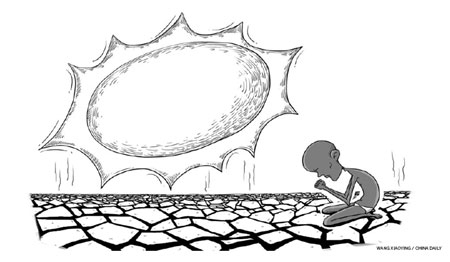
The Horn of Africa is one of the most environmentally fragile places on earth, where resilient people survive off the land amid centuries of tradition and culture. It's a stark but beautiful place, dusty on a dry day, gushing floodwaters on the rare moments when the skies open.
These are dry days in East Africa, in every sense. Across the region, rain has run dry, food stocks have run dry, and people's ability to cope is running drier and drier. In southern Somalia, the word we hoped we would never hear again is now being spoken for real - there is famine. Across Kenya, Ethiopia, Somalia, Uganda and Djibouti, 11 million people are in need of food assistance.
The World Food Programme (WFP) had - along with many other humanitarian organizations - been warning for many months that the situation in the region was deteriorating alarmingly fast. We have been particularly concerned about southern Somalia, where unacceptable demands and threats by the Al-Shabab militia forced us to withdraw from all but a few, small pockets of the capital Mogadishu in January last year.
Somalia is the most complex operational environment WFP faces anywhere in the world - we have lost 14 relief workers there since 2008. We are appealing for urgent, unimpeded access so that we can save lives without delay in the worst affected areas. We are ready to launch a massive operation, but we are also calling on the international community to recognize and understand the inevitable risks that we will be undertaking.
Understanding drought and famine is never as straightforward as other more graphic natural disasters, such as the 2010 Haiti earthquake or this year's earthquake and tsunami in Japan. Food shortages take their toll at different times, in different places, on different people, at a different pace. But always, the first to suffer are the youngest, the children who can do least to protect and nourish themselves.
That is why WFP is delivering high-impact "smart" foods to Somalia - specialized nutritious products which will protect tens of thousands of children from the advances of malnutrition, and boost the brittle young bodies of those who are already wasting slowly from hunger. We are flying these products into Mogadishu because this is the quickest - if most expensive - way to ensure the maximum impact and save lives. More will follow by air and road in the coming weeks, but to save lives now, airlifts are vital amid indications that famine conditions are likely to spread to other parts of the country.
Somalia has become the focus of this crisis, and rightly so. But it is important to understand the enormous needs in neighboring countries as well. Pastoralist communities in Ethiopia, Kenya and Djibouti are also seeing their livelihoods wither as cattle die, unable to find pasture or water. WFP has worked for years with many of these communities, helping them build resilience through agricultural and other infrastructure.
In fact, many communities that suffered terribly in the past are now able to cope better. But though greater resilience in some has blunted the power of the drought - the worst in 60 years - its impact continues to be overwhelming for many more.
Because WFP knows this region well, and has offices across the affected areas, we are well positioned to ramp up our response. Our staff members know the terrain and the people, and understand their needs. What we need to do now is to provide them the resources to get the job done.
A crucial part of our fundraising has been the involvement of the private sector, and this has been true in China and across other affluent parts of the world. Chinese companies such as Tencent and Shanda are doing their bit to support WFP's work in the Horn of Africa, while additional support has been forthcoming through the China Foundation for Poverty Alleviation. This is a really groundbreaking development of huge encouragement to WFP, and a trend we hope will evolve strongly in the years ahead.
All this support - government and private sector - has been vital, but there is still an enormous challenge ahead to make sure we can ease suffering and show the victims of this appalling crisis that the world truly does stand with them.
We can't make the rain fall, but together we can bring some relief from the deadly, dry days in the Horn of Africa.
The author is Bangkok-based Asia spokesman for UN World Food Programme. He spent seven years in Africa with WFP, working extensively in Somalia, Kenya and Uganda, before moving to Bangkok in 2010.
(China Daily 08/17/2011 page9)
 New type of urbanization is in the details

Copyright 1995 - . All rights reserved. The content (including but not limited to text, photo, multimedia information, etc) published in this site belongs to China Daily Information Co (CDIC). Without written authorization from CDIC, such content shall not be republished or used in any form. Note: Browsers with 1024*768 or higher resolution are suggested for this site.
License for publishing multimedia online 0108263 Registration Number: 130349