Now that the leadership issues in the United States and China have been settled, we can finally frame the economic outlook for 2013 with the knowledge of who will be pulling the policy levers in the world's two biggest economies. So, what will they do, and, perhaps more important, what will economic forces do to them?
For starters, the US will face recurring challenges with the "fiscal cliff" until financial markets pressure policymakers into more radical deficit reduction. But, despite this and associated growth disappointments, 2013 will be a stronger year for the global economy than many people expect.
In 2011, China contributed $1.3 trillion in additional GDP to the world, the equivalent of creating another Greece every 12.5 weeks, or close to another Spain every year. Together, the four BRIC countries (Brazil, Russia, India, and China) contributed around $2.2 trillion in 2012, equivalent to another Italy every year. (Despite its problems, Italy is still the world's eighth-largest economy, and will be for at least the next couple of years, until Russia and India possibly overtake it).
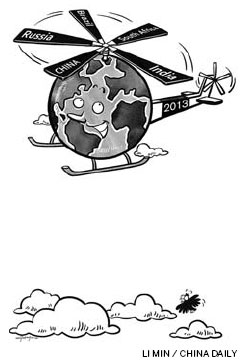
The eight growth market economies - the BRICs plus South Korea, Indonesia, Mexico, and Turkey - created close to $3 trillion in 2011, more than the United Kingdom in one year. These economies' combined size is now approximately that of the US economy, with total annual output reaching $15-16 trillion, or roughly 25 percent of global GDP. Unless their growth rates slow sharply, their contribution to world output will rise dramatically, and global growth will be stronger than worried Western analysts might appreciate. If the "Growth Eight" economies expanded by 10 percent on average in US dollar terms, they would add $1.5 trillion to global GDP in 2013.
For the decade that began in 2011, we at Goldman Sachs Asset Management have assumed that China, which accounts for about half of total Growth Eight output (probably $8.3 trillion by the end of 2012), will grow at a 7-8 percent annual rate in real terms, with inflation around 3 percent. Unless the renminbi falls in value, this translates into an average nominal increase of at least 10-11 percent in dollar terms.
China will grow by 7-8 percent partly because that is what policymakers have decided they want. In late 2009, within a year of their massive policy stimulus in response to the global credit crisis, the Chinese leadership, I believe, decided that 10 percent annual real growth had outlived its usefulness. Income inequality was rising dramatically, environmental damage was worsening rapidly, and inflation was leading to weak real-income growth for poor households.
Indeed, a key reason for China's slowdown in 2011-2012 is that officials wanted it. While the real GDP growth rate stated in the 12th Five-Year Plan (2011-15) should not be viewed as a fait accompli, the fact that the Plan's growth rate was lowered to 7 percent is a powerful signal of official intent.
China's 7 percent growth target, while subject to a number of challenges, is based on maintaining private consumption growth of around 8 percent (while recognizing that exports and investment will not grow as strongly as before), thereby allowing the consumption share of GDP to rise. More focus on innovation and creativity will be accompanied by strong real wage growth, provision of greater rights for urban migrants, and expansion of health care and pensions. If China grows by 7-8 percent again in 2013, it will be more balanced growth than in 2012.
Beyond China, the other BRICs - Brazil, Russia, and India - all face challenges that their policymakers need to meet to spur stronger growth. But there are plenty of exciting developments elsewhere, including Indonesia, the Philippines, Bangladesh, Nigeria, and Mexico - all part of what I call the "Next 11." South Korea and Turkey, which continue to grow reasonably well, albeit not with the others' momentum, are two of this group's other big members.
The 15 countries that comprise the BRICs and the Next 11 contain more than 4 billion people, close to two-thirds of the world's population. As they continue to grow, their share of the world economy will continue to rise, boosting global growth beyond what it otherwise would be.
But the global economy could be weaker in 2013 than it was in 2012 if the worst continues to prevail in Europe and the US, particularly if the new US Congress cannot work with a re-elected President Barack Obama to find a budget deal that improves the medium-term credibility of the US fiscal position while avoiding excessive deficit cutting. This is a difficult balance to achieve, and, without pressure from the markets, I am unsure how it will play out.
I should add, however, that if the US government does not cause problems, two private-sector developments seem likely to be helpful. One is growing evidence of a housing recovery; the other is the prospect of steadily declining energy-import costs as domestic production, particularly of natural gas, continues to rise.
As for Europe, many investors still assume that a moment will arrive when we can definitively conclude that European Monetary Union is finished or saved. Unfortunately, it is much more likely that, at least ahead of Germany's autumn 2013 elections, key decisions will be postponed or avoided. This means that Europe probably faces another challenging year. But, again, the BRICs' output growth amounts to creating the equivalent of another Italy every 12 months. Unless the European environment deteriorates sharply, Europe's travails will not be the main story for the global economy in 2013.
The author is chairman of Goldman Sachs Asset Management and a member of the board of the Bruegel think tank.
Project Syndicate
(China Daily 01/07/2013 page9)

Copyright 1995 - . All rights reserved. The content (including but not limited to text, photo, multimedia information, etc) published in this site belongs to China Daily Information Co (CDIC). Without written authorization from CDIC, such content shall not be republished or used in any form. Note: Browsers with 1024*768 or higher resolution are suggested for this site.
License for publishing multimedia online 0108263 Registration Number: 130349