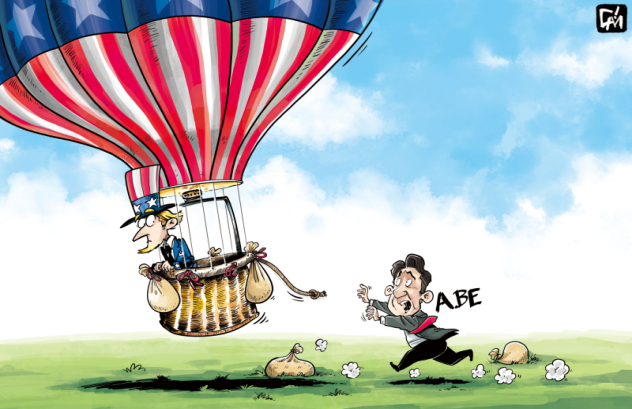
Obama likely to tell Abe 'cool it'

Washington is gearing up to greet Japan's new prime minister. Prime Minister Shinzo Abe's conservative Liberal Democratic Party came to power in December after winning a landslide election over the left-leaning Democratic Party. Abe, who previously served as prime minister in 2006-2007, has vowed to resolve the deep-rooted economic problems that have confronted his nation for decades. He has also pledged to stabilize Japan's troubled relations with some of its neighbors, including China, and enhance security ties with the United States.
What will be the topics discussed by President Barack Obama and Prime Minister Abe? Will economic issues be at the top of the agenda? Or will they be trumped by security considerations?
With respect to economic issues, it is likely that Japan's membership in the Trans-Pacific Partnership, a "high-standard" multilateral free trade agreement, will be on the agenda. Yoshihiko Noda, Abe's predecessor, had committed Japan to membership in the market-opening trade pact, but some in Washington suspect that Abe is having second thoughts. The new regional free-trade agreement is supported by big business, but it is opposed by Japan's agricultural interests. Both groups are among the staunchest supporters of the LDP. It is probable that Obama hopes that Abe will make a firm commitment to join the US-led TPP.
Although economic matters will find a place at the negotiating table, security issues are likely to dominate the talks. For a start, the two leaders may discuss plans to relocate an important US military base within Japan's Okinawa Prefecture - despite the opposition of local residents. Under the plan, the US Futenma Air base that is presently located in a highly populated residential district will be moved to a less crowded coastal area. But progress on the relocation has been slow.
Obama and Abe might also discuss additional US arms sales to Japan. Washington and Tokyo recently agreed a $10 billion deal for 42 Lockheed Martin radar-evading F-35 Joint Strike Fighter aircraft. This and other arms deals could be discussed.
A revision of the US-Japan Defense Guidelines could also be near the top of the agenda. The original guidelines were drafted in 1978, and designed to help the two sides prepare for a possible conflict with the Soviet Union. The current guidelines were inked in 1997, and were a reaction to heightened tensions on the Korean Peninsula. A new set of guidelines will reflect recent changes in the global security environment including the rise of cyber warfare, terrorism and piracy. Japanese officials concede that concerns about the Democratic People's Republic of Korea and the rise of China are also serving as drivers for a revision of the guidelines. The new defense guidelines will probably permit Japan to exercise collective self-defense. This means that Tokyo could use its armed forces to assist allied troops if attacked.
However, it is more than likely that the issue topping the agenda will be the longstanding quarrel between Japan and China over a handful of uninhabited islands in the East China Sea. Tokyo argues that it gained control of the island group in 1895 when they were terra nullius - land belonging to no country. But China says that the territory was stolen by Tokyo in the first Sino-Japanese War and should have been returned after World War II in keeping with the terms of the Cairo Declaration and Potsdam Proclamation. In 2012, tempers flared after a right-wing governor of Tokyo launched a drive to purchase the islands from their "private" owners. To prevent this from occurring, Japan's central government bought them instead. These moves infuriated people in China.
Despite pledges to adopt a measured approach to this quarrel, Abe has done little to defuse tensions. For example, on Jan 11, the prime minister declared that "there is no room for negotiation". And on Feb 2, he rallied his nation's military forces with a pledge to "stand up against the present danger ... at all costs". Given the fact that Washington has called on Tokyo to "reach out" and hold "discussions" with Beijing, such statements cannot be considered helpful.
The US-Japan alliance is a tight one. But it is also fraught with the same tensions that characterize most alliances. As Glenn Snyder explained in his classic study, The Security Dilemma in Alliance Politics, the partners in an alliance often fear abandonment or entrapment. The weaker party will sometimes fear abandonment. On the other hand, if a stronger state perceives that an ally's interests deviate from its own defense concerns, it will fear that it will be entrapped in a conflict with other states over issues that are of little concern to its own security. This helps explain why Obama will probably inform Abe that the US does not want to become entrapped in a conflict with China over a pile of rocks in the East China Sea. Rather, he will be politely urged to tone down his rhetoric and open negotiations to settle this territorial dispute in a flexible and balanced way. Although Abe is sometimes described as a "hawkish" politician and a "hothead," he has also earned a reputation as a pragmatist. With any luck, Tokyo will follow Washington's advice and reach out to Beijing.
The author is director of the Graduate Program in Global Studies at Missouri State University.
(China Daily 02/19/2013 page9)