The problem of water management
Despite its extraordinary economic growth in the past three decades, China has not made commensurate progress in planning and managing its water resources. Chinese policymakers appear to have made an implicit decision that it would be possible to resolve the country's environmental and resource-related problems only after its transition to an economic superpower.
But the breakneck growth, huge population and rising environmental awareness of the people, who are demanding a better quality of life, mean that China cannot continue on an unsustainable development path.
China's rapid economic growth has affected all sectors. Take groundwater for example. In 1972, the country drew about 20 cubic kilometer of groundwater. By 2010, it was drawing 112 cubic km a year, an increase of 560 percent in less than 40 years. And nearly 70 percent of North China's irrigated areas today depend on groundwater. This increasing exploitation of groundwater cannot continue because it is not sustainable.
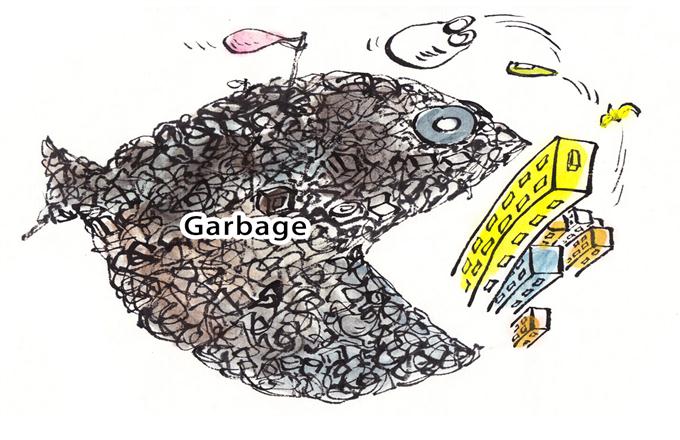
Because of the unfettered exploitation of groundwater - coupled with inadequate investment in water infrastructure, poor water and environmental management practices, and inadequate implementation of existing laws and regulations - China is now facing a groundwater crisis that is unprecedented in history, both in terms of geographical extent and magnitude as well as management complexities.
At present, nearly the entire rural population and half of the urban population depend on groundwater. A report issued by the Geological Survey of China last month said 90 percent of the country's groundwater is polluted, much of it seriously. The report also said that a survey of 11 cities across China indicated that 64 percent sources of water were "severely" polluted and 33 percent "lightly" polluted. Only 3 of the sources could be considered clean.
Much of the blame for this sorry state of affairs could be laid at the doors of local governments, which allow State-owned enterprises to continue discharging wastewater with no or partial treatment. In their misguided quest for economic development, the local governments are protecting polluting industries.
Similarly, last month, the Ministry of Environment admitted for the first time the existence of so-called "cancer villages". It said: "In recent years, toxic and hazardous chemical pollution has caused many environmental disasters, cutting off drinking water supplies, and even leading to severe health and social problems such as cancer villages."
The report further said that water pollution in China is already very serious because of lack of pollution control efforts by enterprises, absence of policies to stop the use of toxic and dangerous chemicals, and insufficient monitoring of water quality. Even when and in places where water quality is monitored, the emphasis is on surface water, and regular monitoring of groundwater quality in the country is in its infancy.
China's groundwater now contains high levels of nitrate, arsenic, fluoride and sulphates. In terms of arsenic, the World Health Organization and the United Nations Development Programme reported in 2001 that some 15 million people were drinking water from wells with higher arsenic concentration.
Other studies indicate that arsenic has been found in groundwater in different areas of China such as the plains in the "Great Bend" of the Yellow River, the Hubao Plains in the Inner Mongolia autonomous region, the Datong basin in Shanxi province and the floodplain on the northern side of the Tianshan Mountains in the Xinjiang Uygur autonomous region.
The overexploitation of groundwater is as unwelcome for China as is the increasing deterioration of groundwater quality. It further accentuates the problem of water scarcity. To offset the shortfall in surface water, either because of quantity or quality considerations, many cities in China have increasingly relied on groundwater, overexploiting it in the process. The depletion in groundwater is lowering water tables in urban as well as rural areas, causing serious subsidence in major cities, forcing lakes and wetlands to run dry, and increasing salinity in and eventually exhausting groundwater reservoirs.
Subsidences of up to several meters have been reported from cities as far apart as Beijing, Tianjin, Shanghai, and Taiyuan and Shijiazhuang in Shanxi and Hebei provinces. The resultant damages to all types of infrastructure in the past decade have been estimated to be 1.4 billion yuan ($225 million). Equally worryingly, some 60,000 square km of plains in North China have subsided by an average of 20 cm.
The costs of water pollution have already become quite severe, about 1 percent of GDP or almost 150 billion yuan. The increase has been not only in economic cost, but also social, health and environmental costs.
The formulation of the first National Plan on Groundwater Pollution Control is a step in the right direction. The plan proposes an investment of more than 34 billion yuan for prevention of groundwater pollution, and its treatment and monitoring all over the country between 2011 and 2020. The need now is to put in place effective legal, regulatory, institutional, administrative and managerial instruments to make the plan successful. In the long term, the plan will attempt to first stop and then reverse the degradation of groundwater.
Pollution and depletion of groundwater are often said to be the result of lack of institutional coordination, poor planning and management of water resources, and lack of enforcement of laws.
The challenge for a fast growing country like China thus lies in the formulation and implementation of a set of policies that balance economic growth, urbanization, and industrial and agricultural development with good quality life and environmental protection. This may not be an easy task but is definitely achievable and, more importantly, essential for China's development.
Cecilia Tortajada is co-founder and president of the Third World Centre for Water Management and former president of the International Water Resources Association. Asit K. Biswas is distinguished visiting professor at the Lee Kuan Yew School of Public Policy Singapore, and co-founder of the Third World Centre for Water Management.
(China Daily 03/05/2013 page10)