Taking corruption by the horns
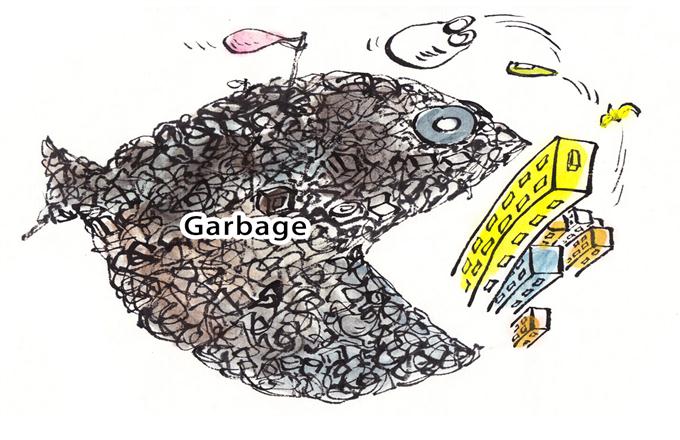
Corruption in China is becoming increasingly serious and the country's leadership has reiterated the urgency to fight it through strengthened institutional mechanisms and more regulations. Party chief Xi Jinping has repeatedly emphasized the importance of "putting power in the cage of regulations" and "swapping flies as well as tigers".
So just how serious a problem corruption has become since the reform and opening-up were introduced. In 1979, Wang Shouxin was declared the most corrupt person in China for embezzling 500,000 yuan ($80,317). Today, corrupt government officials would consider the amount chicken feed.
Before the 1980s, officials had much fewer chances to "make money on the side" because China had not yet embraced market economy and very few funds were transferred through governments. Those days, constant political campaigns and rectitude drives also helped ensure that officials remained honest and maintained a thrifty lifestyle.
Today, China is an economic powerhouse thanks to three decades of reform and opening-up. But the economic success has had some severe side effects that have blurred the functional limits between governments and enterprises. And even where the dividing line is clear, the government can still intervene in the market.
The growing need of the government to intervene in the market has seen a corresponding increase in officials' powers, which has helped spread corruption in a society that depended heavily on its officials' morality and honesty in the past. Even though the central government noticed the problem very early, and took urgent measures and set up new departments to combat corruption, the spread of corruption could not be arrested.
History tells us that contrary to popular belief strict supervision could also help deepen corruption. Why? Supervisors could become power-sharers with the corrupt officials they monitor. In fact, the more powerful a supervisor the more money he/she could make. During the Ming Dynasty (1368-1644), Dongchang and Xichang, or the eunuch agents given the responsibility to keep watch on officials, became the most powerful and corrupt set of supervisors.
Basically, money embezzled by corrupt officials belongs to the people, but they cannot readily report their loss to supervisors and could even be targeted for revenge for doing so. More importantly, supervisors cannot touch local officials of the same administrative levels. The Party's top discipline watchdog does play an effective role in monitoring officials, but China is too vast a country for it to supervise and monitor every official. As a result, many local government leaders are often free from supervision. So rectitude is the only thing that can prevent them from being corrupt, but not all of them can turn a blind eye to the lure of material benefit.
In some places, corruption has become a shared lifestyle - more of the rule than exception - where corrupt officials can join hands to isolate their honest counterparts, and even get them transferred or sacked.
To tackle corruption, the government has to "put the power in the cage of regulations", as Xi has said. It means putting the government's power under check, curbing its interventions in the market wherever possible, and making the administrative process and officials' activities more transparent.
By reducing the powers of governments at all levels and their intervention in the market, and drawing a clear line between the functions of governments and enterprises, the higher authorities could shut the door on "renting" and "sharing" of power. Once that is done, officials will have few avenues to make money through bribes, kickbacks and gifts.
According to the government work report delivered on Tuesday by Premier Wen Jiabao at the annual legislative session, in terms of regulating the exercise of administrative power, the government has adopted a series of new initiatives to build a service-oriented, responsible and clean administration that functions under the rule of law.
The government has been adhering to scientific decision-making, democratic decision-making and decision-making according to the law, and perfecting its decision-making processes, such as public participation, expert evaluation, risk assessment, legitimacy review, and collective discussion and decision.
Over the past five years, some 498 administrative examination and approval items have been cancelled or adjusted, and the total number has reached 2,497, accounting for 69.3 percent of the original administrative examination and approval items. This is the right direction for the government has taken to deepen the reform of the administrative examination and approval system, and governments at all levels should follow in the footsteps of the central government.
New and traditional media have highlighted the urgency to address the serious problem of corruption. Their supervision should be extended to the judicial system, which will help reform the judicial system.
The country's new leadership, headed by Xi Jinping and Li Keqiang, has started its fight against corruption on an excellent note. Not surprisingly, some corrupt officials will resist the moves to fight corruption, but their efforts are doomed to fail because neither the Chinese people nor leaders will tolerate corruption.
The author is a professor of political studies at Renmin University of China.
(China Daily 03/06/2013 page10)