Japan looks to board US' 'black ship'
For two centuries Japanese ports were closed to all but a few Dutch and Chinese traders. But on July 8, 1853, four "black ships" of the US Navy anchored in Edo (Tokyo) Bay, effectively forcing open the doors of trade.
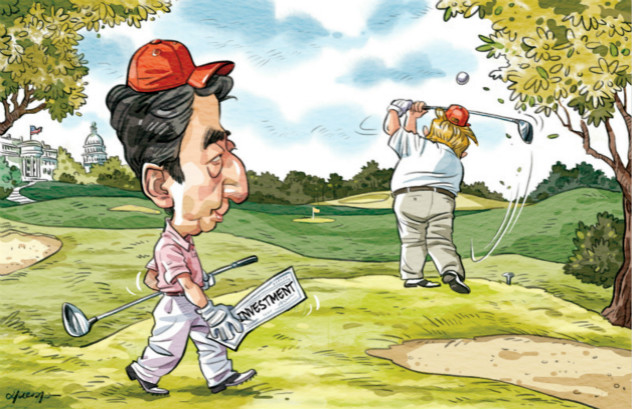
Now Japanese Prime Minister Shinzo Abe is ready to jump into the US-led Trans-Pacific Partnership free trade talks despite the fact that many in Japan regard the trade pact as a new black ship.
Abe's decision to join in the talks, announced on March 15, is a move championed by industrial heavyweights such as Toyota, Toshiba and Mitsubishi, but fiercely opposed by Japan's agricultural and fishery sectors, which fear that the TPP will effectively eliminate their competitive advantage at home.
It could be political suicide for Abe to completely abandon the Japanese farmers, especially as his party's victory in the December election depended heavily on votes from the agricultural sectors. But supporters of the trade pact fear that Japan will "miss the bus" unless it participates in the talks involving 11 other Asia-Pacific nations.
The TPP talks are expected to gain steam now that US President Barack Obama has been re-elected, and if Japan joined the talks at a later date it would likely face a disadvantage in the negotiations to form trade and investment rules inside the framework. Abe has made a quick decision on the issue while his approval ratings are still high, as he wants to accelerate Japan's economic growth by joining the TPP and harnessing the dynamism of other parts of Asia.
By eliminating tariffs on industrial and agricultural products, as well as establishing common rules governing the expansion of private companies into other member countries, the TPP framework aims to revitalize the flow of goods and services between the participating economies.
But embarking on international trade negotiations with domestic opinion so sharply divided on the issue is a gamble for Abe, and many in his party think the odds are against him.
It is risky for him to push the TPP issue ahead of the upper house elections this summer, as his Liberal Democratic Party can expect a very strong reaction from farmers who fear an influx of cheap imports. Abe's government knows that the country's production in the farm, fishery and forestry sectors could decrease by 3 trillion yen ($31.85 billion) a year if all tariffs are abolished unconditionally after Japan joins the TPP.
However, for many people in Japan the TPP is not just a trade issue, it's also a security issue. They think that joining the TPP will lead to stronger Japan-US relations, which they hope will be able to contain China.
"Joining the TPP would enable Japan, East Asian nations, Australia and others to strengthen their economic ties with the United States as the linchpin of the Pacific Rim economy. This would restrain China, a nation that has been expanding its clout economic and otherwise in recent years," Yomiuri Shimbun declared in a 2011 editorial.
The linchpin of Abe's diplomacy is Japan's relationship with the United States. Tokyo is trying to rebuild its diplomacy through efforts to enhance its ties with Washington.
He is willing to sail aboard the US' "black ship", which could be seeking to force China to change its policies to those desired by the US.
However, the TPP has been heavily criticized for its spirit of confrontation and containment, as China, the world's second-largest economy and a traditional powerhouse in the eastern Pacific, is excluded from the Pacific trade pact.
By participating in the talks Japan will further alienate its geographic neighbor and closest economic partner.
The author is Tokyo bureau chief of China Daily. E-mail: caihong@chinadaily.com.cn
(China Daily 03/28/2013 page8)