Not just two-way trade boost
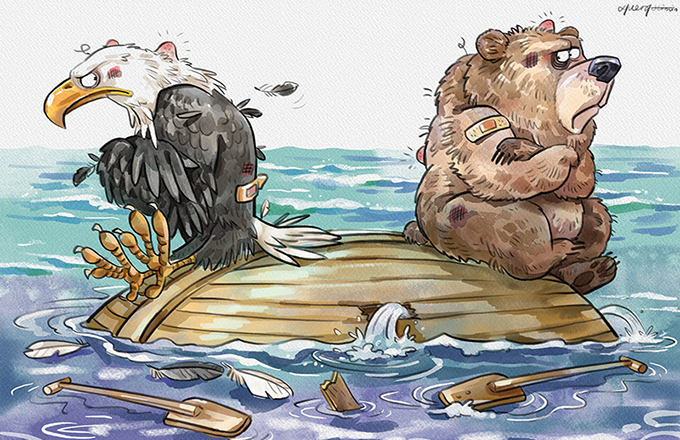
By forging a closer alliance, the EU and US are once again trying to reshape the global economy in their favor
The European Union and the United States announced the official start of free trade negotiations at the G8 summit in Lough Erne in Northern Ireland on June 17 and 18. The start of talks to finalize the Transatlantic Trade and Investment Partnership shows the developed countries are pushing to build powerful new alliances.
With a trade volume of almost $1 trillion, as well as half the world's economic production and one-third of the global trade circulation, trade between the EU and the US is the biggest and most complex of economic relations. The Transatlantic Trade and Investment Partnership would be the biggest trade agreement since World Trade Organization was founded. An independent study by the London-based Centre for Economic Policy Research predicts the EU's economy could benefit by 119 billion euros a year ($156 billion) and the US by an extra 95 billion euros a year.
The TTIP would help tap the huge potential that exists in their services trade and investment. The US is the biggest trader in services, and 40 percent of the trade is with the EU. Besides, they are each other's biggest investor. The US currently invests $2 trillion in the EU and the EU invests $1.7 trillion in the US.
Of the 119 billion euros a year that the Centre for Economic Policy Research forecasts the EU would benefit from the TTIP, 80 percent will be a result of lower supervision, liberalizing the trade in services and public purchasing.
For the US, the TTIP would help form a closer alliance with EU enabling them to better coordinate their policies towards Asia, which in turn will push their Asia-Pacific trade partnerships forward and better facilitate the US' rebalancing to Asia. With the successful conclusion of the TTIP and the Trans-Pacific Partnership processes, the US would find it easier to gain the upper hand in trade strategy.
Of course, there are many divergences between the EU and the US, especially on agriculture, and neither the EU nor the US wants to end the protection and subsidies offered to their high-tech industries and related enterprises. Other obstacles that need to be overcome are surplus tariff rates and expanding market allowances, as well as differences in market supervision and domestic standards. But they are not unsurpassable as both sides have called the TTIP a strategic arrangement and are actively accelerating the process.
Obviously, by forging a closer alliance, the EU and US are trying to dominate global trade rules and influence multilateral trade mechanisms, rather than simply trying to boost mutual trade and investment. Under the TTIP, the two sides would eliminate all agricultural and industrial tariffs on trans-Atlantic trade, further open their services markets, enhance cooperation in public purchasing and policy-making, and establish new regulations in sectors like competition, trade convenience, labor and environmental protection. On top of these, last year the EU and US agreed on the common goal and strategy of urging better protection of Intellectual Property Rights, as well as agreeing on common approaches to some other issues concerning market entry in countries like China, Japan and Russia.
If the TTIP becomes a reality, it would reshape world trade rules, standards and patterns, thus challenging the trade alliances among emerging market economies, especially among the BRICS economies - Brazil, Russia, India. China and South Africa. The new rules forged by the EU and the US would doubtlessly raise the threshold for entry into their markets, as lower trade barriers between the EU and the US would constitute higher barriers to external economies. China's exports to the US would face competition from EU exports and its exports to the EU competition from US exports.
Facing the new situation, China must try and actively participate in the global FTA negotiations, and to this end it should accelerate domestic market reforms to meet the higher standards of international trade rules. It should also strengthen its relations with other emerging economies in order to have a stronger position in the process of making international trade rules and defending its economic interests.
The author is the deputy director and associate research fellow of World Economy Study at the Economic Forecast Department of the State Information Center.
(China Daily 06/26/2013 page8)