Reducing financial risks
The government should guide money to the real economy to ensure stable growth and ease reliance on loans
Economists tend to disagree with one another, but one of the few things they do agree on is the importance of the real economy to a country.
However, since the 2008 financial crisis, it has become common practice for countries to take countercyclical easing measures to stimulate their economies and prevent further decline. That might have helped the global economic recovery, but the good results indicated by promising financial figures come at the cost of the real economy.
Despite data that prove the 2008 crisis is the most serious economic recession since 1959, investors everywhere are still boosting credit loans. Currently the property of all central banks globally has reached $18 trillion, 30 percent of the global GDP, twice the amount it was 10 years ago. "Financial barrier lakes" have already been formed.
The situation is especially serious in China, where increasingly more money is being issued in the financial sector where there is low efficiency in using it. Financial resources are massively distributed to low-productivity fields, such as infrastructure and real estate, and the money invested, instead of having any real effect, goes back into the financial system. Since 2008, China's economy has become highly reliant on credit loans, which are growing faster than its GDP.
A natural result of the over-reliance on loans is the high debt of the real economy. A report from the Institute of Finance and Banking at the Chinese Academy of Social Sciences shows debt of China's non-financial sectors reached 65 trillion yuan ($10.5 trillion) by the end of 2012, or 125 percent of its GDP, much higher than the average 50 to 70 percent of developed countries.
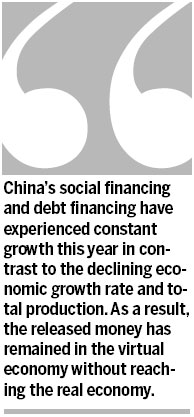
China's social financing and debt financing have experienced constant growth this year in contrast to the declining economic growth rate and total production. As a result, the released money has remained in the virtual economy without reaching the real economy which needs it.
Banks, attracted by the higher returns, are more willing to invest in the financial sector, while enterprises in dire need of money are struggling to get loans. That is why China's financial sector is flourishing while its industrial, agricultural and commercial sectors are all relatively weak. On the one hand, the return rate of the real economy is low while the risks are high. On the other hand, banks also have high risks from their hidden nonperforming assets.
Worse, the roaring realty market has further driven money out of the real economy. In the first half of 2013, investment in the realty market has grown by 20.3 percent compared with last year, while that in manufacturing continues to fall. The financial products catering to real estate market continue to lure money from the real economy.
The huge contrast between the financial sector and the real economy, combined with the self-circulation of liquidity, constitutes huge financial risks for China.
To deal with the risks, the State Council issued a new regulation on July 5 that encourages the financial sector to support the real economy. The problem is, China's economy is staggering as it goes through a necessary transformation in which the domestic and international elements that supported its growth, such as low labor costs, are permanently changed. But its profit margin will shrink if it stays on the low end of global industrial chain.
The absence of proper government supervision and guidance against the risks has become ever more evident since the 2008 financial crisis. Allowances offered by local governments have distorted the prices of productive factors and lowered the cost of investment. A huge amount of additional funds have already been poured into the industries that rely on investment.
In this case, as long as the financial sector offers higher return rates than the real economy, financial capital will continue to drive industrial capital out. However, the recovery will be built on sand if the virtual sector expands and real one withers.
The author is a researcher from the State Information Center.
(China Daily 08/21/2013 page8)