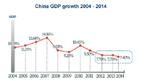
The positive changes in China's economy are not only reflected in the increase of jobs and residents' incomes, but also in the structural upgrading. We have streamlined administration, delegated powers to the lower levels, and adopted fiscal, taxation and financial measures such as targeted tax reduction and targeted reduction of required bank reserve ratio. All these measures have spurred the growth of the service sector, agriculture, rural area and the welfare of farmers, as well as small and micro-businesses, private businesses and emerging industries. In the first half of the year, new businesses and new business models such as logistics, express delivery and e-commerce all developed fast. The number of newly registered service businesses surged by more than 70 percent. The tertiary industry continued to outperform the secondary industry in terms of growth rate and share of GDP, and is a leading sector of the economy. The share of private investment in fixed asset investment increased by 1.4 percentage points year on year. High-tech industries and equipment manufacturing grew faster than the industrial average.
Deepening structural readjustment has improved the quality of economic growth. On the basis of carrying out reform and innovation, we have reduced overcapacity, eliminating outdated capacity in particular, and fostered new growth areas. In the first half of the year, the growth of investment and production of industries with high energy consumption and emissions noticeably slowed down. The per unit GDP energy consumption dropped by 4.2 percent year on year, and carbon intensity was cut by about 5 percent, the largest drop in many years.
We have managed to ensure steady growth and improve the quality of the Chinese economy by taking targeted, range-based macro-control measures. With focus on key areas and weak links of China's economic and social development, we have used more reform and innovation measures to incentivize market entities, strengthen weak links, boost the real economy and ensure that our efforts are well-targeted. This approach, which was also structural adjustment in nature, involved both reform and readjustments. We have strived to remove market obstacles and make the market play a decisive role in resources allocation. We have also endeavored to improve the role of the government and promote social equity. We have worked actively to balance domestic and international demands, coordinate regional development, narrow the gap between rural and urban areas and stabilize agricultural supply and demand. We have strengthened the construction of railways in central and western China, the renovation of rundown areas, as well as pollution control and prevention and other livelihood and development projects. We have actively tackled the bottlenecks that have long constrained China's balanced development. All of these have vigorously supported the process toward a new type of industrialization and effectively increased the supply of public goods.
Facing the new normal state of the global and the Chinese economy, we have remained level-headed and taken steps to tackle deep-seated challenges. We focused more on structural readjustment and other long-term problems, and refrained from being distracted by the slight short-term fluctuations of individual indicators. In July and August, electricity consumption, freight volume and other indicators fluctuated somewhat. That was inevitable and within our expectation. It was because the domestic and international economic situation was still complex and volatile and base figures for the second half of last year were relatively high. When observing the Chinese economy, one should not just focus on its short-term performance or the performance of a particular sector. Rather, one should look at the overall trend, the bigger picture and the total score. Judging by the principle of range-based macro-control, we believe the actual economic growth rate is within the proper range, even if it might be slightly higher or lower than the 7.5 percent target. In particular, we should realize that an important goal of maintaining stable growth is to ensure employment, and the floor of the proper range is to ensure relatively adequate employment. As the economic aggregate continues to expand, and in particular, as the service sector develops rapidly, growth will mean more jobs and there will be greater tolerance to fluctuations. We should also be clear that China's economy is highly resilient and has much potential and ample space to grow, and we have a full range of tools of macro-control at our disposal. The measures we have taken are good both for now and for longer-term interests, and will therefore enable us to prevent major fluctuations and make a "hard landing" even less possible. However, this is not denying that our development faces difficulties and challenges. On the contrary, we are indeed confronted with enormous difficulties and challenges.


Copyright 1995 - . All rights reserved. The content (including but not limited to text, photo, multimedia information, etc) published in this site belongs to China Daily Information Co (CDIC). Without written authorization from CDIC, such content shall not be republished or used in any form. Note: Browsers with 1024*768 or higher resolution are suggested for this site.
License for publishing multimedia online 0108263 Registration Number: 130349