 |
|
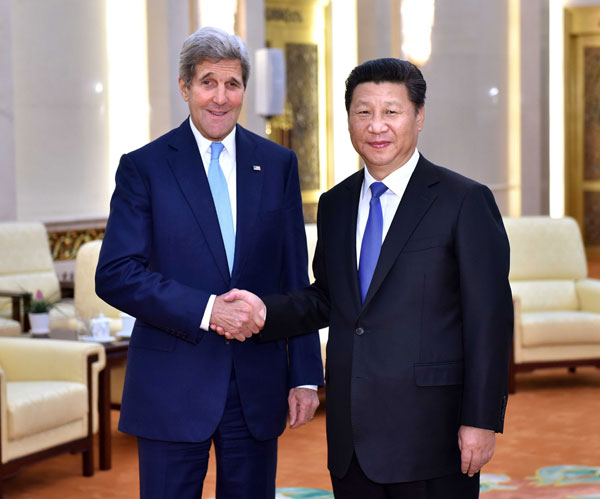
Chinese President Xi Jinping (R) meets with US Secretary of State John Kerry at the Great Hall of the People in Beijng, capital of China, May 17, 2015. [Photo/Xinhua] |
Even if China realizes its second centennial goal of "building a prosperous and strong, democratic, civilized, harmonious socialist modern country" in 2049, the US will not necessarily lose its superpower status. Global configuration is determined by two key factors - comparative strengths and strategic relationships of major powers. From the perspective of comprehensive national strength, the components of China's national strength are imbalanced.
China's economy has had an impact on the world, but its political and cultural influences are limited to the West Pacific. Its military capabilities, the weakest link in its national strength, have hardly crossed the perimeter of defense. It is far more difficult for China's comprehensive national strength to catch up with that of the US than for its economy to do so. The US upgrades its military capabilities through wars, China through military drills - the difference is like that between corporate executives and corporate governance scholars.
Indeed, the US has strategic conflicts with two major powers (China and Russia), but its strategic ties are of higher quality than those of China's. The US has adopted an alignment principle and is in alliance with the United Kingdom, France, Germany and Japan. China follows a non-alignment policy, and has cooperative partnerships with the US, the UK, France, Germany and Russia. The US has about 60 allies, not including China, while China has 58 cooperative partnerships including the US.
In a recent article, "Only China Can Contain China", Joseph Nye has said, that China lacks high-quality strategic partners is an indication of the gap between Chinese and American comprehensive national strengths.
The Chinese economy is more than 60 percent that of the US'. But whether it can sustain a high growth rate depends on whether it adheres to the political trend of liberalizing its economy. Countries with long-term openness have healthier national strength than those in long-term isolation. The disintegration of the Soviet Union and "Arab Spring" in the Middle East are typical examples of what follows long-term isolation.
Since 1978 the political line of opening-up has upgraded China's comprehensive national strength in multiple ways. It has improved Chinese people's sense of right and wrong, corporate competitiveness, the government's innovative capacity and the Party's capability to detect errors, laying a solid foundation for national self-confidence.
So the speculation over a unipolar "Chinese century" is entirely contrary to the forecast of multi-polarization in the post-Cold War world. But given the current conditions, a bipolar international configuration is more likely than a multipolar or unipolar one.
In the next decade, no other major country except China can possibly narrow the gap between itself and the US in national strength. The US' comprehensive national strength is much more and growing faster than those of Russia, France, Germany, Japan and Brazil. And small and medium-sized countries in East Asia have shown a tendency to take sides in their security strategies, reflecting an emerging bipolar pattern.
Bipolarization doesn't mean the world will see another Cold War, which was based on three necessary conditions: Mutual nuclear deterrence and ideological conflicts were the main contradictions, while proxy war was the main means of competition. The core contradictions in Sino-US relations are over international norms - not over ideology - and the means of competition are scientific and technological innovation as well as pursuit of friendly ties.
The Sino-US bipolarization will promote changes in the global configuration. The world's center of gravity will shift from Europe to East Asia. The US' global dominance will gradually weaken and Eurocentric standards in international norms will increasingly yield place to pluralistic standards. The decline of global organizations and the rise of regional ones will take place simultaneously. And a practical issue in international relations will be, what sort of bipolar global configuration to build.
The author is dean of the Institute of Modern International Relations, Tsinghua University.
Courtesy: China & US Focus


Copyright 1995 - . All rights reserved. The content (including but not limited to text, photo, multimedia information, etc) published in this site belongs to China Daily Information Co (CDIC). Without written authorization from CDIC, such content shall not be republished or used in any form. Note: Browsers with 1024*768 or higher resolution are suggested for this site.
License for publishing multimedia online 0108263 Registration Number: 130349