 |
|
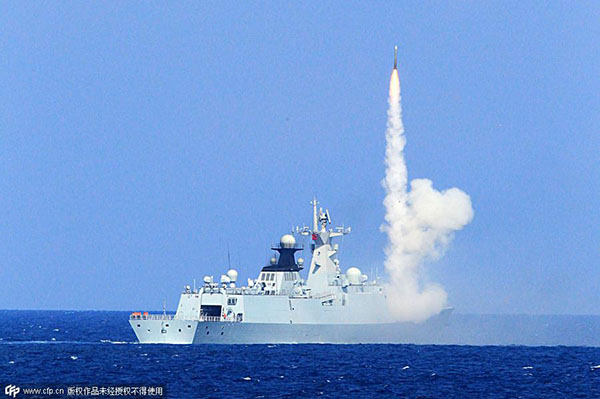
A missile is fired during a Chinese navy drill in South China Sea, July 28, 2015. The ongoing drill is part of the annual exercises, Chinese navy spokespersonLiang Yang said on Saturday, playing down "excessive interpretations." Liang said that such a drill is in line with international laws and practices, and the navy will continue to hold similar drills in the future. [Photo/CFP] |
China's military exercises in the South China Sea have caused international media to explode with fear mongering. There is a need to look at the South China Sea from an objective perspective and discuss the increasing role of other powers in the region to draw some plausible conclusions.
Boundary disputes are common in international relations. 80% of members of the UN have some dispute of boundaries with their neighbors. It's an irony that only a few disputes are covered by the media dominated by the West's strategic communication network, and the South China Sea happens to be one of these.
In the Gulf of Mexico, the United States, Mexico and Cuba have had serious problems in delimiting maritime space between the three nations, especially when it comes to the continental shelf. Spain-Portugal, Ireland-UK, Croatia- Italy- Slovenia, Iran-UAE, Bangladesh-India-Myanmar are just a few examples of maritime disputes affecting international relations and security.
It is also interesting to find that the US always jumps into any dispute (maritime or land), whereever it can draw strategic mileage. Despite being a non-signatory of UNCLOS (United Nations' Convention on Law of Sea), US Extended Continental Shelf (ECS) claim based on UNCLOS methodology views the entire Pacific Ocean as a US lake.
US global hegemony is the main cause of instability around the whole world, as described by Russian Deputy Defense Minister, Anatoly Antonov,quoted by The diplomat on 1st June 2015, "An epidemic of 'color revolutions' swept the Middle East and, like a hurricane, wiped out several states in the region. This disease went across several European countries, where events are freely controlled from the outside".
The US concept of Asia Pivot revolves around isolating China and creating a block of Regional and Extra Regional 2nd tier powers to strategically suffocate China in the 21st century. These 2nd tier powers include India, Australia and Japan. As reported by The Diplomat (a Japan-based online magazine) on 4th March 2015, Abe and Modi have capitalized on their close personal ties with each other – and the increasingly uncertain external environment created by China's bellicose foreign policy.In July 2014, Japan participated in the Malabar exercises, traditionally a bilateral India-U.S. exercise, at India's invitation.


Copyright 1995 - . All rights reserved. The content (including but not limited to text, photo, multimedia information, etc) published in this site belongs to China Daily Information Co (CDIC). Without written authorization from CDIC, such content shall not be republished or used in any form. Note: Browsers with 1024*768 or higher resolution are suggested for this site.
License for publishing multimedia online 0108263 Registration Number: 130349