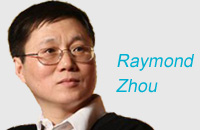
Structural reform has been a heated issue in this year’s G20 summit. Currently many countries are also faced with a series of structural problems, like the limitation and constraint for fostering further reforms brought by the political system and the pressure for revenue and public financing brought by the social welfare system - the room for advancement for deficit is very limited. Could you offer some suggestion to foster the structural reforms?
For any government, developed, developing, or the advanced, all the countries need the continuity of structural reforms. Having said that it’s not easy to implement that, it could be the economic issue, th epolitical issue, the security issue to the implement of the reforms. But staying still is not the answer. The world is moving, it’s a dynamic world, so you need to continue the reform. However, to do the reform, you must have the ability to develop the capacity of the country, but can’t say that I could achieve the reform overnight. And the private sector could be given power, and then regulator should be watching that the public interests could be protected. I’m believed of de-regulation, liberalization and privatization. de-regulation does not mean the deprivation of regulation by government, they still have laws, they still have to oversee, but they should not be micro-managing everything. so structural reform is a central need for every country. No country could afford to stay still, or living in the past. They have to live for the future. Like military, education, health care, talent development, whatever is needed, it should be improved and reconstructed. When I was in Pakistan government, we used to issue one million new phones a month, when we de-regulated it, so we give it to private sector. We have once a provider before, state telephone company, but then we de-regulate it, so this company went down. Who’s been benefited? The people, that’s the purpose of the reform.
And as for the problems of labor market, when the government’s processing the de-capacity in some industries, factories are going to be shut down, workers are laid off, which might cause a lot social problems.And also we’re faced up with aging population, concerns are brought up about the potential labor shortage. How would suggest for this issue?
This is the challenge for the whole world. Developed world and developing world. Governments are trying to deal with it, they are looking up for the problems, and the steel industries are in recession at the moment. Government should provide a social security system for the employees. Employees they must have the ability to eat, to live, to support their families. So many countries they have their own social security systems. If they are unemployed, they could get some minimum wage from the government for a while, and then they could try to find jobs. The fact is, we’re living in a world which has the economic cycles, when the cycle is good, you could create great jobs, when the cycle is bad, the jobs would be finished. So the social safety net is provided in many countries, you may get some allowances. the other side is if there’s no job government could create for the environment, at least provide the minimum wages. Many countries have this program for social security, for social safety net, which allows them and their families to survive.
As premier Li Keqiang put forward in this year’s two sessions, the government would encourage banks with investment banks on debt-to-equity swap, so that doubtful and substandard loans with underlying enterprises positioning in promising sectors could have room to grow. How would you evaluate this strategy?
The debt-to-equity swap is very good suggestion that when the companies have too much debts, and the equity levels are below what they should be, then we could use it to let the banks and investment banks to become shareholders, by converting the debt to equity. And then when the companies become well, every body could benefit form its equity. It could give the company more liquidity to come stronger. So it’s an excellent work to reconstruct. I support it. Positive, supportive, especially for companies in industries which are suffering from the downside trend, it’s a good way to manage the cash flow.
In Pakistan we didn’t use too much debt-to-equity swap, we did some. When I came into government, a lot of companies in downside industries are in trouble, so we restructure a lot of them, we fund the private sector we privatized, we de-regulate the laws, process reform in economic activities. And it was successful effort. Pakistan’s economic growth was accelerated at that time.


I’ve lived in China for quite a considerable time including my graduate school years, travelled and worked in a few cities and still choose my destination taking into consideration the density of smog or PM2.5 particulate matter in the region.

Copyright 1995 - . All rights reserved. The content (including but not limited to text, photo, multimedia information, etc) published in this site belongs to China Daily Information Co (CDIC). Without written authorization from CDIC, such content shall not be republished or used in any form. Note: Browsers with 1024*768 or higher resolution are suggested for this site.
License for publishing multimedia online 0108263 Registration Number: 130349