 |
|
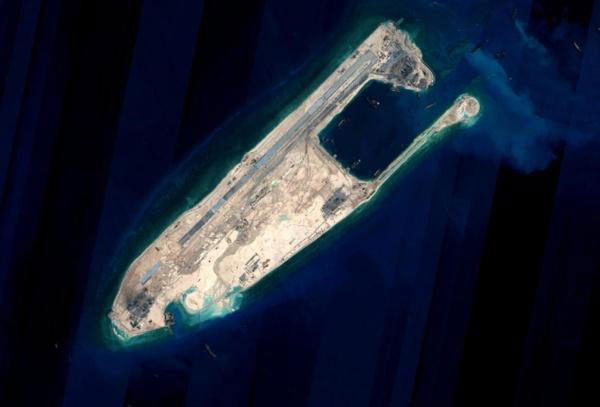
This satellite image shows the Yongshu Jiao of China's Nansha Islands. [Photo/Xinhua] |
China's clear-cut stance in response to the arbitration case unilaterally pushed forward by the Philippines on its dispute with China in the South China Sea can be generalized as "non-acceptance, non-participation, non-recognition and non-compliance".
The arbitration case submitted by the Philippines to the Permanent Court of Arbitration in The Hague is in essence about the territorial sovereignty of some islands and reefs in the South China Sea, a jurisdiction that is beyond the scope of the United Nations Convention on the Law of the Sea and also inapplicable to the Convention's explanations.
Given that land territorial ownership is the legal basis to demarcate the maritime rights of coastal states according to international law, a judgment about maritime rights and interests in the South China Sea can be made only after territorial sovereignty is determined.
In the arbitration case, Manila partitions China's Nansha Islands, and asks the arbitral tribunal to make a ruling on the maritime rights of the islands and reefs "occupied or controlled" by China. However, the maritime rights and interests of the South China Sea islands are inseparable from their sovereignty. According to international law and judicial practices only countries owning sovereignty over islands and reefs in a sea are privileged to claim such maritime rights as an exclusive economic zone or continental shelf in accordance with the Convention. Therefore, only after a country's ownership of islands and reefs is legally recognized, can the Convention or its explanations be applied to the settlement of disputes if other countries question whether that country's maritime claims conform to the Convention or raise their own claim to overlapping maritime rights.
It is also China's stance that the legitimacy of its activities in the waters of the Nansha Islands and Huangyan Island is based on its ownership over these islands and reefs and corresponding maritime rights. In its arbitration case, the Philippines says it enjoys indisputable jurisdiction over the waters where China's "law enforcement" activities are conducted. But the fact is that China and the Philippines have not concluded their maritime demarcation in the sea. So Manila's arbitration application should come after the sovereignty of relevant islands and reefs is confirmed and maritime demarcation is completed.
The Philippines' proposal that the Convention is first used to judge China's maritime rights in the South China Sea even if the ownership of some islands and reefs in the sea is not confirmed is in violation of the general principles of international law and international judicial practices. Any ruling made by the arbitral tribunal under Manila's arbitration request will directly or indirectly make a judgment on the ownership of relevant islands and reefs in the South China Sea, thus unavoidably causing de facto maritime demarcation in the sea.
The unilateral arbitration pushed by the Philippines is also in contravention of the agreements it reached with China, and regional agreements that it is party to such as the Declaration on the Conduct of Parties in the South China Sea.
Any ruling made by the court in The Hague, which is beyond the scope of its jurisdiction, will only add to the escalation of tensions in the South China Sea rather than calm disputes. It will also harm efforts to resolve disputes through talks and the implementation of confidence-building measures, thus making the South China Sea issue more difficult to resolve.
With its forced arbitration case, the Philippines is attempting to repudiate China's territorial sovereignty and maritime rights in the South China Sea, cover up its illegal occupation of some islands and reefs in the sea that belong to China, and smear China's international image. China will not budge from its stance that it will neither agree to talks on the South China Sea issue based on so-called international arbitration nor accept any subsequent appeals or proposals.
The author is director of the Ocean Strategy Studies Center at the Shanghai Academy of Social Sciences.


I’ve lived in China for quite a considerable time including my graduate school years, travelled and worked in a few cities and still choose my destination taking into consideration the density of smog or PM2.5 particulate matter in the region.
Copyright 1995 - . All rights reserved. The content (including but not limited to text, photo, multimedia information, etc) published in this site belongs to China Daily Information Co (CDIC). Without written authorization from CDIC, such content shall not be republished or used in any form. Note: Browsers with 1024*768 or higher resolution are suggested for this site.
License for publishing multimedia online 0108263 Registration Number: 130349