 |
| Song Chen/China Daily |
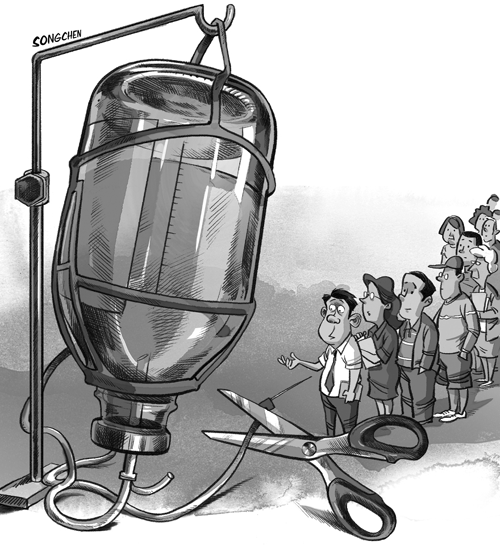
Imagine you have bacterial infection and all the antibiotics prescribed by doctors in the hospital cannot cure it. This is no science fiction scenario about "superbugs"; it is actually happening worldwide. Improper or overuse of antibiotics is proven to be the leading cause of public health problems.
China accounts for half of the antibiotics consumed worldwide, half for humans and the rest for food animals. Antibiotics for long have been available in the country's hospitals to prevent post-surgery and other infections. They are also available over the counter at drugstores which people use for self-treatment-for conditions like cough or a running nose.
Public health experts say the more antibiotics a person has taken the greater the risk he/she has to be infected by superbugs, and urge for strengthened and coordinated government efforts to stop the misuse and address the challenge.
The Review on Anti-microbial Resistance (AMR), published in the United Kingdom this year, estimates that by 2050, AMR (including antibiotic resistance) could cause 1 million premature deaths a year in China.
China's decision-makers have recognized the looming crisis and decided to take coordinated action to prevent it. A State-level action plan on AMR prevention and control will be issued this month by more than 10 departments, including the National Health and Family Planning Commission, the Food and Drug Administration, and the education and agriculture ministries.
Xiao Yonghong, a professor at the Institute of Clinical Pharmacology at Peking University, says the long overdue initiative shows the government's determination to tackle the issue head on.
Previously, the health authorities largely initiated the measures to fight AMR, which included stricter control of antibiotic usage at medical facilities. For instance, last year East China's Jiangsu province became the first province to issue a blanket ban on the use of intravenous antibiotics on outpatients. And provincial health authorities say the ban is working with public awareness about overuse of antibiotics increasing. Other provinces like Zhejiang, Jiangxi and Anhui are likely to follow suit soon. But that's far from enough.
The misuse of antibiotics in the agricultural sector is still widespread, which has been noted by many Chinese experts and even in the UK report on AMR.
To prevent infections in and boost the growth of food animals-most of them reared on feces-filled, cramped farms operators-regularly feed them antibiotics. This has turned the farms into fertile breeding grounds for drug-resistant pathogens that could also threaten humans.
Remember a joint China-US study in 2013? It found "diverse and abundant antibiotic-resistant genes in Chinese pig farms", which could contaminate the soil and water and migrate to humans through food. So the fight against AMR cannot be won without the active involvement of the agriculture sector, for which the use of antibiotics in food animals must be drastically curbed.
Other stakeholders like the environment and education authorities, too, have to join the fight by monitoring the antibiotics contamination level and helping raise public awareness.
There's still a long way to go and the expected government action plan would be a good start to the all-out war on AMR in China. That will also help China fulfill its international responsibility in public health.
Previously, cross-border medical tourism was blamed for the spread of New Delhi Metallo-beta-lactamese-1 (or NDM-1, a bacteria-resistant enzyme) after a British national visiting India for surgery because of the lower cost carried the superbug home. But some non-medical American tourists also carried the superbug home from India.
Be that as it may, but with one-fifth of the world's population, China has to be part of the global fight against AMR. And the global war on AMR cannot be won without China.
The author is a senior reporter with China Daily. shanjuan@chinadaily.com.cn

Copyright 1995 - . All rights reserved. The content (including but not limited to text, photo, multimedia information, etc) published in this site belongs to China Daily Information Co (CDIC). Without written authorization from CDIC, such content shall not be republished or used in any form. Note: Browsers with 1024*768 or higher resolution are suggested for this site.
License for publishing multimedia online 0108263 Registration Number: 130349