Dollar, not yuan, poses biggest risk to world
 |
|
US Federal Reserve Chair Janet Yellen attends a press conference in Washington D.C., the United States, Sept 17, 2015. [Photo/Xinhua] |
Recently, the Chinese currency fell to its lowest level since late 2008. The renminbi has been trading around 6.89 to the US dollar. The plunge is typically explained with the anticipated US Federal Reserve rate increase in December and president-elect Donald Trump's threat to label China a currency manipulator and slap tariffs on Chinese exports.
In reality, there is much more to the story.
In the long term, China's growth will translate to currency power in foreign-exchange markets. In October, the renminbi officially joined the International Monetary Fund's currency reserve basket, known as Special Drawing Rights. In the coming decade, the renminbi will expand rapidly through the IMF reserve basket, the allocations of central banks, and those of public, private, sovereign and individual investors.
After summer, the renminbi's fundamentals improved thanks to positive spillover effects from overcapacity reduction, fiscal stimulus and a boost to export competitiveness, due to weaker exchange rate.
In the fourth quarter, the Chinese currency will also feel the adverse impact of a mild correction of property prices.
The renminbi's short-term volatility is also compounded by the tumultuous global environment and the US dollar. Along with other emerging market currencies, the renminbi must cope with the US dollar, which recently hit a 14-year high, driven by rising US bond yields, expectations of a Trump fiscal stimulus and the impending Fed rate hike. In the process, other Asian currencies-the Japanese yen, Indian rupees, Korean won, Indonesian rupiah and the Malaysian ringgit-suffered a sell-off.
In the long term, the spillovers from the US and Chinese financial markets are likely to have a different impact on financial markets in the Asia-Pacific region. Studies conducted by central banks suggest that in normal times China's influence in the equity has risen close to the US' level, although the relative impact of the US has been stronger during crisis periods.
The influence of China is based on a regional pull, while that of the US reflects a global push. The current crisis favors the dollar, but over time stability will support the renminbi.
Unfortunately, the renminbi, along with other emerging market currencies, must also cope with the dollar's growing risk in the world economy. Before the 2008-09 global financial crisis struck, there was a close correlation between leverage and the volatility index (VIX). When the VIX was low, the appetite for borrowing went up, and vice-versa. That correlation no longer prevails, due to years of ultra-low rates and rounds of quantitative easing by advanced economies' central banks.
Recently, the Bank for International Settlements reported that the US dollar has replaced the volatility index as the new fear index. As the VIX's predictive power has diminished, the dollar has become the indicator of risk appetite and leverage. This dynamic has distressing implications, because it has pushed international borrowers and investors toward the dollar.
And yet, as the dollar's appreciation is exposing borrowers and lenders to valuation changes, the US' fundamentals are eroding, as president-elect Trump himself has acknowledged. The US' sovereign debt has soared to $19.9 trillion. And in the past year, foreign central banks sold almost $375 billion in US Treasuries.
In these conditions, the Fed rate hikes could boost the US dollar as a kind of global Fed funds rate, which would result in dollar tightening and deflationary constraints-which, in turn, could impair emerging economies that today fuel global growth prospects.
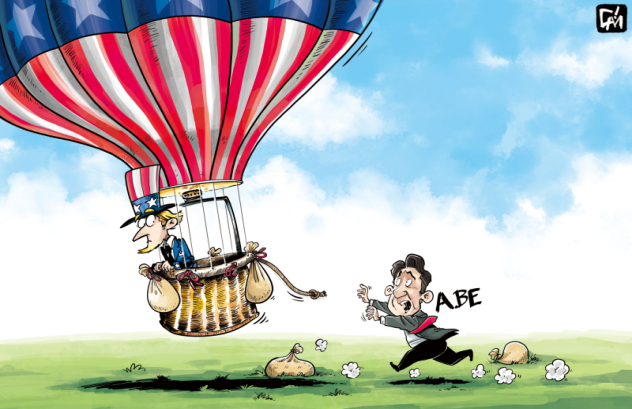
It is not the renminbi but the US dollar that today poses the greatest risk to the global economy and serves as its fear gauge.
The author is the founder of Difference Group and has served as research director at the India, China and America Institute (USA) and visiting fellow at the Shanghai Institutes for International Studies (China) and the EU Center (Singapore).