Goodbye TPP, hello inclusive trade
 |
|
Chinese President Xi Jinping delivers a keynote speech at the Asia-Pacific Economic Cooperation CEO Summit held in Lima, capital of Peru, Nov 19, 2016. [Photo/Xinhua] |
President Xi Jinping has just wrapped up his third visit to Latin America since 2013, which took him to Ecuador, Peru and Chile. During his visit, he also attended the 2016 APEC Economic Leaders' Meeting in Lima.
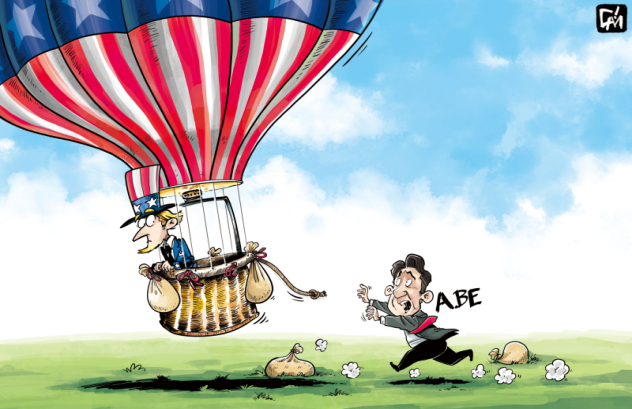
Xi's visits to Latin American countries have injected fresh momentum into bilateral relations. His latest visit came at a time of change in regional economic integration. The United States has elected Donald Trump as its next president, which many believe signals the demise of the Trans-Pacific Partnership Agreement championed by incumbent President Barack Obama. The Beijing-backed Free Trade Area of the Asia-Pacific, on the other hand, has gained support in the Asia-Pacific community, including Latin American countries.
Backed by a regional economic engine, the FTAAP has great potential to reshape the geopolitical landscape and deepen China-Latin America trade ties, which started booming after China became a member of the World Trade Organization in 2001. Under the South-South cooperation framework, China, the world's largest developing country, and Latin America, home to a myriad of emerging economies, have managed to move beyond political and cultural exchanges.
In less than two decades, China has become the second-largest trade partner and third-largest source of investment for Latin America, while Latin America is now China's seventh-largest trade partner. And two-way trade reached $260 billion in 2014, a twenty-fold increase since 2000.
Although the two-way trade fell by 10 percent last year, as China slowed down its growth to suit its economic new normal, as did Latin America's export because of a decline in bulk commodity prices, it is just one side of the story.
The slowly recovering global economy is indeed a speed bump. However, China's non-financial direct investment in Latin American countries reached about $21.5 billion in 2015, registering a year-on-year increase of 67 percent, which can contribute significantly to the sustainable development of the two-way trade. In the long run, therefore, the FTAAP could be an economic boon for Latin American countries.
This year marks a crucial moment in Asia-Pacific economic integration. The ambitious TPP, which was signed by its 12 members in February after years of strenuous negotiations, faces indefinite suspension because US president-elect Trump has vowed to withdraw the US from the agreement on his first day in office. In contrast, parties to the Regional Comprehensive Economic Partnership, an alternative arrangement launched by the Association of Southeast Asian Nations, are striving to conclude the negotiations by the end of this year.
As the beneficiaries of globalization and free trade, some Latin American countries may not be happy with Trump's decision to withdraw from the much-touted TPP. But they might have found relief at the just-concluded APEC meeting, where Xi made clear China's determination to take forward globalization instead of ruining it.
The Lima Declaration on FTAAP marks a landmark achievement for all economies concerned, particularly the Latin American economies, to advance their pursuit of inclusive economic cooperation.
Lima, as Peruvian President Pedro Pablo Kuczynski said, aims to serve as a logistics hub and trade pivot linking Latin America and Asia. Other Latin American economies aspiring to get rid of their economic dependence on the West have good reasons to follow as well.
The author is director of the Center for Latin American Studies and a research fellow at the National Academy of Development and Strategy, Renmin University of China.
- Hopefully death knell for TPP signals US is about to change tack
- TPP doomed from the start
- RCEP has to be more inclusive than TPP
- China ushers in new FTAAP era
- China renews call for building FTAAP as economic globalization falters
- FTAAP top priority for APEC economic leaders in Lima: report
- Xi calls for better connectivity in Asia-Pacific, accelerated construction of FTAAP
- Put FTAAP on the fast track
- FTAAP a timely answer to China skeptics