WTO debacle heralds end of postwar trade regime

When China joined the WTO on Dec 11, 2001, it was written into the agreement that members could treat China as a "non-market economy", due to the size of the Chinese economy, government intervention and its State-owned enterprises. As a result, advanced economies could ignore Chinese domestic price comparisons and rely on "constructed values" to reflect the "true" Chinese economy.
In turn, those "surrogate figures" allowed them to impose heavy anti-dumping duties on the basis that China's low prices did not reflect market realities.
As Dec 11, 2016 deadline for this practice approached, their lobbyists, which represent some of the most uncompetitive companies in a few sectors (especially steel), began to urge WTO members to "reinterpret" the accession language. Now it was argued that in the original agreement there was an "escape clause," which would conveniently justify the continued treatment of China as a non-market economy.
In the past 15 years, the surrogate figures have permitted wide discretion and manipulation of price data, which has been used as basis for anti-dumping charges; that is, tariffs up to 40 percent higher than normal anti-dumping duties.
A few days ago, Japan said that it will not recognize China as a WTO market economy, which will leave tariffs as a ready option against Chinese exports. That is convenient at a time when the reform agenda of Prime Minister Shinzo Abe has failed to reflate the Japanese economy. In turn, the US administration of Barack Obama has stated that the time was "not ripe" for China's market economy status and the European Union has followed its lead.
Such a "reinterpretation" of the WTO rules is very expedient from the standpoint of Washington, Brussels and Tokyo. In the past, it has allowed them to deploy market-restricting figures and methods to shun competition by Chinese companies. As advanced economies are struggling with secular stagnation, it seeks to extend the anticompetitive past practices far into the future.
Yet, this revision of history is relatively new. Through much of the past 15 years, US presidents (Bill Clinton, George W. Bush), US Trade Representatives (Charlene Barshefsky), Secretaries of Commerce (Gary Locke) and key administration figures repeatedly affirmed that the non-MES methodology would expire in due time.
The change came with the Obama administration in 2012 when the US Trade Representative Ronald Kirk reversed its position and affirmed a new "reinterpretation", which reflects protectionist doctrines-even though such a reinterpretation by the EU was contradicted only months before the 2011 WTO Appellate Body decision.
Why the sudden change? The new approach did not emerge in a historical vacuum, but amid the US pivot to Asia, which was developed by then-Secretary of State Hillary Clinton and initiated by President Obama.
In legal terms, the reinterpretation represents the violation of the 2001 agreement, which will be China's chief argument in the to-be-expected legal battle at the WTO.
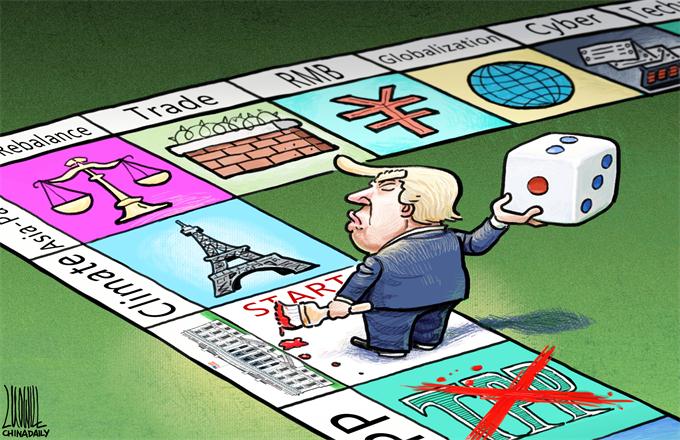
In practice, the Obama administration's reinterpretation of the WTO agreement reflects the kind of geopolitical trading environment that was to emerge with the US pivot to Asia, particularly the Trans-Pacific Partnership Agreement-both of which incoming president Donald Trump plans to redefine or bury to make room for assertive "America first" trading regime.
Through the past 15 years, the US, the EU and Japan have often lectured China and other emerging economies on being "responsible international stakeholders" and the importance of the "rule of law" in international relations. On Sunday, they violated these tenets, which heralds the end of the postwar trading regime and the return of irresponsibility and the rule of might.
The author is the founder of the Difference Group and has served as the research director at the India, China, and America Institute (USA) and a visiting fellow at the Shanghai Institutes for International Studies (China) and the EU Center (Singapore).