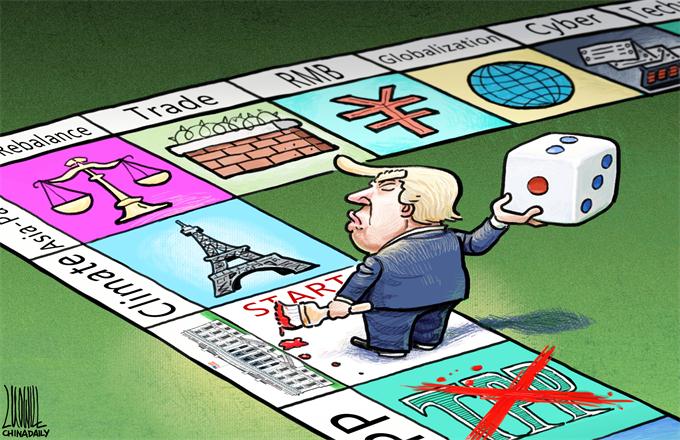
Obama to leave behind mixed policy legacy
 |
|
CAI MENG/CHINA DAILY |
US President Barack Obama's tenure will end next month, leaving behind eight years of roller-coaster China-US ties.
Facing the rise of a big country such as China, the Obama administration's China policy has been multi-dimensional and complicated. Obama established the US-China Strategic and Economic Dialogue in April 2009 and the US-China High-Level Consultation on People-to-People Exchange in November the same year. The two mechanisms have helped deepen mutual understanding even when bilateral ties soured. As such, they are a valuable institutional legacy of Obama.
Thanks to his visit to China in November 2009, Obama became the first US president to visit Beijing in the first year of office. He underplayed the issues of human rights and Tibet, paid greater attention to commerce and trade, and thought highly of Sino-US cooperation, prompting US think tanks to raise the concept of the "Group of 2".
But China was reluctant to accept the G2 concept, reiterating its status as a developing country and its non-alignment principle. The response made Obama better understand the complexity of Sino-US relations and Beijing's resolve to defend its own interests and stance.
Obama's initial policy toward China triggered considerable objection in the US, with many opposition leaders pressing him to change his stance.
The change came suddenly in late January 2010 with the US Defense Department announcing $6.4 billion worth of arms sales to Taiwan. In February, Obama hosted the Dalai Lama in the White House. At the end of 2011, he announced the "pivot" to Asia strategy, which escalated tensions in the South China Sea and East Asia. And to counter China's proposal on regional free trade, he proposed the Trans-Pacific Partnership Agreement.
These changes in the Obama administration's China policy harmed mutual trust, leading to strategic frictions.
Since late 2012, however, the new Chinese leadership has shown greater resolve and capability to safeguard the nation's core interests. In 2013, China marked its air-defense identification zone over the East China Sea and began island constructions in the South China Sea.
The US-supported arbitration case in the Sino-Philippine dispute in the South China Sea intensified the conflict between Washington and Beijing. But the arbitration later proved to be a farce because of China's effective counter-measures.
President Xi Jinping visited the US in August 2013 and proposed building up a "new type of major-country relationship". But Obama has been beating around the concept, possibly because he doesn't want Washington's allies in Asia to believe the US has accepted China as an equal.
Yet despite the increasing trade frictions and political differences between the two sides, their economic and people-to-people relations are becoming stronger. By the end of 2015, the US had invested $77.47 billion in China, and by the middle of this year, China had invested $64.6 billion in the US.
The bilateral trade volume has increased from $298.3 billion in 2009 to $558.3 billion. Last year, people from the US and China made 4.75 million trips to each other's countries, and there are more than 320 direct flights a week between the two countries.
In 2013, China proposed the Belt and Road Initiative (the Silk Road Economic Belt and 21st Maritime Silk Road), to promote shared development along the routes, which is in line with global interests, including that of the US. A bitter fact for Obama to swallow is that he has prevented many US enterprises from benefiting from the initiative by misjudging China's intentions as aggressive and invasive.
China's GDP was 30 percent of the US' in 2009; it is about 50 percent now. This shows Obama's policy to contain China's rise has not succeeded, which should be an important lesson for Trump.
The author is a writer with China Daily. liyang@chinadaily.com.cn