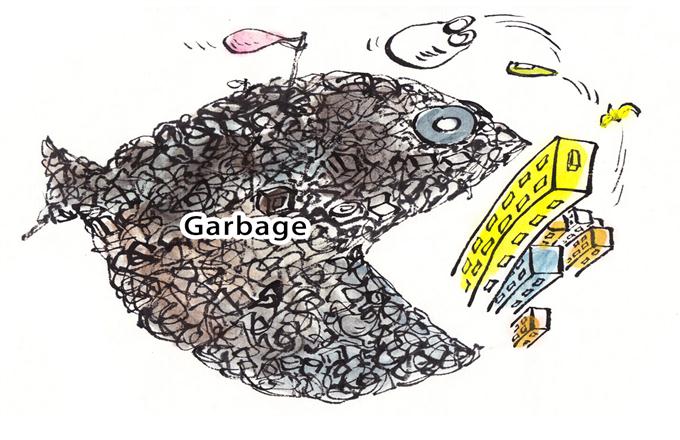
Can overcapacity be avoided by foresight?
 |
|
CAI MENG/CHINA DAILY |

The task of reducing overcapacity, one of the five major goals of supply-side structural reform, will continue to face challenges next year. Since reducing overcapacity relates to structural adjustment, which is a long-term process, overcapacity can hardly be reduced in one stroke.
Making the matter more complex is the fact that industries involved in reducing overcapacity are pillar industries that played a key role in China's rapid economic growth.
So overcapacity reduction and solving the problems resulting from overcapacity demand special attention. Overcapacity can be reduced in a short time by administrative measures, but the reasons behind overcapacity cannot be eliminated overnight. They could again create overcapacity in some industries, leading to similar economic problems in the future.
Overcapacity relates to not only a specific stage of the development cycle, but also an economy's development pattern. First, local governments in China pay too much attention to GDP scale to get "higher scores" for their political performances despite the fact that they reflect neither the quality of economic growth nor people's well-being.
Second, after enterprises rise to a certain level and scale, local governments offer some preferential policies to them and thus transform them into business entities "too big to fail". In fact, when such enterprises face a severe crisis, local governments tend to help them overcome it instead of leaving them to fend for themselves.
Third, many State-owned enterprises have only "soft restrictions", because they enjoy strong support from governments. As a result, many SOEs become low on efficiency: many SOEs carry out projects without considering their economic consequences, because they know the governments are always there to bail them out of trouble.
Fourth, the authorities rely too much on economic stimulation. A slightly faster or slower economic growth is normal-in accordance with the law of economic development. But the governments more often than not try to stimulate the economy, leading many a time to overcapacity.
Fifth, national industrial policies may propel local governments to develop certain industries in the short term. And some local governments and enterprises do use fraudulent means to get industrial subsidies from the central government, leading to overcapacity in certain industries.
Developed market economies face the problem of industrial overcapacity, as well. But their sound market-economy systems prevent them, in most cases, from using administrative measures that lead to overcapacity.
The core of market economy is sound microeconomic individuals or entities, which enjoy clear property rights and are subjected to laws. This means enterprises use their own money to do business, making them sensitive to overcapacity. And since they are aware of the risk of overcapacity, they do not invest excessively to produce goods whose demand is not sustainable in the long run and, instead, seek to invest in other areas.
Moreover, many market economy mechanisms such as mergers, reorganizations, and declaring bankruptcy could solve the overcapacity problem for many enterprises at an early stage. Mergers, in essence, are redistribution of social resources based on the principle of market and efficiency. By declaring bankruptcy, an individual or an enterprise sets social resources free for reuse by others, which is also a solution for the enterprises that cannot survive in the market.
Economic downturn in more ways than one eliminates outdated industrial overcapacity, which is a reflection of the market. This phase will force enterprises to innovate and upgrade, because only better and more advanced products can capture the market again.
To avoid the economic problems resulting from overcapacity, enterprises have to take multiple measures. And if administrative measures are used to correct the market, the government should make more efforts to improve the market economy mechanism so as to prevent overcapacity.
The author is a professor of economics at Renmin University of China.