News Analysis: US-Russia ties hardly to break spell of bell-shaped development
BEIJING, Jan. 6 (Xinhua) -- Great uncertainties remain on whether the U.S.-Russia ties can sustain long-term stable development, even after Russia-friendly U.S. President-elect Donald Trump takes office.
Analysts say it is possible the U.S.-Russia relationship will fall again under the spell of bell-shaped development since the end of the Cold War, as structural contradictions exist between the two countries due to total difference in their global strategies, national security and geopolitical interests.
Since the end of the Cold War, the United States, with a strategy of contacting while containing Russia, has not fundamentally changed its policies of weakening and suppressing Russia.
In international affairs, Washington usually neglects Moscow's interests on issues concerning Russia's security and strategic interests; while Moscow opposes U.S. hegemonism and unilateralism, and hopes to set up a new global political order to safeguard Russia's national security and geopolitical interests.
SPELL OF BELL-SHAPED DEVELOPMENT
Since the end of the Cold War, U.S.-Russia relations have experienced bell-shaped development -- improving first and deteriorating later -- during the U.S. administrations of George Bush, Bill Clinton, George W. Bush and Barack Obama.
During Obama's first tenure, ties between Moscow and Washington were relieved after the two countries signed the new Strategic Arms Reduction Treaty in April 2010, then Russian President Dmitry Medvedev visited the United States in June 2010 and Russia joined the World Trade Organization in 2011.
However, bilateral ties were not able to break the spell and even plunged into the so-called "new Cold War."
Washington criticized Russia's parliamentary and presidential elections. It urges other Western countries to jointly isolate Russia, impose economic sanctions on Russia and suspend Russia from the Group of Eight following the Ukraine crisis and Crimea's incorporation into Russia.
NATO, RUSSIA'S IRRECONCILABLE DIFFERENCES
The relations between U.S.-led NATO and Russia have experienced ups and downs due to the irreconcilable structural differences between the two sides.
Russia hopes to prosper again, which is hardly accepted by many NATO members especially the United States and Central and Eastern European countries. Therefore, NATO, holding a strategy of containing Russia, has considered Russia as a strategic rival and has been suppressing it.
Besides, NATO wants to foster the basis for common strategic interests among its members through establishing and even consolidating the so-called "Russia threat."
NATO and Russia have differences on issues such as the U.S. and NATO's plan to increase military deployment in Central and Eastern Europe, the Ukraine crisis, NATO's eastward expansion and the bloc's European missile defense system.
The NATO-Russia ties, affected by the U.S.-Russia ties to a large extent, however, are more complicated. The United States has to consider its European allies' stances while Central and Eastern European and Baltic states have firmly called for the U.S. fulfillment of its commitment to its allies on security.
Observers say that after Trump takes office on Jan. 20, the U.S.-Russia ties will improve and the NATO-Russia ties will ameliorate as well.
However, as long as deep differences between NATO and Russia exist, NATO will not abandon its strategy of weakening Russia and encroaching on Russia's geopolitical strategic space, which will determine to what extent the United States and Russia can improve their ties.
DIFFICULTIES IN COOPERATING ON SYRIA ISSUE
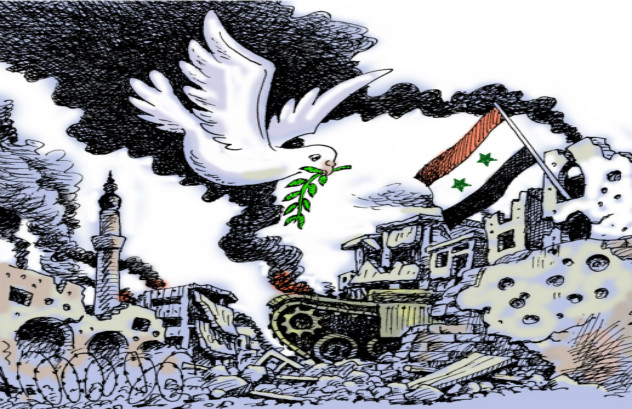
Trump's policies on Syria he advocated in the presidential campaign, such as abandoning U.S. policy of overthrowing other countries' governments and fighting terrorists, have offered possibilities of U.S.-Russia cooperation on the issue.
However, there are uncertainties about whether the two countries can cooperate in the end and to what extent they can cooperate.
First, with the development of the Syria war, the influences of the United States and Russia on the Middle East have been in a waxing-and-waning state. Will Trump, who pledged to "make America great again," abandon the Middle East and concede it to Russia?
Second, even if Trump agrees to cooperate with Russia on the Syria issue, who will lead the cooperation is a question. It is not possible that Russian President Vladimir Putin will concede Moscow's leading role on the issue to Washington. But will Washington still cooperate with Moscow under Russia's leadership?
Besides, Trump will face issues such as whether he can change the negative impression Russia and the Syrian government have left on the U.S. public opinion, whether Gulf Arab countries that have deep contradictions with Russia on the Syria issue give up their appeal for Syrian President Bashar al-Assad's resignation and stop supporting the Syrian opposition, and whether Gulf countries will pay for building a "safe zone" in Syria.
Furthermore, it is not easy for Trump to improve the U.S.-Russia ties as the U.S. policy on Russia has been decided by bipartisan political elites since the end of the Cold War and the pro-establishment camp including mainstream Republicans will contain Trump's pro-Russia tendency.