Duplicity, thy other name is Japanese policy
 |
|
The Japanese embassy in the UK is seen in this file photo taken on March 6, 2008. [Reuters/Toby Melville] |
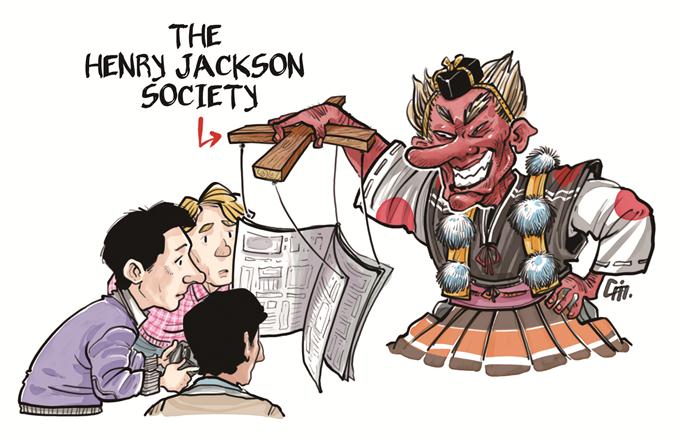
On Jan 29, The Sunday Times reported that the Japanese embassy in Britain had been paying £10,000 ($12,480) a month to Henry Jackson Society, a registered charity, to encourage British politicians and journalists to oppose China's foreign policy. One such opposition came from Britain's former foreign secretary Malcolm Rifkind. The headline of the article Rifkind purportedly authored for The Daily Telegraph in August read: "How China could switch off Britain's lights in a crisis if we let them build Hinkley C".
The Henry Jackson Society reportedly approached Rifkind with a prepared article, asking him to read and (if need be) amend it. The Daily Telegraph then published the article with Rifkind's permission.
Since the article was published before Britain gave the go-ahead to China and France to build the Hinckley Point C nuclear power plant, it raised public fears over "backdoor technologies" being introduced in a nuclear power plant.
Was the article aimed at helping Japanese companies, which were also bidding for the project, to bag the deal? And was a Japanese company paying the monthly "honorarium" to the Henry Jackson Society? Either way, the Japanese embassy's deed qualifies as a political scandal.
So far, the Japanese government has kept silent over the incident. The Japanese embassy in Britain told China Daily through an email that it "is not in a position to comment on the article since it is about the activities by a British private entity which do not concern the embassy". And Japanese media outlets have ignored it.
It appears Western think tanks and the Japanese media are not as independent as they claim to be. Money and political clout make a powerful concoction.
Many Chinese people already believe Japan is a past master at striking underhand deals and disowning its contemptible behind-the-curtain actions.
What makes this scandal different, however, is that it has been exposed by a Western media outlet.
Had a Chinese newspaper done so, the Japanese government would probably have trashed the report and accused China of trying to frame it.
But thanks to centuries of China-Japan interactions, the Chinese people are too familiar with these tricks-from Japan's invasion of Northeast China during the Qing Dynasty (1644-1911) to the Diaoyu Islands dispute in the East China Sea.
For United States citizens, the bombing of Pearl Harbor in 1941 gave them a taste of this duplicity, which saw overt and amiable Japanese diplomatic talks going on well with covert but intense military preparations till the last minute before the attack. As US anthropologist Ruth Benedict argues in The Chrysanthemum and the Sword, such duplicity has its origin in Japanese people's inexplicable, if not congenital, fear of the unknown and the sense of shame that usually comes with failure.
To avoid failure, Japanese people make very thoughtful preparations and plans, but it is very difficult for them to accept failure, even if it is temporary. That the Japanese tend to use many self-deceptive or even immoral practices to hide, dilute or ignore their failures-be they in war or business-puts them in a state of constant anxiety and nervousness.
In their language, Japanese call the day they surrendered to the Allies in World War II as a day of "war's end"-no place for surrender or defeat. But when it comes to victories, they term those against the Qing Dynasty in 1894 and Russia in 1905 as glorious.
Last month, 73-year-old Toshio Motoya, president of APA Group of hotels, and 69-year-old Takashi Kawamura, mayor of Nagoya, denied that the Japanese army had perpetrated the Nanjing Massacre or forced women into sexual slavery during World War II.
Are they really ignorant of history? Or were they trying to whitewash it? And were they whitewashing history because they were defeated in the war or because of the shame of being exposed?
Aping an ostrich is not going to help Japan, especially in its relations with China. Only when it owns up to its war past and accepts China's rise as the present reality can Japan succeed in building a brighter future.
The author is a writer with China Daily. liyang@chinadaily.com.cn