The uneven story of US-Japan relations
 |
|
US President Donald Trump (R) and Japanese Prime Minister Shinzo Abe pose for a photograph as they walk to board Marine One departing for Andrews Air Force Base en route to West Palm Beach, Florida, after their joint press conference at the White House in Washington DC, US on Feb 10, 2017. [Photo/Xinhua] |
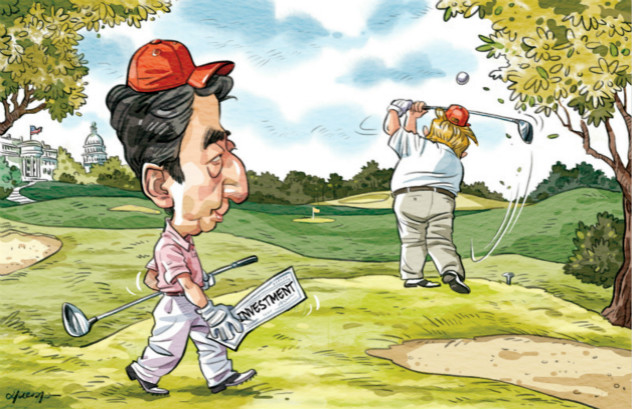
Japanese Prime Minister Shinzo Abe has just concluded a visit to the United States. His meeting at the White House, and a private dinner at the Mar-a-Lago Club (the "Winter White House"), as well as a round of golf on Florida's Palm Beach with US President Donald Trump seem to make him feel honored.
In November, when Abe met Trump, he gifted the then president-elect a luxury, gold-colored golf driver. This time, Abe carried a much more precious gift for Trump, in the hope of putting the Washington-Tokyo alliance back on track.
Trump's remark during the campaign trail that Japan was manipulating its currency to steal US jobs had made Abe rather nervous, and his threat to bring the US troops home if Japan did not pay the entire cost for the deployment of US armed forces there had perturbed Abe. And that Trump withdrew the US from the Trans-Pacific Partnership agreement on his first day in office might have made Abe feel the new US president actually meant what he said on the campaign trail.
So to please his Washington host, Abe promised to invest $150 billion in the US to "bring" 700,000 jobs to the country. In return, he managed to secure the US' reassurance of defending Japan. He also agreed with Trump to negotiate the bilateral economic framework now that the US has abandoned the TPP.
But Washington's "gifts" for Tokyo seem hollow in comparison to the gift basket Abe presented to Trump.
Trump's decision on the TPP has made Japan not only lose the opportunity to conduct more business in a regional free trade grouping, but also miss the chance of promoting its trade at China's expense.
On the mutual defense front, Trump did reassure Japan that the US remains committed to the Washington-Tokyo security treaty, and that it will use conventional as well as nuclear force to do so. This is not a new assurance from the US, however.
The Washington-Tokyo unequal mutual defense agreement dates back to 1950s, under which the US is committed to defending Japan. And since the US' military umbrella already covers Japan, Washington's offer of nuclear protection is nothing new.
Besides, Tokyo has to yield many rights to Washington, including allowing US forces certain extraterritorial rights in Japan, which undermine Japan's sovereignty and dignity. In this sense, Abe's redoubled effort to win Washington's reassurance merely affirms that Tokyo remains the minor partner in the US-Japan security deal.
Moreover, despite getting the US' reassurance, Abe failed to prompt Trump to use the US-Japan defense treaty to declare the Diaoyu Islands as Japan's territory. Unwilling to accept the disputed islands are Japan's territory, the US has maintained its neutral position on this critical sovereignty issue, much to the dismay of Abe. But then the US said the US-Japan security treaty covers the Diaoyu Islands.
The fact that Japan has to work with the US through a bilateral mechanism in the future will be a big challenge for Abe, particularly while facing a US president who has vowed to "Make America Great Again" at any cost. As part of the agenda for his visit, Abe might have hoped of persuading Washington to be critical of Beijing. But he failed in this mission, as Trump made a "cordial" phone call to President Xi Jinping on the eve of Abe's visit, reaffirming the US' commitment to the one-China policy and later said he was sure a good China-US relationship was also good for Japan.
Despite his campaign rhetoric, Trump seems to be learning the rules of the game, and is likely to manage a delicate trilateral relationship with China and Japan. There is a lesson here for Abe: there is limit to which one can drive a wedge between China and the US.
The author is a professor at and associate dean of the Institute of International Studies,
Fudan University.