 |
|
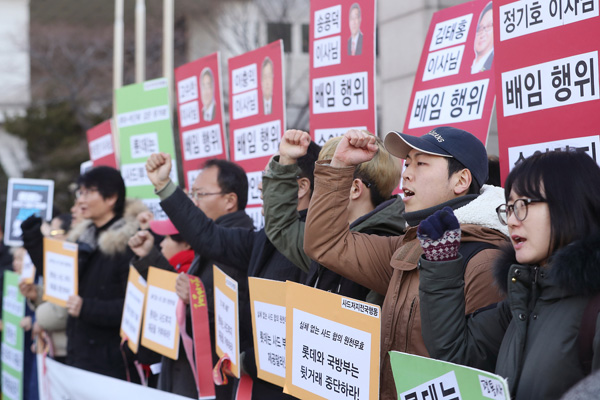
People gather to protest the land swap contract between the military and Lotte Group in Seoul, South Korea, Feb 27, 2017. [Photo/VCG] |
The United States and the Republic of Korea began their annual military exercises, codenamed Key Resolve and Foal Eagle, on the Korea Peninsula earlier this month. Simultaneously, the US has resorted to war rhetoric, fueling concerns over the already volatile situation on the peninsula.
While the Key Resolve is a computer-simulated exercise and will last two weeks, Foal Eagle will continue until April with thousands of US and ROK troops taking part in it, and the scale of the drills is unprecedented.
In a related development, during his first visit to Seoul last week, US Secretary of State Rex Tillerson said the Donald Trump administration will take "a different approach" to the Democratic People's Republic of Korea's nuclear issue, stressing that "all options are on table", including military action, though he added that that was not the desired option.
Tillerson's remarks mark a major departure from the decades-old US policy on the DPRK, which has been a combination of containment and on-and-off engagement. The US has used economic sanctions and political pressure in the past in response to the DPRK's nuclear and missile tests. And once the US decides to not tolerate the DPRK's provocations, the Korea Peninsula will be one step closer to war. This scenario will benefit none of the stakeholders in the Asia-Pacific region, as its consequences will be unbearable to all.
As a close neighbor of the DPRK, China has repeatedly urged the other stakeholders to exercise utmost restraint and refrain from making any more reckless moves.
Foreign Minister Wang Yi recently put forward a new proposal to break the impasse on the peninsula. He urged the DPRK to suspend its nuclear and missile programs, while asking the US and the ROK to halt their large-scale military exercises. But, so far, China's suggestion has not elicited any positive response.
Obviously, Washington and Seoul are stuck in a vicious circle-of responding to an arms threat with a counter-threat. The decision to deploy the Terminal High Altitude Area Defense anti-missile system in the ROK is the result of this mindset, and gives the DPRK an excuse to continue pursuing its nuclear and missile programs.
The decision to deploy THAAD has also become a sticking point in Beijing-Seoul relations, as China sees it as a tool to spy on the Chinese territory. And a deterioration in Beijing-Seoul ties serves the interests of neither country and may cast a shadow on East Asia cooperation as well.
China is the ROK's largest trading partner, the largest destination for its overseas investment and its largest source of overseas students. Also, the ROK is one of China's most important partners in investment and trade and people-to-people exchanges. Beijing-Seoul ties are passing through a difficult phase as a result of the ROK agreeing with the US to deploy THAAD disregarding China's genuine concerns and interests.
Many in China also believe THAAD is part of the "pivot" to Asia policy of the previous US administration, which still serves Washington's purpose of hedging against Beijing.
In recent years, the US has strengthened its military alliances in the Asia-Pacific apparently to contain China's rise. And there is little doubt that the US' military alliances with the ROK and Japan have assumed greater importance for implementing its regional strategy.
By deploying the anti-missile system in China's neighborhood, the US can complete the missing link in its global missile defense system as well as contribute to its strategic maneuvering in the Asia-Pacific. What the US allies don't realize is that, after becoming the US' partners in its strategic games, they will have to face the backlash of countries like China and Russia in the region. Seoul's icy relations with Beijing are a case in point.
The onus is on Washington and Seoul to change the situation; they should have faith in negotiation, as it is the only way the DPRK can be made to see the necessity and importance of peace. Using war rhetoric and taking provocative actions will lead us nowhere.
The author is a senior writer with China Daily. wanghui@chinadaily.com.cn


Last weekend, I was hanging out downtown with a friend and my sister. We were walking through a public spare when all of a sudden a heated argument between a student and a middle-aged woman arrested our attention.

Copyright 1995 - . All rights reserved. The content (including but not limited to text, photo, multimedia information, etc) published in this site belongs to China Daily Information Co (CDIC). Without written authorization from CDIC, such content shall not be republished or used in any form. Note: Browsers with 1024*768 or higher resolution are suggested for this site.
License for publishing multimedia online 0108263 Registration Number: 130349