Give skilled workers the respect they deserve
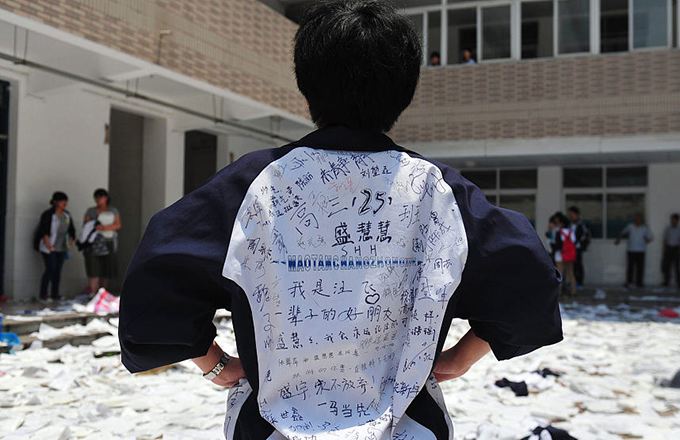
Compared with the recently concluded annual college entrance examinations, or gaokao, which was taken by 9.4 million students, a contest concurrently held in Shanghai and Suzhou, East China's Jiangsu province, that brought together youths from across the world for a skills' competition invited much less attention.
Most of the participants in the 2017 global skills' competition graduated from vocational schools. However, compared with those who passed gaokao and are considered by many as the "favored sons of God", the vocational school graduates seemed more proud of their professional skills. The event simultaneously held in Shanghai and Suzhou was the first large-scale global contest for skills hosted by China, which has participated in three previous such events and won five gold medals at the 43rd WorldSkills Match Sao Paulo, Brazil, in 2015.
The importance attached by the Chinese government to skilled labor highlights its resolve to transform China from a "big manufacturing" to "powerful manufacturing" country, for which a large number of highly skilled workers are needed. According to media reports, skilled workers are in short supply in China, which, to a large extent, can be attributed to the lack of social respect for skilled labor.
Thanks to the promotion of the "Made in China 2025" strategy, the inclusion of the "spirit of craftsmanship" in the Government Work Report and manufacturing enterprises' efforts to raise their standards, the salary and social status of skilled workers have been rising and a healthy relation is being formed between vocational education and the real economy.
But Chinese society's inherent discrimination toward skilled labor has not changed. Many Chinese still believe entering a college is the best way for a person to climb up the social ladder. And they still see a blue-collar worker, no matter how skilled he or she is, as second best, if not a failure.
Even if senior blue-collar workers earn several times more than white-collar workers, they are still considered inferior social beings. Such a perception largely stems from people's belief that white-collar workers make larger contributions to society. And that is the problem.
Statistics show that highly skilled workers account for 27.3 percent of all skilled workers in China, compared with more than 40 percent in some advanced economies. In previous WorldSkills matches, most of the medals for automobile technology, car spray-painting, aircraft maintenance and even bricklaying were won by skilled workers from industrialized countries such as Britain, Australia and Japan. And it is skilled workers who have largely helped these countries evolve into manufacturing powers.
The question is: How can China encourage more youths to accept that skilled workers are also talents and make equal, if not greater, contributions to the country's development? To begin with, China should cultivate a vocational culture that respects blue-collar workers. In these regard, Shanghai has made extensive efforts to improve vocational education, an example that other cities and provinces should follow.
In recent years, an organic combination of educational mechanism has been introduced to elementary and middle schools to make students aware of the advantages of vocational education and sharpen their vocational skills. The incorporation of the "spirit of craftsmanship" into basic education will also help them abandon their prejudice against blue-collar jobs.
To accord blue-collar workers more social respect, China's vocational education system must follow the trend of the times. Vocational education should not only cultivate traditional craftsmanship, but also add value to emerging technologies and industries. At the 2017 WorldSkills Match in Shanghai and Suzhou, 21 different skills were on show in which contestants not only displayed their skills in areas such as carpentry and welding, but also demonstrated their expertise in virtual-reality technology, smart building techniques and robotic technology. The event also showed innovation is becoming a key part of competition.
The social status a society accords to its skilled workers reflects its value orientation and attitude toward its workers in general. Only by building a cultural atmosphere that respects and favors skilled labor can China realize its dream of becoming a modern manufacturing powerhouse.
This article was originally published in People's Daily.