 |
|
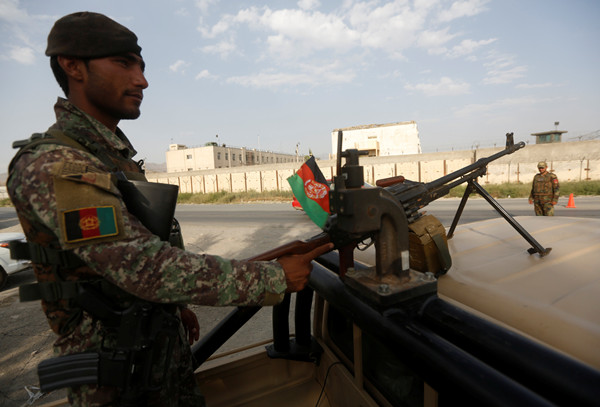
An Afghan National Army (ANA) soldier keeps watch at a checkpoint in Kabul, Afghanistan, August 22, 2017. [Photo/Agencies] |
Instead, Trump is expected to beef up the United States’ military presence in the country. Although Trump stopped short of mentioning a number, he authorized US Defense Secretary James Mattis in June to deploy as many as 3,900 extra troops.
Currently, the US has about 8,400 troops in Afghanistan, part of an international force that is roughly 13,500 strong that is training and assisting Afghan forces to fight the Taliban, and conduct counter-terrorism missions. But, even with the proposed increase in US troops, the Taliban is unlikely to be contained, let alone rooted out.
Yet compared with what the US has done to fight terrorists in the Middle East in recent years, the new US strategy does represent a greater willingness to shoulder more security responsibilities in Afghanistan. Military aid and airstrikes, but no ground troops, marked the previous US administration’s strategy in the Middle East, with Barack Obama unwilling to maintain a military presence in the region.
Despite that, much headway has been made this year in the international campaign against the Islamic State terrorists in both Iraq and Syria. Under such a backdrop, a greater US presence in Afghanistan will help Afghanistan forces improve the country’s security situation and prevent defeated IS terrorists from entering into the country and colluding with the Taliban.
However, since Trump asserted, “We are not nation-building again. We are killing terrorists”, his Afghanistan strategy obviously lacks a long-term commitment to the Central Asian country. Many in Afghanistan and elsewhere are justified to feel disappointed about it as the US has a responsibility to clean up the mess it has created in Afghanistan.
Despite the fact that George W. Bush claimed “mission accomplished” two years after he unleashed the Afghan war against the Taliban in Oct 7, 2001, and Obama announced an end of the war and the US withdrawal at the end of 2014, the war in Afghanistan has never come to an end.
The country’s security situation has continued to worsen after Obama withdrew the majority of the US forces. Now, hardly a day has passes without civilian casualties in Taliban instigated attacks, and the country has set one record after another in humanitarian disasters over the past few years.
For the US, its longest war has been fought at a formidable price: Some 2,400 Americans have died in the war, more than 20,000 have been wounded and the conflict is estimated to have cost almost $1 trillion
Yet, despite the toppling of the Taliban regime in late 2001, the US and its allies have spent most part of the 16-year-old war playing cat and mouse games with the Taliban. And, more ironically, over the years the land controlled by the terrorist group in Afghanistan has increased instead of being diminished.
As such, dispatching a further several thousand troops to Afghanistan will not be enough to end the conflict in the country once and for all. Instead, the US should learn the lessons from Iraq.
After the US invaded and toppled Saddam Hussein, its withdrawal left a political and security vacuum in the country. Political instability and factional rifts in post-war Iraq provided a hotbed for the rapid growth of the IS group, which later spread into Syria, and inspired terrorist attacks elsewhere.
The US should understand no country alone can tackle the challenge of terrorism. Before it plunges deeper into another Afghanistan quagmire, the US should truly reflect upon its anti-terror strategy and cooperate with other countries in jointly fighting terrorism.

Copyright 1995 - . All rights reserved. The content (including but not limited to text, photo, multimedia information, etc) published in this site belongs to China Daily Information Co (CDIC). Without written authorization from CDIC, such content shall not be republished or used in any form. Note: Browsers with 1024*768 or higher resolution are suggested for this site.
License for publishing multimedia online 0108263 Registration Number: 130349