Tackling rising natural disasters
 |
|
A local resident walks across a flooded street in downtown Miami as Hurricane Irma arrives at south Florida, US, September 10, 2017. [Photo/Agencies] |
The past few weeks have been a grim reminder that natural disasters know no borders. They can strike countries at opposite ends of the globe simultaneously and whether in Asia or North America, the images of people and livelihoods being swept away are disturbing.
Intense monsoon floods, Typhoon Hato, Hurricane Harvey and Hurricane Irma all raise questions about what more can be done to both mitigate the risks of extreme weather conditions and improve relief operations.
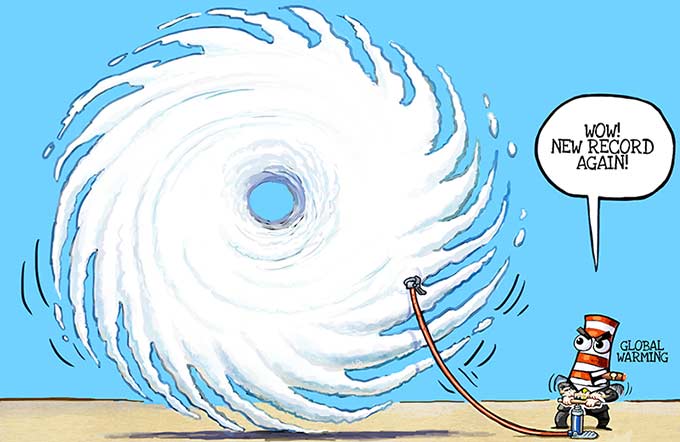
Disasters are becoming more frequent and intense. The UN Economic and Social Commission for Asia and the Pacific, in its recent report," Disaster Resilience for the 2030 Agenda for Sustainable Development: Leaving No One Behind", shows natural disasters were responsible for the loss of 2 million lives and cost the region's economy $1.3 trillion between 1970 and 2016. Over 90 percent of the deaths were due to earthquakes, tsunamis, cyclones and floods. The poor and vulnerable bore the brunt of these disasters, suffering a death toll five times higher than the rest of the population.
By 2030, 50 percent of the Asian population will be living in urban areas. The combination of unplanned urban sprawl and new cities means increasing numbers of people and economic stock will be exposed to future disasters we cannot predict. In megacities, more than 50 percent of the population already lives in disaster-prone areas where inequality is high.
Our focus must be on identifying potential scenarios, determining risk tolerance levels and building response capacity where it is inadequate. Policymakers need to strengthen the science and policy interfaces to allow countries to deal effectively with these risks. The report offers a clear set of recommendations on how to build resilience and reinforce sustainable development in the region.
The importance of early warning cannot be overemphasized. In 2004, the world experienced the Indian Ocean tsunami. It killed more than 250,000 people and was one of the deadliest natural disasters ever recorded. Unlike the Pacific Ocean, the Indian Ocean had no early warning system in place for coastal communities. Thanks to a founding contribution of $10 million from Thailand, the ESCAP Trust Fund for Tsunami, Disaster and Climate Preparedness, has helped to plug this gap.
But for a tsunami warning system to be sustainable, it needs to address multiple coastal hazards. Regional cooperation can help share vital innovations in science and technology to strengthen tsunami early warning systems. ESCAP's Trust Fund has helped to empower people through improved early warning of disasters and supported knowledge transfer from countries with strong disaster risk management capabilities to other Asia-Pacific countries. To take just one example, technical support, modern equipment and online technologies helped upgrade the Myanmar National Earthquake Data Center, to meet international standards for tsunami warning centers.
ESCAP, in collaboration with the Ministry of Foreign Affairs of Thailand, organized an event at the 72nd session of the UN General Assembly, entitled "Disaster Risk Reduction in Asia Pacific: Achievements in Regional Cooperation for Tsunami, Disaster and Climate Preparedness", to explore these issues further. The session was held on Sept 21, further presenting ESCAP's research and showcasing the ESCAP Trust Fund's contribution to building people's resilience to disasters, so that no one is left behind in the pursuit of the UN Sustainable Development Goals.
The author is an under-secretary-general of the United Nations and the executive secretary of the Economic and Social Commission for Asia and the Pacific.
- Troops from PLA Macao Garrison mobilized for typhoon Hato disaster relief in Macao
- Xi expresses condolences over mudslide disaster in Sierra Leone
- Moments of heroism during disaster
- China increases natural disaster recovery fund
- Asia faces disaster from soaring temperatures if climate change unchecked
- What lessons can be learned after disaster?