My life in medical research
 |
|
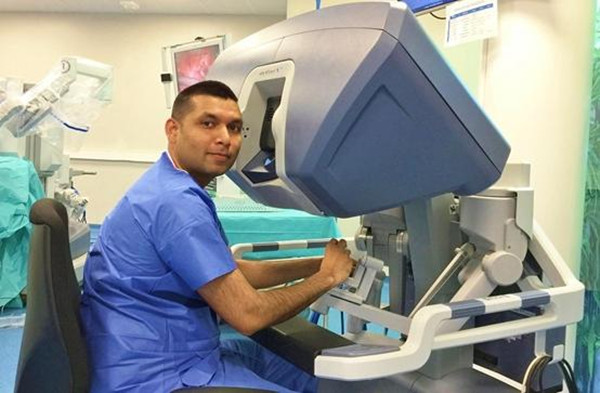
Muhammad Shahbaz Ali [Photo provided to chinadaily.com.cn] |
China has made great progress socially and economically. I witnessed the transformation since I was in China in 2006. The houses became buildings and buildings became skyscrapers and the now once you enter any city in China, it looks like the jungle of clones of buildings. The same situation is true for the hospitals. New hospital buildings were constructed throughout China, and I witnessed the construction of Qilu hospital, which was completed in just a couple of years.
I was born in Pakistan, received higher education in China and I'm now in France for a fellowship in minimally invasive and robotic surgery. Since its approval as the first robotic surgery system by the US Food and Drug Administration in 2000, the Da Vinci Robotic System has changed the concept and experience of surgery for people around the world, making an operation more precise and less painful, with less bleeding and a short hospital stay. China has made giant leaps in the medical field, as it has done in other fields. The progress in minimally invasive surgery is excellent. Da Vinci is an advanced robotic system to perform complex procedures with precision. It is the third generation of surgery after the second generation of laparoscopic surgery debuted in 1987 and the first generation of open surgery began long ago in human history.
Statistics from Da Vinci's producer, Intuitive Surgical, state that 54 Da Vinci surgical systems have been installed throughout China and 800 medical personnel are trained to operate the system. As of the end of December 2015, more than 40 Chinese hospitals had installed over 50 surgical robots and performed 11,445 cases of surgery in 2015 and 22,917 cases over the years cumulatively. With recent developments in medical technology, more and more systems will be installed. China is one of the leading countries that has a large number of the Da Vinci Robotic Systems installed and used for surgeries. Da Vinci simulators are being used to train doctors with advanced surgical skills.
In my opinion the Belt and Road,Inititive can be an opportunity for health sector development in the region for the countries involved in the project. Especially for Pakistan, I see it more from the healthcare point of view. I also hope that the corridor will bring healthcare facilities and infrastructure cooperation to Pakistan from China. I have re-named it the CPHC - the China-Pakistan Health Corridor, or simply, "The Health Corridor".
Another field our research team focused on is to find methods to make cancer treatment more effective, such as targeted therapies, which are drugs that interfere with specific molecules involved in cancer cell growth and survival. We tried to explore the precise information about the role that targeted therapies play in precision medicine and how targeted therapies work against cancer, who receives targeted therapies, common side effects, and what to expect when having targeted therapies.
The main members our team, including Liang Benjia, Gao Huijie, Wu Junben, NiuZhengchuan, Peng Cheng and myself, conducted the research under the supervision of Professor Niu Jun. Professor Niu has been working on novel and exciting research for the last two decades. Under the supervision of my tutor and mentor Professor Niu, I have learned surgical skills and have actively participated in academic research work.
In 2009 I attended the 22nd International Conference of Lymphology and Oncology and I won the best young scientist speaker award. There is a famous saying that, "I can have cancer but the cancer cannot have me". In the process to find new methods of treatment and make the existing methods of treatment more effective, we conducted the research on a variety of cancers, which were mainly pancreatic cancer and colon cancer.
There are different kinds of ways we can contribute to scientific society. One is basic research, the second is translational medicine, and the third is clinical research. The successful application of each method can improve the prognosis of disease. And we also can put different methods of treatment together in the form of adjuvant therapy to increase the efficacy of the treatment.
There were tears in my eyes as a young girl told Professor Niu, "Wo tong guo le," which means "I passed the exam." One month before, he had told the patient, "You can participate in the gaokao." It was the whole team of our general surgery department, headed by Professor Niu, that celebrated the happiness that we successfully operated on the 17-year-old girl with thyroid cancer metastasized to the lungs. She wanted to take the exam; it was on June 7, 2013. She had been admitted to our ward on May 15. She had the option to come after the exam, or operate; however, as the cancer could spread to other parts of her body if she chose a later date, she opted to go for the operation, to be done on May 20. The successful surgery was done and she was able to speak within a few days of the operation. She was discharged from the hospital on May 27, 10 days before the exam.
Visiting L'Institut de Recherchecontre les Cancers de l'Appareil Digestif (IRCAD) in France, was also a great experience to learn about innovation, precision and minimally invasive surgery and robotic surgery. In April 2007 Professor Jacques successfully performed scarless surgery, also called as NOTES (Natural Orifice Translumenal Endoscopic Surgery); in this kind of surgery we approach the diseased part from the natural opening of human body, e.g. the mouth, or anus, to resect the diseased organ and remove it through the natural opening. The technique was brought to China and the first such kind of operation was performed by a team of surgeons, gynecologists and gastroenterologists headed by Professor Niu in 2009. I feel it is my honor to learn minimally invasive surgery and modern precision surgery from the two best surgeons in the world. The future of surgery will be based on image guided surgery via the use of the techniques of virtual patients, preoperative simulation, intraoperative assistance, and combining augmented reality and robotics.
Muhammad Shahbaz Ali is a Phd student of general surgery on CSC Scholarship, School of Medicine, Shandong University, and a research fellow at Qilu Hospital, Department of General Surgery.
- China's medical security system improved: white paper
- Medical alliance brings hope to health sector
- Medical workers choose to save man's life, not his clothes
- Top medical scientists share advancement in functional neurosurgery in Beijing forum
- Outstanding Contribution Award for Medical Education Administration
- Shanghai takes aim at medical bribery