China and Brazil widening possibilities for partnerships
 |
|
Image taken on March 2, 2015 shows people visiting an exhibition promoting tourism in Beijing, capital of China, in Rio de Janeiro, Brazil. [Photo/Xinhua] |
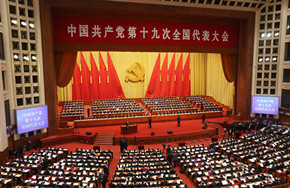
China's gross domestic product grew 6.8 percent in the third quarter, according to official data. Over the same period last year, the increase was 6.9 percent, above the 6.5 percent target for this year. The increase means a GDP worth 80 trillion yuan ($12.1 trillion), as President Xi Jinping stated at the opening of the 19th National Congress of the Communist Party of China, the country's most important political event in five years.
It is the ninth straight time that China's quarterly growth has fluctuated between 6.7% and 6.9%. For those accustomed to double-digit growth for the country, it seems low, but this is the “new normal”, a path adopted by Beijing to achieve sustainable growth. In this context, how will Brazil be positioned, with China as its largest trading partner since 2009? What will this mean for its commodities?
Exports from Brazil, which sells 25 percent of what it produces to China, should not be affected. "The dynamics of Brazil's trade with China are more related to what happens in the steel market because of iron ore, and what happens to consumption in general, because of soy and oil. Steel continues record production, so the demand for ore remains," said André Soares, a non-resident fellow of the Atlantic Council's Adrianne Arsht Latin America Center and a former coordinator of the Brazil-China Business Council.
Tulio Cariello, a CEBC research coordinator, believes there will be no significant change to the Sino-Brazilian relationship in the short term. "China should continue to import mainly agribusiness products, natural resources and oil, which are key to China's food, energy and mineral resource security,” Cariello said. “It should be noted such products can show drastic price fluctuations, which may eventually cool Brazilian exports in terms of value.".
But the analyst reminds us of another factor: the current composition of GDP and the opportunities presented to Brazil. Consumption is central in this respect. According to Xi, from 2013 to 2016 final consumption contributed to 55 percent of the country's economic growth. In the first half of 2017, this figure jumped to 63.4 percent.
"This sets the precedent for Brazilian companies to think about diversification strategies, and to explore new areas such as the high-end products and service sectors in order to serve a growing Chinese middle class," Cariello said.
In an article published on Friday in the Brazilian newspaper Valor Econ?mico, Soares also mentions the importance of consumption as a key driver, even though China maintains state investments as fundamental engine for economic development. Consumption and innovation could mean another reconfiguration in the pattern of growth, perhaps an adjustment of the annual GDP to a level 5 percent. This is a move the researcher, while not pointing out as certain, believes could be taken thanks to the political goodwill after the congress.
Consumption and innovation have received increased attention. According to official data released on Oct 20, China's spending on research and development accounted for 2.1 percent of GDP in 2016, reaching $233 billion. Of this total, 78 percent came from companies.
"Innovation policy is at the heart of contemporary China's economic thinking,” Cariello said. “In a way, it very much resembles Japan's strategy, which went from a post-war factory floor to one of the most important players in technology and innovation in the world, allowing the small island in the Pacific to be the second-largest economy in the world, a position now occupied by China."
For professor and researcher Ricardo Muccillo da Silva, who recently defended his doctoral thesis on Chinese innovation at the Federal University of Rio Grande, the ability to generate technological innovations is treated as essential for China's economic development.
"The 12th Five-Year Plan (2011-2015) reinforced the government's strategic thinking to promote an ecosystem conducive to innovation and technological modernization of the country,” Silva said. “In addition, issues were addressed on tackling the environmental problems caused by the country's heavy pollution. The 13th Five-Year Plan (2016-2020) also has special concern with environmental pollution and the provision of basic natural resources for the sustainability of the country's growth.".
Silva points out important points of the 13th plan that targeted innovation: strong investment in new alternative sources of energy and "green technology"; popular entrepreneurship with the creation of new businesses; creation of social technologies with the intention of solving local problems; an increase in the country's capacity to generate native innovations, reducing technological dependence; the creation of global Chinese trademarks and constant improvement in the country's educational indicators. In higher education, the goal is to put China's educational institutions among the best in the world. Finally, the plan aims for greater integration of civil and military industries. This item represents a great investment from the country for the development of the defense industry and its integration with the National Innovation System.
Janaína Camara da Silveira is a communication consultant at Radar China and a development researcher as a Master in Economics candidate at Unisinos University, Brazil.
The opinions expressed here are those of the writer and don't represent views of China Daily and China Daily website.