Supervisory commissions tackle graft from the root
 |
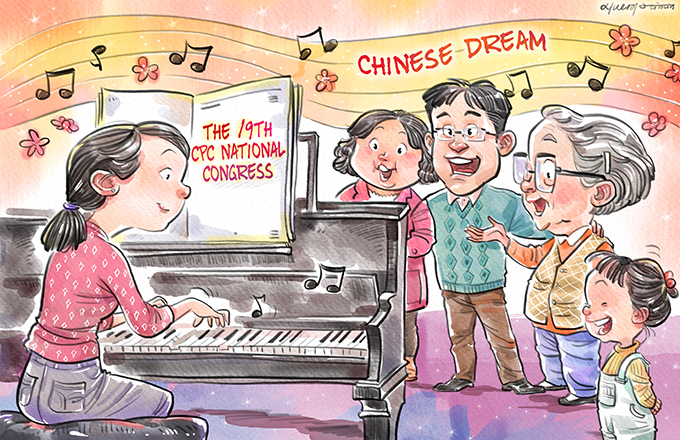
| CAI MENG/CHINA DAILY |
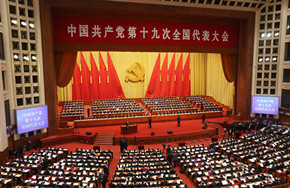
The just-concluded 19th National Congress of the Communist Party of China included "Xi Jinping Thought on Socialism with Chinese Characteristics for a New Era "in the Party Constitution. As part of General Secretary Xi Jinping's report to the 19th Party Congress on behalf of the CPC Central Committee, Xi's thought shows the political wisdom of the central leadership with Xi Jinping as the core.
An important part of Xi's thought is the enhancement of Party leadership over all aspects of society to advance law-based governance in all corners of China and to help the people run the country with commitment to the organic unity of Party leadership.
The idea of extending the supervisory commissions, piloted in Beijing municipality, Shanxi and Zhejiang provinces, to different parts of the country corroborates the principle of overall Party leadership in all aspects of society. Once the supervisory commissions are established nationwide, they will help unify the principles of overall Party leadership, the people running the country and the rule of law into one organic whole.
First, the emphasis will be on Party leadership in supervisory commissions. In the past, various levels of the Party's disciplinary bodies mainly conducted the investigations against Party officials suspected of corruption. And if enough evidence was collected against Party officials suspected of corruption, they were made to face the judiciary.
Still, the Central Commission for Discipline Inspection, the Party's highest anti-corruption watchdog, and disciplinary bodies at different levels are Party organs so their decisions used to be effective against only Party members. In some cases, when a suspected official was not a Party member, the CPC's disciplinary bodies could not exercise any power.
Now, the supervisory commissions will be under the Party's leadership and, hence, will have the power to probe the cases of any official, irrespective of whether he or she is a Party member, suspected of corruption. In this way, the Party's leadership in all aspects of society will be realized.
Second, the principle of the people running the country has also been emphasized. The fact that supervisory commission leaders are elected by people's congresses at the same level and are under the supervision of people's congresses reflects the principle of democracy.
Democracy in China is practiced mainly through two channels: the election of various levels of Party leaders and committee members by Party congresses; and the election of different levels of governmental officials and judiciary chiefs by people's congresses. Now, the supervisory commissions will combine the two channels of promoting democracy.
This move is crucial, because the determination of the Party leadership and the active participation of the people both are needed for the success of the anti-corruption campaign. That many corrupt officials faced justice because the people provided the clues against them to the authorities shows that only with the joint efforts of the Party and the people can the anti-corruption drive succeed.
Third, the supervisory commissions will help strengthen the rule of law. Xi said the practice of shuanggui, an intra-Party disciplinary action that requires a Party member under investigation to cooperate with the interrogating officials at a designated place and designated time, will be replaced by detention of suspects, in order to bring the interrogation process under the rule of law. The promulgation of a national supervisory law will strengthen the legal procedure of regulating the probes against officials suspected of corruption, as it will specify the time length and place needed for the probe, as well as the rights the suspects enjoy during the process.
Therefore, the supervisory commissions, once they start operating nationwide, will strike corruption at the root. Corruption emerges because of a lack of strict supervision over power, so we must strengthen the supervision over power. As such, the supervisory commissions will combine the Party's leadership, the people's participation and the rule of law to fight corruption, and help eliminate corruption from the root.
The author is a professor at the Zhou Enlai School of Governance, Nankai University, Tianjin.
- Top graft-buster appeals for calm among supervisory officials
- Supervisory step forward
- Supervisory body to strengthen fight against red tape, extravagance
- Pilot supervisory reform paves way for national legislation
- National People's Congress holds press conference on supervisory work
- Wang: supervisory system changes underpin broader political reform