Tsai must stop playing dangerous game
 |
|
Taiwan's main opposition Democratic Progressive Party, DPP, Chairperson Tsai Ing-wen speaks during a press conference in Taipei, Taiwan, April 15, 2015. [Photo/IC] |
By resorting to the old, tricky game of "private and unofficial" transit through United States territory, Taiwan leader Tsai Ing-wen has made her previous "stance" to seek better ties with the Chinese mainland quite doubtful.
Foreign Ministry spokesman Geng Shuang had urged the US not to allow Tsai to transit through Hawaii and Guam on Saturday on her way to some Pacific countries, because it would violate the one-China principle, which not only Washington but also the international community has acceded to.
Tsai's transit through the US on Saturday is her second this year. In January, she stopped over in Houston and San Francisco on her way to and from Latin America.
Although the US insists there is no change in its one-China policy, Tsai would do good to avoid such severe provocations if she really wants to improve cross-Straits ties, which have deteriorated since she assumed the role of Taiwan leader in May last year.
On Oct 26, before Tsai embarked on the provocative trip, Ma Xiaoguang, spokesman for the mainland's Taiwan Affairs Office of the State Council, reiterated that the 1992 Consensus holds the key to the peaceful development of relations between the two sides of the Straits. His remarks came in response to a speech given that day by Tsai, who reiterated her "stance" to improve cross-Straits ties while trying to beautify the role her ruling Democratic Progressive Party has played in past cross-Straits exchanges. She delivered the speech at a forum celebrating the 30th anniversary of the resumption of exchanges between the mainland and Taiwan.
Such actions and remarks have brought her approval rating down. In fact, polls do not bode well for Tsai, as a recent survey shows more than 50 percent of Taiwan residents are not satisfied with her performance and policymaking, particularly her failure to fully recognize the 1992 Consensus.
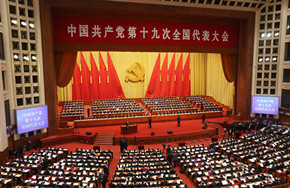
With too much at stake, she had kept close eye on the 19th National Congress of the Communist Party of China and the report delivered by General Secretary Xi Jinping at the opening session on Oct 18, which stressed that the one-China principle is the political foundation of cross-Straits ties. "We will never allow anyone, any organization, or any political party, at any time or in any form, to separate any part of Chinese territory from China," Xi said.
The central leadership's resolve to fight separatist forces on the island is in contrast to Tsai's ambiguous stance on cross-Straits ties, which led to the suspension of official communication channels between the political parties on the two sides last year.
Equivocation on the one-China principle will also put extra pressure on Tsai's cross-Straits approach as the mainland steps up its efforts to fight the secessionist forces.
The resumption of contacts between the political parties on both sides, as Tsai said in her latest address, is indeed key to better cross-Straits ties. But that would be possible only when Tsai and the DPP stop the play of words and offer a clear answer to whether or not they accept the one-China principle. Tsai's "ultimate goodwill", if there is any, appears to have sabotaged the political foundation of the eight-year peaceful interaction when her predecessor Ma Ying-jeou was in office.
Tsai knows full well that the attempt to seek "constitutional independence" of the island, as former Taiwan leader Chen Shuibian did between 2000 and 2008, is doomed to fail again. And her plan to gradually consolidate the secessionist forces on the island while putting on a show of "maintaining the status quo" is not a smart move.
Tsai's ambiguous stance on the 1992 Consensus faces a moment of truth. With the opposition Kuomintang on the ropes, Washington's tacit approval of the so-called de-sinicization campaigns on the island may embolden Tsai and the DPP to go against the wishes of most Taiwan compatriots and, instead, take measures that could further deteriorate cross-Straits relations.
However, the strong tone in Xi's report made it clear that the mainland will resort to even stronger countermeasures if Tsai takes risky moves.
The author is an associate researcher at the Institute of Taiwan Studies, Chinese Academy of Social Sciences.