Trump at APEC could spark regional shift
 |
|
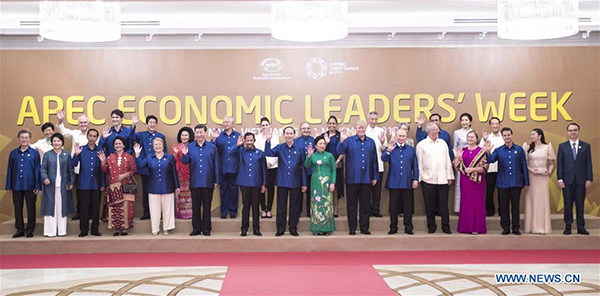
Chinese President Xi Jinping (6th L, front) poses for a family photo before a gala dinner hosted by Vietnamese President Tran Dai Quang and his wife for leaders, delegates and spouses attending the 25th Asia-Pacific Economic Cooperation (APEC) Economic Leaders' Meeting, in Da Nang, Vietnam, Nov. 10, 2017. [Photo/Xinhua] |
The 25th Asia-Pacific Economic Cooperation (APEC) Leaders' Meeting at Da Nang in Vietnam holds particular significance for a number of reasons. The first of these, of course, is the presence of US President Donald Trump, his first visit to the APEC forum. Apart from this, the APEC meeting is significant since the US under President Trump has moved away from its earlier "pivot to Asia" strategy. Indeed, President Trump's focus on approaching issues bilaterally has made the world and the Asia-Pacific region wonder over his views on regionalism and multilateralism.
A less "active" US role in the Asia-Pacific has distinct implications for regionalism, which the rest of the member countries must factor in. The third reason for this meeting’s significance is the decision some APEC members took on the TPP. After Trump pulled out the US from the TPP, the remaining 11 TPP members have been discussing the fate of the agreement. It now remains to be seen whether they agree to take the deal forward without the US. With so many points of interest, there is little doubt that the APEC meeting will be closely followed.
On his first visit to Asia as president, Trump travelled to Japan, Korea and China — the three major Asian members of APEC — before heading to the APEC Leaders’ Meeting in Vietnam. After APEC, he will travel to the Philippines to attend the East Asia Summit. His itinerary leaves little doubt over this trip being an occasion to spell out his vision over the US’ role in Asia. His preference for approaching international relations on a "transactional" basis has made US allies jittery, particularly since he has made it clear the US would like to see its defense partners financially contributing more for the US security support they get.
On one hand, when it comes to non-US security partners in Asia, the most important of which is China, he has been emphasizing a "trade imbalance". At the same time, however, he is keen on paying a "price" for China’s help in keeping the Democratic People’s Republic of Korea in check. It is clear that when it comes to relations in Asia, he will focus on specifics in bilateral relations.
With such heavy emphasis on bilateral matters, it is not clear whether he — and the US foreign policy approach he would like his administration to follow — will have a pronounced regional focus. Indeed, in this respect, whatever his pronouncements are at the APEC and EAS, there will be doubts over whether the US under Trump will be committed to advancing the larger interests of the APEC.
There are several areas of the APEC’s work program where the US might confine itself to playing a limited role, except for those that might directly connect to its security interests, such as counter-terrorism. Furthermore, Trump’s references to US interest in ensuring a "free and open" Indo-Pacific, as opposed to an "Asia-Pacific", also implies a shift in US strategic vision of the region.
In a broader sense then, the US "rebalancing" and relative disengagement leaves the field open for other APEC members to contribute actively and substantively to APEC’s work agenda. In this regard, much is expected from China. Indeed, APEC's ability to move forward to large regional initiatives like the Free Trade Area for the Asia-Pacific and a new rules-based regional order would depend on how China, as the largest regional economy, is able to fashion a vision for the Asia-Pacific community. This would be the key take-away from the Vietnam meeting.
The author is a senior research fellow and research lead in trade and economic policy at the Institute of South Asian Studies in the National University of Singapore. He can be reached at isasap@nus.edu.sg and amitendu@gmail.com.