CAFTA sees marked achievements
Updated: 2011-10-20 07:54
By Liu Xiaoqiong and Huang Zhaohua (China Daily)
|
|||||||||||


|
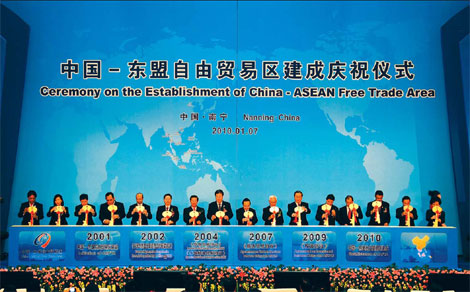
High-ranking Chinese and ASEAN officials celebrate the official establishment of the China-ASEAN Free Trade Area, in January, 2010. Photos provided to China Daily |
ASEAN is very important for any Chinese firms looking to 'go global'
China and the Association of Southeast Asian Nations (ASEAN) are increasing economic and trade cooperation as a hedge against uncertainties in other economies and to ensure the stable development of their economies, China's commerce minister told a recent gathering of trade ministers in Indonesia.
China is ASEAN's biggest trade partner and the largest export destination for ASEAN goods.
"Ever since the China-ASEAN Free Trade Area (CAFTA) opened on Jan 1 last year, economic and trade relations between the two have developed rapidly," Chen Deming told the 10th China-ASEAN economic and trade ministers conference, in Manado, Indonesia, this past August.
This is in response to "increasing uncertainty in the world economy and the probability of declining demand from developed countries."
In 2010, China-ASEAN trade was worth $292.78 billion - thanks to the tariff-free treatment it gets in the free trade area - a 30-percent increase over the previous year.
China's Premier Wen Jiabao told the 13th China-ASEAN Leaders Summit, in October 2010, that China will make a greater effort to increase imports from ASEAN and will cooperate closely with it to simplify clearance procedures, improve inspection and quarantine standards, and cooperate more on the origin of imports, to have $500 billion worth of bilateral trade by 2015.
The China-ASEAN free trade area as the first free-trade zone to benefit mostly developing countries. Its zero-tariff policy applies to more than 90 percent of the goods it handles.
China's average tariff on ASEAN goods has fallen from 9.8 percent to 0.1 percent, while the tariffs of six ASEAN countries on Chinese products have fallen from 12.8 percent to 0.6 percent. These have been helped the rapid growth of bilateral trade.
Nanning channel

Against this dramatic setting, Nanning, the capital of China's Guangxi Zhuang autonomous region, has become a sort of bridgehead in Sino-ASEAN exchanges, thanks in no small part to its proximity to those countries.
One force behind this trade growth, and the "accelerator" in the China-ASEAN free trade area's development, has been the China-ASEAN Expo and China-ASEAN Business and Investment Summit.
Both of these are held in Nanning annually and have been christened a new "Nanning channel", an indication of the city's importance in China-ASEAN exchanges.
The Nanning channel takes a pragmatic approach to cooperation between the two and has produced a number of documents, such as the "Nanning consensus", "Nanning manifesto", and "Nanning proposal".
The city itself has become more than just a site for China-ASEAN cooperation but an important place for reaching national goals.
According to the General Customs Administration, trade between China and ASEAN amounted to $292.78 billion in 2010, a 37.5-percent increase from 2009, and 2.8 percent greater than average growth of foreign trade in China overall.
China's exports to ASEAN were valued at $138.21billion, up 30.1 percent, while China's imports were $154.57 billion, up 44.8 percent.
The ASEAN region has become China's fourth major trading partner, after the European Union, the United States, and Japan.
Meanwhile, local economies have cooperated more with ASEAN, for example in Fujian province, where it reached $13.2 billion in 2010, up 41.1 percent from 2009, and Guangdong province, where it increased 31.9 percent, to $6.53 billion.
Trade boom
China's exports of ships, steel, clothing, and ceramics to ASEAN are increasing, and its imports from ASEAN are also showing growth. In the past, they were mainly copper, rubber, and cocoa, but now they include mechanical products and electronics, which have a fairly high added value and therefore help create more jobs in ASEAN countries.
According to customs statistics, mechanical products and electronics imports from ASEAN countries were worth $82.94 billion in 2010, an increase of 39.4 percent over 2009, and accounted for 53.7 percent of total imports from the region. And they account for 50 percent of total Chinese exports to ASEAN.
At the same time, the free trade zone (CAFTA) piques the interest of Chinese enterprises who want to take advantage of the zone's preferential policies to develop one big market.
Statistics show about 410,000 Certificates of Origin in the CAFTA from the National Inspection and Quarantine Institution, in the first 10 months of 2010, an increase of 79.3 year-on-year.
New opportunities
Also, thanks to the CAFTA, Guangxi, which already has close ties with ASEAN, has even more opportunities to open up to outsiders and speed up development.
Last year was said to be the 10th consecutive year that the ASEAN region was Guangxi's biggest trade partner and largest export market.
Trade between Guangxi and ASEAN grew 31.9 percent in 2010, to $6.53 billion, with the exports to ASEAN amounting to $4.59 billion, up 27.1 percent, and imports from ASEAN at $1.94 billion, up 45.1 percent.
Data from the Guangxi Commerce Bureau's official website shows trade with ASEAN at $4.89 billion in the first seven months of 2011, an increase of 56.9 percent.
With the China-ASEAN trade block's economy bouncing back strongly in 2010, bilateral trade relations, including investments, seem to be headed in the right direction.
As of June, bilateral trade exceeded $80 billion. Chinese investment in ASEAN is also doing well and equaled more than $13 billion, about half of it from the past two years.
ASEAN is one of the most important destinations for Chinese companies in their move to "go global".
(China Daily 10/20/2011 page19)