Comments
  Print
Print  Mail
Mail  Large Medium Small
 |
|
From left: Henry Paulson, former US treasury secretary; Alexei Ge Siji, Johnson & Johnson CEO; Cai Hongbin, dean of Peking University's Guanghua School of Management; Dominic Barton, McKinsey & Co global managing director; and Stephen Roach, researcher at Yale University. More than 600 global business and political leaders participated in the 2013 Fortune Global Forum in Chengdu to discuss issues facing the world. Provided to China Daily |

Hundreds of global and business leaders gather in Chengdu
China's new economic stage and its implications for the world was the theme of the discussions during the 2013 Fortune Global Forum held in early June in Chengdu.
Reform, innovation, consumption and technology all became buzzwords among more than 600 global business and political leaders in their three days of intensive brain-storming.
Zhang Gaoli, China's vice-premier, said in a keynote speech that the country is committed to accelerating economic reform, moving faster to a consumer-driven economy and expanding imports, while strongly opposing all forms of protectionism.
"We will accelerate change to the development model and vigorously improve and optimize the economic structure," Zhang said, adding that the country will work to expand consumer demand.
He said China will in the next five years import $10 trillion worth of goods from around the world and invest $500 billion abroad.
Tony Blair, former prime minister of the United Kingdom, said China's crucial role in the global economy is shown in "the interdependence of our economy with that of China, the fact that we now watch anxiously for the latest signs of how China is growing, its management of credit, its purchase of commodities, the development of its labor market, and the presence here of many of the largest companies in the world".
But he also told his Chinese friends that China as a power will be "analyzed differently, questioned differently and engaged with much greater scrutiny, even anxiety, than in the days when it was simply and only a developing nation.
"This scrutiny is the fate of a power. It will mean, for example, that as the world opens up economically to China, as it should do, China is expected to reciprocate," he said.
Henry Paulson, former United States treasury secretary and former Goldman Sachs CEO, in his speech highlighted the need for China to reform.
"What hits me right smack between the eyes is the same thing the Chinese government knows. The current growth model is running out of gas. They're going to need to reinvigorate reform, it's clear," he said.
China is "too reliant on State-led investment and infrastructure and manufacturing," Paulson added. "Too reliant on exports. There's not enough domestic-led growth. It needs more from the services industry."
He also suggested that China's local governments should be allowed to issue municipal bonds to fund their projects, instead of relying on land sale revenue.
Cai Hongbin, dean of the Guanghua School of Management at Peking University, has noticed a pattern in the way people respond to the stiff challenges facing modern China: "Those who come often to China are pretty optimistic. Those who rarely or never come say China's economy is collapsing."
McKinsey & Co's Global Managing Director Dominic Barton said as China's urbanization progresses, the numbers coming from the countryside may be slowing. But China is still just at "the end of the beginning" of its urban transformation.
New business model
One of the hot topics in the forum was balancing the need for economic expansion while encouraging sustainable innovation. How do companies create a new set of tools that will permit economic growth without putting too much stress on the environment?
Fu Chengyu, chairman of Sinopec, one of the largest petroleum corporations in the world, said China has huge potential for improving energy efficiency.
"For China, one thing is unique: that is, over 70 percent of its energy consumption is coal-based or coal-derived. And that energy structure will remain basically unchanged in the coming 20 to 30 years.
"So in this context, our responsibility is how to deliver clean coal, how can we deliver clean coal-based energy, and how to convert coal into other energy sources in a clean manner," Fu said.
Jeffrey Immelt, the CEO of General Electric Co, said GE basically has a bet on every technology: "We're in solar. We're in wind. We're in coal. We're in gas. And we're driving technology around all those."
"The two biggest surprises, I would say, over the last decade are no one would have ever guessed that natural gas would be three or four dollars in the United States, but it is. I can't look at one GE pro forma that ever predicted that. But that is a massive game changer driven by technology."
There was also intense discussion of the emerging business models and rules around the world and how companies adapt to it.
Yang Yuanqing, chairman and CEO of Lenovo Group Ltd, one of the largest personal computer makers in the world, said Lenovo has a strategy to become not just a PC player, but also a "PC-plus player".
"We must win in the tablet area, in the smartphone area. So now everything goes mobile," he said.
Muhtar Kent, chairman and CEO of The Coca-Cola Co, said we are seeing shifts in the retail landscape in terms of how consumers shop.
"We see shifts in mobility, shifts in consumer trends, consumption patterns everywhere around the world. And where they stay, where they go to be entertained, how they want to be entertained, what they want to drink, what they want to eat, all of those things are changing," he said "The important thing is to understand them, and to be able to actually be ahead of those trends."
He said instead of a product manufacturer, Coca-Cola is actually a "relationship company", with 275 partners around the world. Coca-Cola operates with those local partners, which helps it understand the local conditions and consumers much better.
"I think probably the important thing that we see that is changing, shifting at a very dynamic rate is consumers no longer want to be talked to by companies that make products, that they actually want to have a dialogue with consumers," he said.
Talking about how to cope with a new paradigm in the Internet world, Tim Armstrong, chairman and CEO of AOL Inc, said: "Around the world, cultures are different, but in a lot of ways there's a lot of similarities between what consumers want. I think social media is going to play a really big piece in unlocking kind of universal joint aspects of societies and social behavior overall."
Reward for the host
The three-day event was also fruitful for Chengdu, the host city, which aspired to use this forum to raise its international profile and become a growth hub in China's west region.
According to the Chengdu government, at least 74 business deals were signed between the capital city of Sichuan province and Fortune 500 companies or large multinationals, with the combined value surpassing 112 billion yuan ($18.26 billion).
Of this, 12 major projects worth 25.6 billion yuan were sealed on June 7 at a contract signing ceremony at the city's Jinjiang Hotel.
Semiconductor design and manufacturing company Texas Instruments Inc announced its long-term strategy for manufacturing facilities in Chengdu in conjunction with officials of the Chengdu High-Tech Industrial Zone at the ceremony.
Its future plans include a new assembly and testing operation and the expansion of its existing wafer fabrication factory.
Texas Instruments' investment in the operation could total $1.69 billion over the next 15 years for more facilities, manufacturing equipment and land.
Schneider Electric SA of France is planning to establish its first subsidiary for Southwest China in Chengdu.
Sam Chum, vice-president of Schneider Electric China, said the company will soon upgrade its representative office to a branch in the Chengdu High-Tech Industrial Zone as the market in western regions attracts more and more attention from the company's top management.
The branch's business will cover sales, management, coordination and service support, and there are plans for it to become a regional hub that could reach other cities in Sichuan province, Chongqing and the Tibet autonomous region by the end of 2014.
Ellen Kullman, chief executive officer of E I Du Pont De Nemours and Co, said that the company built a plant in Chengdu last year, while jointly founding a research institute with Sichuan University to develop new fire- and heat resistant materials.
"The western city is now a hub for many manufacturing industries and we are glad to have set up a plant here," she told China Daily in an earlier interview.
Shi Lei, an economics professor at Fudan University, said cities such as Chengdu in Western China are maintaining resilient momentum,
"Looking to the future, they may become engines of growth when export-oriented coastal cities encounter more headwinds from shrinking external demand," Shi said.
Contact the writers at zhengyangpeng@chinadaily.com.cn and liyu@chinadaily.com.cn
 |
| Pandas entertain guests of the 2013 Fortune Global Forum in Chengdu on June 7. The event was fruitful for the city. According to the Chengdu government, at least 74 business deals were signed between the city and Fortune Global 500 companies or large multinationals, with the combined value surpassing 112 billion yuan ($18.26 billion). |

 Hello, new semester!
 Students prepare for new school semesters
 Yellow River roars
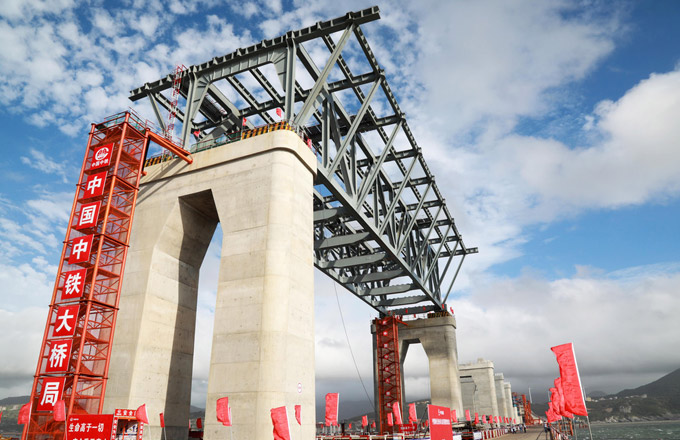 China's first cross-sea rail-road bridge takes shape
 Harbin-Mudanjiang high-speed rail one step closer
 China's new-generation bullet train starts operating
 Little Wolf Warriors brave harsh training
 'World's Largest Paint Party' comes to Shanghai
 Different shades of Beijing sky: Blue to violet
 Mountains can't stop boy's dream of going to school
 WWII bomb deactivated in Frankfurt after mass evacuation
 L.A. declares local emergency amid huge wildfire
 Colors accentuate Panjin Red Beach marathon
 Sharapova wins Slam return while Peng leads Chinese charge at US Open


Copyright 1995 - . All rights reserved. The content (including but not limited to text, photo, multimedia information, etc) published in this site belongs to China Daily Information Co (CDIC). Without written authorization from CDIC, such content shall not be republished or used in any form. Note: Browsers with 1024*768 or higher resolution are suggested for this site.
License for publishing multimedia online 0108263 Registration Number: 20100000002731