Sichuan Opera a draw as Chengdu 'goes global'
Updated: 2014-06-12 11:23
(China Daily)
|
|||||||||||


Lisa Bielby is the first foreigner in history known to have participated in a Sichuan Opera contest.
Born in Michigan of the US, Bielby started to study drama in her hometown when she was 13 years old.
When she came to Chengdu at the age of 24, she enrolled in the provincial Sichuan Opera School to learn the more orthodox skills of recitation, acting, singing and acrobatics.
 |
| Fire 'breathing' in Sichuan Opera is usually followed by the face-changing display for which it is renowned. |
 |
| Sichuan Opera actor. Zhu Xingxin / China Daily |
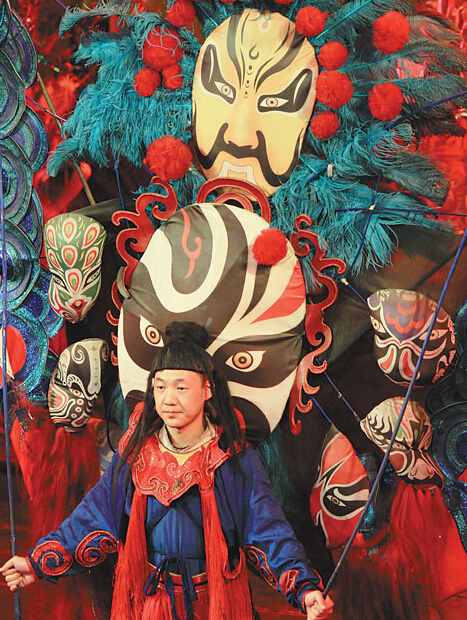 |
| Some of the colorful face masks used in performances. |
But she was not the first and only foreign student registered in the school, showing that the ancient opera has gradually become a global phenomenon.
Sichuan Opera originated at the end of the Ming Dynasty (1368-1644) and the beginning of the Qing Dynasty (1644-1911) as migrants flooded into the province.
Inscribed on the national intangible heritage list in 2006, the ancient art form is widely known for less constrained singing than the more popular Peking Opera.
Dramas are blended with local dialects, customs, folk music and dances into a more humorous form unique to Sichuan culture.
Face changing is the highlight, a legacy from ancient times when it is said people painted their faces to drive away wild animals.
Modern Sichuan Opera has perfected it into an art.
Performers make their own masks and no one else knows how they work as one image flicks in front of another.
Different masks represent changing demeanors and states of mind to show emotions and sudden switches in mood to achieve artistic effect.
The dramatic art is mainly presented in three forms - the wiping mask, blowing mask and pulling mask techniques.
Wiping mask requires performers to paint cosmetics on a certain part of their faces.
When wiped off with a rapid movement, the countenance of the face appears to change.
Blowing mask uses powder cosmetics in gold, silver and ink.
A tiny can with powders is placed on the floor of the stage. When actors need to change faces, they blow into the can to make the powder fly up and stick to their face.
Pulling mask is the most complex, requiring actors to draw different images on pieces of well-cut damask, link them with silk thread and paste them to their face one by one.
The silk thread is fastened in the belt or other inconspicuous part of the costume.
Covered by dance movements, the actor quickly whisks away the masks one by one as the drama develops.
Performers can change some 10 masks in less than 20 seconds.
In addition to interesting culture, the capital of Sichuan province also has rich historical relics.
It is home to the remains of the Jinsha civilization that dates back more than 3,000 years
Widely believed to have been the capital of the ancient Shu state, the site is hailed as one of the major archeological discoveries in China in the 21st century.
One of the Jinsha relics unearthed is a gold foil rendering of a divine solar bird. It is now used as the symbol of Chengdu and its local cultural heritage.
The city also has the Qingcheng Mountains and the Dujiangyan irrigation system.

Qingcheng has long been recognized as the birthplace of Taoism, China's ancient indigenous religion, while Dujiangyan is considered to be the oldest functioning water-control project in the world.
Chengdu, capital of Sichuan province, has implemented a 72-hour visa-free policy since last September, which will further help the iconic culture to "go global", local officials say.
The visa policy allows citizens from 51 countries in Asia, Europe, the Americas and Oceania to spend three days in Chengdu if they have valid visas and onward flight tickets.
Chengdu is the first city in the western region of China to offer foreign tourists a three-day visa and the fourth nationwide to adopt the policy following Shanghai, Beijing and Guangzhou.
haonan@chinadaily.com.cn





Hot Topics
Wei Guirong drives his granddaughters from kindergarten on his home-made three-wheeled vehicle in Luorong county, Liuzhou city of Guangxi Zhuang autonomous region, on May 19.
Editor's Picks

|

|

|

|

|

|