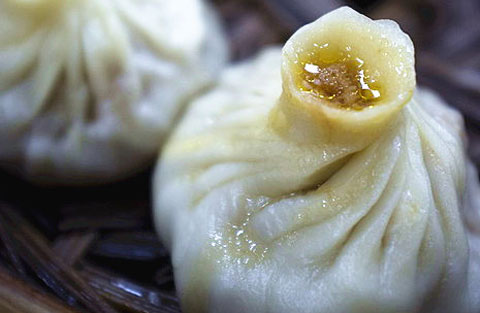
On the busy streets of South Korea's biggest Chinatown in Incheon stands Gonghwachun, a Chinese restaurants popular among tourists to the area. "We hold pride in our 100-year history," its sign reads.
Not many are aware that the restaurant is in fact owned by a Korean, and has no direct link to the original Gonghwachun (1912-83), the legendary restaurant considered to be the first in South Korea to offer jajangmyeon, the beloved localized Chinese noodle dish.
If Wang Ae-joo, the granddaughter of the Chinese founder of the original Gonghwachun, and her mother had known more about Korean law, Wang would have owned the right to the name of her family business, which lasted for three generations.
The Korean owner of the new Gonghwachun bought the restaurant's trademark in 2001, 18 years after the original closed down.
Wang, with her husband, owns a small Chinese restaurant named Shinsheungbanjeom about a five-minute walk from the new Gonghwachun. The property is about one-fifth the size of the new Gonghwachun, and relatively unknown to tourists and visitors.
"I've tried (to retain the name)," the 43-year-old said. "My mother opened the restaurant that I run now back in 1980, as a second branch of Gonghwachun. At the time, we didn't know that not using the same name would bring such consequences."
Wang is one of some 10,000 remaining Chinese residents in Incheon's Chinatown area, where the first Chinese settlers arrived in the late 19th century.
Most of them, including Wang, are descendants of farmers from today's Shandong province in China, who moved to the port city of Incheon for job opportunities. Wang's grandfather worked as a laborer in Incheon before founding his own restaurant.
For more than a century, Chinese residents in Incheon were heavily affected by China's turbulent modern history, as well as South Korea's discriminatory policies against the Chinese - especially during Park Chung-hee's authoritarian regime in the 1960s.
In 1949, Chinese communist leader Mao Zedong established the People's Republic of China. After the Korean War (1950-53), South Korea recognized Taiwan as the only Chinese government, due to its anti-communist political agenda.
While few Chinese residents in Incheon had even visited Taiwan, they had to obtain Taiwanese citizenship in order to be granted residency status in Korea.
In 1961, South Korean President Park implemented discriminatory policies against the Chinese in an attempt to control their economic activities.
"I was told we weren't allowed to have much cash, we couldn't invest in property, and we were restricted from engaging in banking activities," Wang said.
Today, Incheon's Chinatown is one of the most popular tourist sites in the port city.
The area is filled with Chinese-style buildings, most of them red, along with historical sites including the property of the original Gonghwachun, which is now a museum on the restaurant's history and its famous specialty, jajangmyeon.
But Incheon's longtime residents recall the area being far from what one would call "Chinese" before 2002, when the city's government invested 6.5 billion won ($6.3 million) in a project to revive its Chinatown - mainly to attract large numbers of visitors from China's mainland.
"I just remember the area being ordinary and a little bit shabby, with a lot of Japanese-style buildings," said Jang Mi-hee, a tour guide and longtime Incheon resident. "This landscape of Chinatown we see now was practically created artificially in 2002."
The diplomatic relations between South Korea and Taiwan were terminated in 1992, the same year South Korea established diplomatic ties with the People's Republic of China.
Incheon's Chinatown is now the home for migrants from the Chinese mainland, as well as the descendants of the early settlers.
The Korea Herald
Asia News Network
(China Daily 08/05/2014 page5)
Copyright 1995 - . All rights reserved. The content (including but not limited to text, photo, multimedia information, etc) published in this site belongs to China Daily Information Co (CDIC). Without written authorization from CDIC, such content shall not be republished or used in any form. Note: Browsers with 1024*768 or higher resolution are suggested for this site.
License for publishing multimedia online 0108263 Registration Number: 130349