Kunqu Opera in the Olympic limelight in London
Updated: 2012-08-05 08:06
By Mu Qian(China Daily)
|
|||||||


|
Today's audiences can respond to the art and emotions of the ancient form of Kunqu Opera. Provided to China Daily |
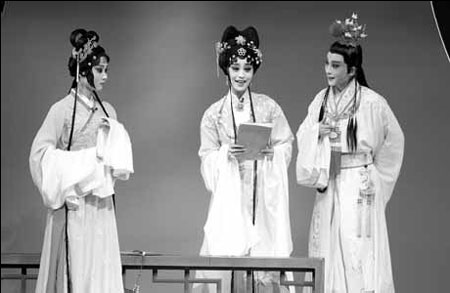
China's Kunqu Opera was recently performed for the first time at the Shaw Theater of London - and to great acclaim.
The theater, named after Irish playwright George Bernard Shaw, hosted two performances of the genre as part of Beijing Culture Week in London. The Northern Kunqu Opera Theater staged A Dream of Red Mansions on July 24 and The New Legend of Pipa on July 25.
These works are not the genre's best-known, but troupe's vice-president Cao Ying believes they represent important aspects of Kunqu Opera.
A Dream of Red Mansions, which is based on the namesake classical novel, is an original work that made its debut last year. The New Legend of Pipa is a recently revived work that hadn't been performed for 300 years. Its playwright, Cao Yin (1658-1712), was the grandfather of A Dream of Red Mansions' author, Cao Xueqin (1724-1763).
"Kunqu is regarded as the 'origin of a hundred operas' in China," Cao Ying says.
"It has a history of 600 years and has influenced not only many styles of Chinese opera but also Chinese literature, music and art."
In the novel A Dream of Red Mansions - one of China's "Four Great Classical Novels" - there are 26 depictions of Kunqu, the best-known one of which is when heroine Lin Daiyu is enchanted by 12 girls singing Kunqu in the 23rd chapter.
However, there was never a Kunqu adaptation of A Dream of Red Mansions, except for some excerpts, until the Northern Kunqu Opera Theater premiered their version last year.
Written in the middle of the 18th century, A Dream of Red Mansions tells about the rise and decay of a noble family and, by extension, of the Qing Dynasty (1644-1911). The best-known plotline of the work is the tragic love story between hero Jia Baoyu and heroine Lin Daiyu, who are forced apart by Jia's family, Romeo and Juliet-style.
"A Dream of Red Mansions is a great work that covers various dimensions of feudal China, including the political, social and cultural - and even medicine and food. It's a great challenge for us to put it onstage," the work's general director Cao Qijing says.
Traditionally, there was no director in Kunqu Opera, and the leading actors and actresses decided the form of presentation. But today's directors are getting more involved in traditional Chinese operas.
"I think this is something natural as arts become more multidimensional, although I have a principle of not changing the original aesthetics of the ancient art of Kunqu Opera," Cao Qijing says.
"My approach is 'limited innovation'."
One way Cao Qijing innovates is by including such Western instruments as the violin, viola, cello and harp to the accompanying Chinese orchestra.
"I feel these instruments will add to the expressiveness of the original Chinese instruments, and can help convey the rich emotions of the work more vividly," she says.
The new orchestration went over well with some English audience members. Robin Haller, a 33-year-old Londoner, believes the music was the most successful part of A Dream of Red Mansions.
"In a way, it was the music that reached out to a Western listener, and it made a better bridge between the traditional Chinese music and what we, as European audiences, expected to hear in an opera," Haller says.
"In a way, the composer has done the most in reaching out to the Western audience."
Haller was also impressed by the English subtitles that were provided during the performances.
"The translator did a good job. I could more or less follow what was going on onstage, although I have never read the original novel," he says.
"As long as there is good translation, there are not really cultural barriers that prevent one from appreciating Kunqu Opera."
The cast of A Dream of Red Mansions includes not only award-winning actors and actresses from the Northern Kunqu Opera Theater but also performers, who auditioned, from Kunqu companies in Shanghai and Jiangsu province.
When adapted to other forms of Chinese operas, some parallel plots from the novel were made part of the narration. But the Kunqu version has some plots run simultaneously onstage - for example, that of Lin burning her scripts and Jia's wedding.
The New Legend of Pipa, which the Northern Kunqu Opera Theater recently revived after a script was found in the National Library of China, is closer to Kunqu Opera's traditional form.
The work tells about Cai Wenji, a Han Dynasty (206 BC-AD 220) woman poet and composer, who was taken prisoner by the Xiongnu nomads and became a chieftain's wife but eventually returned home.
Wei Chunrong, who played Wang Xifeng in A Dream of Red Mansions and Cai Wenji in The New Legend of Pipa, says it's a great honor for her to perform in London just before the 2012 Olympic Games.
"Kunqu Opera is an ancient art of China that reflects the lives of Chinese people in the past, but it's understandable to today's audiences from all over the world because people's sensitivity to art and emotions are similar," she says.
Kunqu Opera dominated Chinese theater from the 16th to the 18th centuries and has influenced many other Chinese theater forms, including Peking Opera. In 2001, UNESCO listed Kunqu Opera among the Masterpieces of the Oral and Intangible Heritage of Humanity.
Wei says she belongs to a generation of Kunqu Opera singers who are responsible for both inheriting the tradition and developing the old art.
"I hope I will have an opportunity to exchange and collaborate with UK theater workers next time," she says.
muqian@chinadaily.com.cn
(China Daily 08/05/2012 page5)