A dessert's rise and fall, and other film treats
Updated: 2013-06-16 07:42
By Robert Ito(The New York Times)
|
|||||||


|
Natasha Subramaniam and Alisa Lapidus, at work on a movie about a dessert. The layers eventually crumbled. Photographs by Stephanie Diani for The New York Times |

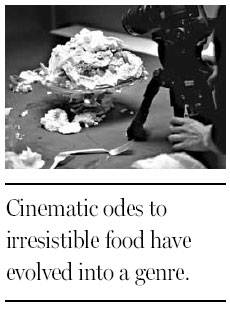
LOS ANGELES - For four hours, the filmmakers Natasha Subramaniam and Alisa Lapidus constructed a four-tiered dessert out of whipped cream, amaretto cookies, baked meringue and edible flowers. "It's a Pavlova meets a croquembouche," Ms. Subramaniam said.
As Ms. Lapidus stacked Frisbee-size discs of meringue atop the ever-growing sweet, Ms. Subramaniam took still shots of each layer, which would be edited together into a stop-motion sequence.
And then, without warning, the mountain began to fall, the bottom layer of cream oozing out under the weight of the meringue discs and cookies. If this were a commercial shoot, the dessert would probably be scrapped and a new one built. But the two California Institute of the Arts graduates weren't making a commercial here, in a bedroom-turned-studio, they were making a film, "Bloem," about the life, death and consumption of this dessert by unseen diners. In other words, it's an art film, so a little ooze is fine.
Where does one screen a movie about the life and death of an oversize dessert? At one of a growing number of festivals and film events across the United States devoted to all that is most fun and delicious about food, calories be damned. These films aren't about how your meal might kill you (like the documentary "Forks Over Knives") or sully the environment ("Food, Inc.") or make you feel really lousy ("Super Size Me"). No, these are cinematic hymns to food, mini-odes with names like "Sushi, Handcrafted Happiness" and "Bark Butter: Why Every Hot Dog Needs a Little More Pork Fat."
"We don't show message films, or get involved with scolding polemic," said George Motz, director of events like the Charleston Food Film Festival in South Carolina. "What we do is we celebrate food, and those who make it. We skip the bad parts."
The festival is the direct descendant of the New York City Food Film Festival, now in its seventh year, and the Chicago Food Film Festival, which began in 2010; all three are overseen by Mr. Motz. Over the years, similar festivals and one-offs have popped up across the United States, all devoted to a subgenre with its own aesthetics and even awards.
Films now on the festival circuit include two documentaries, about a Los Angeles ramen junkie who opens a noodle shop in Tokyo ("Ramen Dreams") and a New Orleans native who sells produce from his pickup truck ("Mr. Okra"); and a 98-second, narration-free look at the creation of an orange-pistachio doughnut.
That short, "The Benevolent Baker: Doughnuts," by Scott Pitts, a Seattle commercial food photographer, captures gorgeous close-ups of a chef sifting flour, zesting an orange and rolling out circles of dough.
In another of Mr. Pitts's films, "The Benevolent Butcher: Bacon," a slab of bacon is coiled around a tenderloin steak, then plopped in a pan to sizzle in olive oil and its own fatty juices.
How does Mr. Pitts judge a film's success? "If you watch the film and say to yourself, 'I really want to go have a bacon-wrapped steak,' then it worked," he said. "It's pretty simple."
But another filmmaker, Liza de Guia, has always been more interested in the people who make food. After working in various local TV jobs around New York, Ms. de Guia, a Brooklyn resident, dreamed of creating a Web series about little-known food producers and vendors.
Starting in 2008, she pitched the idea to "just about every food blog in town" - and was turned down by all of them.
"And then I got smart," she said. "I was like, 'Why am I waiting to be given permission to do something that I want to do?'"
In 2009, she filmed a three-minute video about rooftop farmers in Brooklyn and posted it on YouTube. The video quickly went viral. Ms. de Guia followed up with pieces about urban beekeepers, small-scale duck farming and sustainable ice cream, which she posted on her own newly created Web site, Food Curated.
Six months later she received a nomination for a James Beard award for best video webcast. In 2012, after several more Beard nominations, Ms. de Guia was named filmmaker of the year at the New York Food Film Festival. "I think I know how to shoot food because I love it so much," she said.
In Los Angeles, where Ms. Subramaniam and Ms. Lapidus were filming the "devouring" portion of their short, Ms. Subramaniam directed as Ms. Lapidus jabbed a fork into the crumbling Pavlova, raking furrows with the tines.
Ms. Subramaniam said: "It's funny, because it's just a fork going through a dessert, but it does start to feel like you're acting, like you're this character eating a dessert."
The New York Times
(China Daily 06/16/2013 page12)