DNA tests show herbal pills may not be what they seem
Updated: 2013-11-17 07:13
By Anahad O'connor(The New York Times)
|
|||||||


Americans alone spend an estimated $5 billion a year on unproven herbal supplements that promise everything from fighting off colds to curbing menopausal symptoms to boosting memory. Global sales of supplements and vitamins are estimated to be $84 billion.
But supplement buyers should beware: DNA tests show that many pills labeled as healing herbs are little more than powdered rice and weeds.
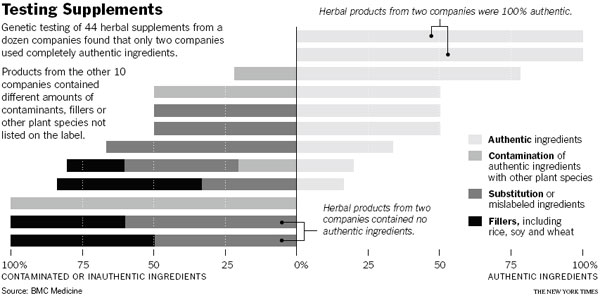
Using a test called DNA bar coding, a kind of genetic fingerprinting, Canadian researchers tested 44 bottles of popular supplements sold by 12 companies. They found that many were not what they claimed to be, and that pills labeled as popular herbs were often diluted - or replaced entirely - by cheap fillers like soybean, wheat and rice.
Consumer advocates and scientists say the research provides more evidence that the herbal supplement industry is riddled with questionable practices. Industry representatives argue that any problems are not widespread.
The researchers selected popular medicinal herbs, and randomly bought different brands of those products from stores and outlets in Canada and the United States.
Among their findings were bottles of echinacea supplements, used by millions of Americans to treat colds, that contained ground up bitter weed, Parthenium hysterophorus, a plant found in India and Australia that has been linked to rashes and nausea.

Two bottles labeled as St. John's wort, which studies have shown may treat mild depression, contained none of the herb. Instead, the pills in one bottle were made of nothing but rice, and another bottle contained only Alexandrian senna, an Egyptian shrub that is a powerful laxative. Gingko biloba supplements, promoted as memory enhancers, were mixed with fillers and black walnut, a potentially deadly hazard for people with nut allergies.
Of 44 herbal supplements tested, one-third showed outright substitution, meaning there was no trace of the plant - only another plant in its place. Many were adulterated with ingredients not listed on the label, like rice, soybean and wheat.
In some cases, these fillers were the only plant detected in the bottle, said the study's lead author, Steven G. Newmaster, botanical director of the Biodiversity Institute of Ontario.
The findings, published in the journal BMC Medicine, follow a number of studies that have suggested a sizable percentage of herbal products are not what they purport to be. But because the latest findings are backed by DNA testing, they offer perhaps the most credible evidence of adulteration, contamination and mislabeling in the industry, a rapidly growing area of alternative medicine that includes an estimated 29,000 herbal products sold in North America.
"This suggests that the problems are widespread and that quality control for many companies, whether through ignorance, incompetence or dishonesty, is unacceptable," said David Schardt, a senior nutritionist at the Center for Science in the Public Interest, an advocacy group based in Washington.
Stefan Gafner of the American Botanical Council, a nonprofit group that promotes the use of herbal supplements, said the study was flawed, in part because the bar-coding technology it used could not always identify herbs that have been purified and highly processed.
"Over all, I would agree that quality control is an issue in the herbal industry," Dr. Gafner said. "But I think that what's represented here is overblown."
Dr. David A. Baker, a professor at Stony Brook University medical center in Long Island, New York, bought 36 black cohosh supplements from online and chain stores. Bar-coding tests showed that a quarter of them were not black cohosh, but instead contained an ornamental plant from China.
Dr. Baker called the state of supplement regulation "the Wild West," and said most consumers had no idea how few safeguards were in place.
"If you had a child who was sick and three out of 10 penicillin pills were fake, everybody would be up in arms," Dr. Baker said. "But it's O.K. to buy a supplement where three out of 10 pills are fake. I don't understand it. Why does this industry get away with that?"
The New York Times
(China Daily 11/17/2013 page12)