Smog hackers
Updated: 2014-02-16 08:34
By Erik Nilsson(China Daily)
|
|||||||


China's air pollution is provoking grassroots dreamers to imagine, invent and innovate. Erik Nilsson reverse engineers these tech-tinkers' mentalities.
Robots that scuttle up high-rises. Massive electromagnetic vacuum cleaners. An atmospheric sprinkler system. That's not to mention kites, bikes and DIY ventilation systems.
The thinkers and tinkers are tackling China's smog. With all eyes on the skies, grassroots artists, designers and inventors have their heads in the (hazy) clouds. They're putting their minds to the mist of poisonous particulate that clots the country's air.
Some conceptions veer more toward whimsical.
Take Dutch designer Daan Roosegaarde's fantastical scheme to install giant electromagnetic coils to zap Beijing's smog through electrostatic attraction - and then compact the captured particles to fashion jewelry.
Beijing-based British artist Matt Hope has rigged a bike to filter air, using a fighter-jet pilot helmet, a pedal-powered generator, a tube and a filter. He points out it's more of a statement than a solution.
A Chinese farmer is creating traditional Chinese medicine facemasks with filters that incorporate tea leaves. Zhejiang University researcher Yu Shaocai proposes installing sprinklers on high-rises and planes to wash the skies - a tweak on a November China Meteorological Administration proposal to use cloud-seeding to coerce rain.
Other innovations seem more viable.
Fudan University professor Chen Liangyao has installed a DIY air-ventilation system to suck indoor pollution from his apartment. An American duo has developed DIY purification kits that are essentially filters fixed to fans. A Beijing inventor has installed walls that sap pollution in his apartment.
To harness this innovation surging from ordinary people, China Academy of Fine Arts associate professor Fei Jun organized a grassroots smog-solutions development competition at the 2013 Interactive Beijing Innovation Conference in November.
The theme was "Our Air, Our Responsibility".
"It's not a choice anymore for us to decide what topic we take," he says.
"It's a necessity. We need to do something about it."
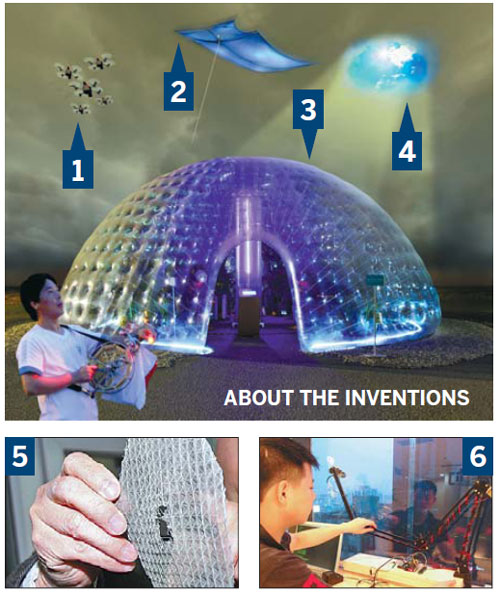
Perhaps Interactive Beijing's most futuristic concept is Window Airbot - a Spiderman-like robot that scurries up the sides of buildings and knocks on residents' windows to inform them when pollution is extreme.
This "sci-fi" contraption is intended to "provide a more exciting way to keep updated about our air quality", Fei says.
The competition's winning project was AirPet, a social Android app in which users nurture a cute creature that feeds on good pollution-index readings based on real-time, location-based data. If the creature grows to maturity, it moves to Air City, where it enjoys fresh air and free housing. In real life, a small donation is made to environmental NGOs when a user's pet reaches adulthood.
The developer won 8,888 yuan ($1,460) to take the project further.
Another app contrived by Interactive Beijing is Air Bank, which connects users to the "invisible" links between finance and air quality.
"Everyone in China has savings in different banks - CCB, ICBC, BOC, just to name a few - yet not everyone knows where the banks invest our money," Fei explains.
"Yes, it's mostly in heavy industries, which are exactly the core cause of environmental problems. Air Bank is an Android app that informs users with updated ratings of banks according to how environmentally friendly they are - how much money they lend to green companies or social enterprises."
Users can also share the information on social media.
"What this app really hopes (to do) is make everyone aware of this vital cause that matters much to our air and take a simple action - transfer savings into those banks that are currently more socially responsible."
Fei has also been working on Eco Air Bubble, which addresses how smog has caused users of government-provided outdoor exercise equipment to dwindle.
"We hack the public gym-bikes and link them with air purification systems and surround the exercise area with three types of fresh air-generating plants to create this oxygen-rich zone."
In 2011, Tianjin native Wang Xiaowei started workshops that teach Beijingers to affix kites with lights connected to $15 pollution sensors.
Groups of ordinary people fly the kites in public squares. The colors that flash indicate pollution levels. Sensors' data is stored on SD cards, then uploaded and distributed by e-mail.
Part of the notion behind using kites is that they're icons of Chinese heritage. Another is that ordinary Chinese can take monitoring and data distribution into their own hands.
China's smog hackers largely believe they shouldn't only wait for change from above but also become their own white knights who blue gray skies. Their shining armor is an alloy of imagination and participation.
"There has been a huge effort - not just in China - of DIY makers and hackers tackling China's and other countries' smog," Wang explains.
"Our project is very much in the same vein. It's really about equipping average citizens with the tools, hardware and knowledge to bring visibility to pollution issues."
Fei agrees that public consciousness of smog is crucial to curbing it.
"Awareness is the first stage," Fei says.
"We're calling for the new collectivism, for ordinary people like us, who can't afford to pack up and leave the cities, to all work together to rescue our last public asset - the air - from the bottom up, to turn the negative into the positive."
This requires a mentality shift, he believes.
"It's gradual," Fei says.
"But it's possible."
|
1 Air Whistle: Quadracopters detect air pollution and broadcast PM2.5 scores through a sound pitch simulating homing pigeon whistles. 2 Float: A community kite-making project affixes sensors and lights that flash different colors to indicate pollution levels. The data are saved to SD cards and distributed by e-mail. 3 Eco Air Bubble: This project creates an "eco fresh air zone" around public exercise equipment. 4 Giant electromagnetic "vacuum cleaner": Electrostatic charges created by masses of underground coils attract and capture particles, "punching holes" in the smog. 5 DIY indoor ventilation system: The system allows fresh air in but blocks particles. 6 Window Airbot: A robotic arm knocks on windows to inform residents of high pollution levels. Photo Illustration by China Daily from Pictures Provided to China Daily |
(China Daily 02/16/2014 page1)